
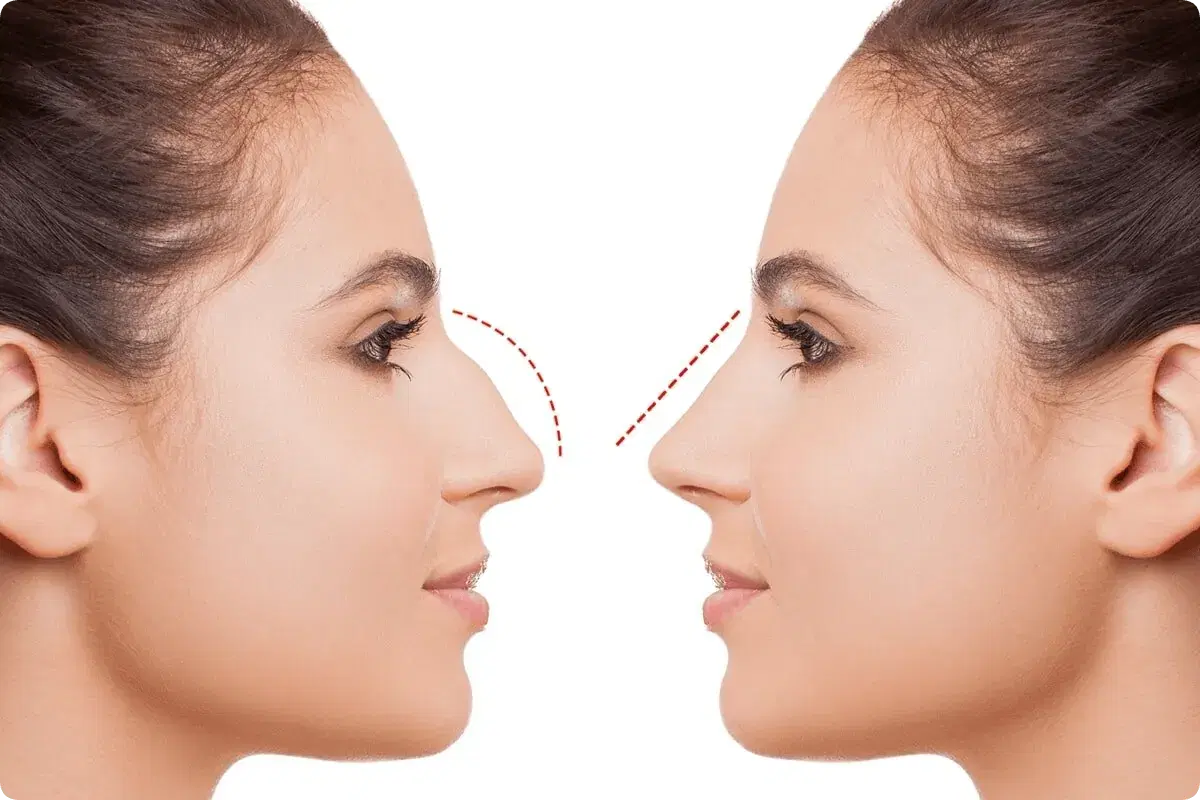
What Are the Main Rhinoplasty Techniques?
The main rhinoplasty techniques include open, closed, structural, preservation, ultrasonic, functional, revision, tip-focused, and non-surgical approaches.
These terms do not all describe the same part of surgery. Open and closed rhinoplasty describe how internal nasal structures are accessed. Structural and preservation rhinoplasty describe different philosophies for reshaping and supporting the nose. Ultrasonic rhinoplasty refers specifically to powered bone-cutting instruments. Functional rhinoplasty focuses on nasal airflow, while revision surgery corrects problems after an earlier operation. Non-surgical rhinoplasty uses injectable filler rather than surgery. Modern rhinoplasty can combine elements from several techniques within one procedure.
What Is Open Rhinoplasty?
Open rhinoplasty is a surgical approach that uses internal nasal incisions plus a small external incision across the columella to expose the nasal framework directly.
Lifting the skin and soft-tissue envelope provides broad visualization of the cartilage and bone beneath it. This access can be particularly useful when extensive tip reconstruction, major asymmetry correction, cartilage grafting, or complex revision work is required. The external incision normally heals as a small scar between the nostrils. Open access does not automatically produce better results than closed surgery. Recent comparative evidence found similar overall functional and aesthetic outcomes between both approaches when they were appropriately selected.
What Is Closed Rhinoplasty?
Closed rhinoplasty is performed through incisions inside the nostrils without creating the external columellar incision associated with an open approach.
The nasal framework is reached through these internal openings, allowing bone, cartilage, and selected tip structures to be modified. Because external skin is not divided across the columella, there is no visible external approach scar. Closed techniques can be particularly suitable for selected primary procedures requiring limited structural changes. However, the internal approach provides less direct exposure than full open access. Modern comparative research has not demonstrated clear superiority of either approach for overall satisfaction, functional improvement, bruising, swelling, or complication rates.
What Is the Difference Between Open and Closed Rhinoplasty?
Open rhinoplasty provides wider direct exposure through a columellar incision, while closed rhinoplasty accesses nasal structures entirely through incisions inside the nostrils.
The most relevant differences include:
Open surgery provides broader visualization of cartilage and bone.
Closed surgery avoids an external columellar incision.
Open access is frequently useful for complex reconstruction.
Closed access can suit selected primary corrections with limited structural change.
Either approach can incorporate preservation or structural techniques.
Neither approach has demonstrated universal superiority in clinical outcomes.
Recovery differences are not consistently significant across comparative research.
Technique selection therefore depends more on the planned correction than on one approach being inherently better.
What Is Structural Rhinoplasty?
Structural rhinoplasty reshapes the nose through controlled modification and reconstruction of cartilage and bone, often using grafts and sutures to create support.
The approach became particularly influential alongside open rhinoplasty because direct exposure allows detailed reconstruction of the nasal framework. Cartilage grafts can reinforce the middle vault, tip, nostril margins, or other areas requiring additional structural strength. Sutures can also reposition existing cartilage without removing unnecessary tissue. Structural techniques are especially useful when support is weak, anatomy is significantly distorted, or previous surgery removed important tissue. The central principle involves rebuilding a stable framework that maintains the planned nasal shape and supports breathing over time.
What Is Preservation Rhinoplasty?
Preservation rhinoplasty is a surgical philosophy that reshapes the nose while maintaining as much native cartilage, ligament, soft tissue, and dorsal anatomy as reasonably possible.
Instead of routinely removing the nasal hump and reconstructing the resulting open roof, preservation techniques can reposition existing structures while maintaining anatomical continuity. Modern preservation surgery can involve dorsal preservation, ligament preservation, subperichondrial dissection, and conservative tip modification. The approach has developed substantially during the past decade and is now an established part of contemporary rhinoplasty. However, it is not appropriate for every nasal shape, and comparative evidence remains less extensive than enthusiasm surrounding the technique might suggest.
What Is Dorsal Preservation Rhinoplasty?
Dorsal preservation rhinoplasty lowers or reshapes the nasal bridge while maintaining the natural bony-cartilaginous dorsal surface instead of removing the hump from above.
Traditional hump reduction commonly cuts away the highest portion of the nasal dorsum before reconstructing the remaining framework. Dorsal preservation follows a different concept by removing tissue beneath the bridge and allowing the intact dorsal structure to move downward. Common approaches include push-down and let-down principles, although technical variations continue evolving. Preserving the natural dorsal lines can maintain anatomical continuity in appropriately selected noses. Recent evidence supports reliable outcomes, while also emphasizing that patient selection and technique-specific complications remain important.
What Is Ultrasonic Rhinoplasty?
Ultrasonic rhinoplasty uses piezoelectric instruments that generate high-frequency vibrations to cut and reshape nasal bone with controlled precision.
The technology is primarily an alternative to conventional bone instruments rather than a completely separate form of rhinoplasty. Piezoelectric devices selectively work on mineralized tissue, allowing osteotomies and bone contouring while reducing unintended injury to nearby soft tissues. They can be incorporated into open or other surgical approaches when bone modification is required. A 2026 randomized-trial meta-analysis found lower early swelling, bruising, pain, and mucosal injury with piezoelectric osteotomy compared with conventional methods at several postoperative measurements. The underlying cartilage and tip work may still use traditional rhinoplasty techniques.
What Is the Difference Between Piezoelectric and Conventional Osteotomy?
Piezoelectric osteotomy cuts nasal bone using ultrasonic vibration, while conventional osteotomy uses mechanical instruments such as osteotomes to mobilize or reshape bone.
Both methods can create the fractures required to narrow or reposition the bony nasal vault. The main difference involves how mechanical energy reaches the bone. Piezoelectric devices permit controlled bone cutting and can reduce unintended soft-tissue injury. Current randomized evidence indicates lower early postoperative edema and bruising at several time points with piezoelectric techniques. Reduced pain and mucosal injury have also been reported. However, both methods remain capable of effective osteotomy, and piezo technology does not replace other steps required during rhinoplasty.
What Is Functional Rhinoplasty?
Functional rhinoplasty reshapes structural parts of the nose to improve airflow when obstruction results from problems involving the nasal valves or external nasal framework.
Treatment may strengthen weak sidewalls, widen narrowed internal valve areas, correct structural deviation, or reposition cartilage that interferes with breathing. Cartilage grafts such as spreader or batten grafts can become part of functional reconstruction when additional support is required. Functional rhinoplasty differs from isolated cosmetic reshaping because improvement in nasal ventilation forms a central objective. However, functional and aesthetic correction can occur during the same operation. Large pooled studies have shown substantial improvement in validated nasal-obstruction symptoms after functional rhinoplasty for appropriately identified structural airway problems.
What Is Septorhinoplasty?
Septorhinoplasty combines rhinoplasty with correction of the nasal septum when internal septal problems and external nasal shape need treatment during the same operation.
The septum divides the nasal passages and also provides structural support for the external nose. Significant deviation can therefore affect breathing, visible alignment, or both. Septorhinoplasty can straighten obstructing septal cartilage while simultaneously reshaping the bridge, tip, or other external structures. Septal cartilage removed during correction can sometimes provide graft material for nasal reconstruction. The term describes the combination of septal and external nasal surgery rather than one specific incision or instrument. Open, closed, structural, preservation, and other techniques can potentially form part of septorhinoplasty.
What Is Tip Rhinoplasty?
Tip rhinoplasty focuses primarily on changing the shape, projection, rotation, width, or symmetry of the lower third of the nose.
Treatment mainly involves the lower lateral cartilages and surrounding supportive structures rather than extensive modification of the nasal bones. Cartilage can be reshaped with sutures, conservative trimming, repositioning, or structural grafting. The procedure can address a bulbous, drooping, asymmetric, overly projected, or poorly supported nasal tip. Tip surgery may be performed through open or closed access depending on the required correction. When the bridge and nasal bones already have acceptable proportions, concentrating treatment on the tip can avoid unnecessary manipulation of otherwise satisfactory nasal structures.
What Is Revision Rhinoplasty?
Revision rhinoplasty is secondary nasal surgery performed to correct persistent or newly developed aesthetic, structural, or breathing problems after a previous rhinoplasty.
Revision procedures can range from limited contour adjustments to extensive reconstruction of the nasal framework. Scar tissue and altered anatomy make these operations more complex than primary surgery. Previous procedures may also reduce available septal cartilage, creating a need for cartilage from another donor site in larger reconstructions. Complex revision cases frequently use open access because broad exposure helps identify damaged or missing structures. Current 2026 evidence continues to describe revision rhinoplasty as technically demanding and strongly focused on reconstructing nasal support and valve function.
What Is Non-Surgical Rhinoplasty?
Non-surgical rhinoplasty reshapes selected nasal contours with injectable filler rather than surgically cutting or repositioning cartilage and bone.
Hyaluronic acid fillers can camouflage a dorsal hump, improve selected asymmetries, alter profile lines, or provide temporary projection in appropriate areas. The treatment adds volume rather than making the nose physically smaller. It also cannot perform major structural narrowing or permanently correct significant airway obstruction. Results are temporary because injectable material gradually breaks down. Although recovery is shorter than surgical rhinoplasty, nasal filler injections carry important vascular risks. Rare arterial occlusion can cause skin necrosis, visual injury, or other severe complications, making detailed anatomical knowledge essential during treatment.
Can Different Rhinoplasty Techniques Be Combined?
Different rhinoplasty techniques can be combined because modern surgery frequently uses open or closed access together with structural, preservation, functional, or ultrasonic methods.
These descriptions refer to different aspects of the same operation rather than mutually exclusive procedures. An open rhinoplasty can incorporate structural grafts while using piezoelectric instruments for bone work. Preservation techniques can also be performed through open or closed approaches. A functional operation may simultaneously include cosmetic changes, while septal correction can provide cartilage for structural support. Recent developments increasingly include hybrid rhinoplasty, where preservation and structural concepts are selected according to different parts of the nose. The final technique can therefore contain several complementary surgical principles.
Which Rhinoplasty Technique Causes Less Swelling?
Piezoelectric bone surgery has the strongest comparative evidence for reducing early swelling when rhinoplasty requires osteotomies, although overall recovery still depends on the complete operation.
A 2026 meta-analysis of randomized trials found that piezoelectric osteotomy generally reduced edema during the first postoperative week compared with conventional bone cutting. Significant differences appeared at specific postoperative time points rather than consistently every day. Open and closed rhinoplasty, meanwhile, have not shown consistent significant differences in edema across broader comparative evidence. Swelling also reflects the amount of dissection, bone manipulation, tip work, operative complexity, and individual tissue response.
Which Rhinoplasty Technique Is Used for Complex Nose Correction?
Open structural rhinoplasty is frequently used for complex nasal correction because it provides broad exposure for major asymmetry repair, grafting, and framework reconstruction.
Complex crooked noses, saddle deformities, major tip abnormalities, severe septal problems, and extensive revision cases often require direct access to several anatomical structures. Open exposure can make cartilage positioning, graft fixation, and detailed reconstruction easier to visualize. Recent comparative literature continues to associate open techniques with complicated deformities and larger revision procedures. Preservation concepts can still be incorporated when suitable native anatomy can be maintained. The required complexity therefore determines how much exposure and structural reconstruction becomes necessary rather than one universal procedure being used for every difficult nose.
Which Rhinoplasty Technique Is Best?
The best rhinoplasty technique is the approach that matches the nasal anatomy and required correction while preserving breathing, structural stability, and appropriate facial proportions.
Current comparative evidence does not identify open or closed rhinoplasty as universally superior. A 2025 systematic review and meta-analysis involving more than 1,000 patients found no significant overall differences in functional outcomes, aesthetic outcomes, satisfaction, swelling, bruising, or complications. Preservation techniques offer another established philosophy, while structural methods remain important for reconstruction and support. Piezoelectric instruments can improve aspects of early recovery when bone work is required. The strongest modern approach therefore selects techniques according to the specific anatomical problem rather than relying on one label for every rhinoplasty.