
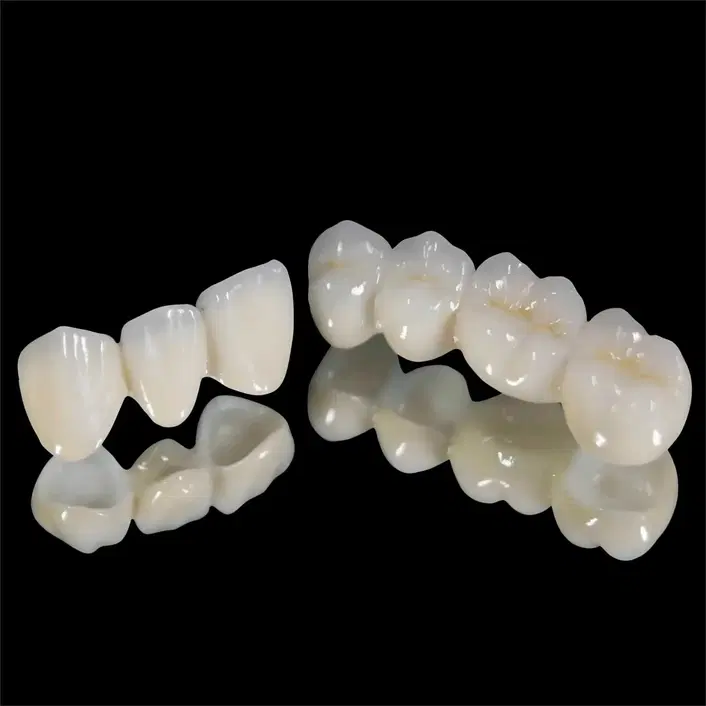
What Is a Zirconium Crown?
A zirconium crown is a full-coverage dental restoration manufactured from zirconia ceramic. The crown fits over a prepared natural tooth and recreates its visible shape, contact with neighbouring teeth and chewing surface. Crowns may be used to restore significantly damaged or broken teeth, protect selected weakened teeth or improve shape and appearance when full coverage is clinically appropriate.
Modern zirconia is not a single material with one fixed appearance. Different formulations have been developed to balance strength and translucency. Traditional zirconia compositions generally provide greater mechanical strength, while newer, more translucent versions can offer improved optical properties at the expense of some mechanical performance. This trade-off is one reason the material selected for a back molar may not necessarily be identical to the material chosen for a highly visible front tooth.
The crown is commonly designed digitally and milled from a ceramic block before finishing, colouring, polishing or layering is completed according to the restoration type.
Who May Be Suitable for Zirconium Crowns?
A zirconium crown can be useful in many restorative situations, but it should not automatically be applied to every tooth someone wants to make whiter or more uniform. A crown requires preparation of the natural tooth, so the amount of remaining healthy tooth structure should be considered before selecting full coverage.
Situations in which a zirconia crown may be considered include:
A significantly damaged or fractured tooth that requires full-coverage restoration.
A heavily restored tooth where an ordinary filling may no longer provide suitable protection.
Selected root-canal-treated teeth that require additional structural protection after treatment.
Teeth with substantial shape or colour problems when a crown is considered more appropriate than a less invasive cosmetic option.
Posterior teeth exposed to substantial chewing forces, provided the crown design and bite are suitable.
Implant-supported restorations, where zirconia can also be used as part of the visible prosthetic tooth.
Patients seeking a metal-free, tooth-coloured restoration when zirconia is clinically appropriate.
Cases where the dentist can preserve enough sound tooth structure to create a predictable foundation for the crown.
The decision should be tooth-specific. If a tooth can achieve the desired result through a more conservative treatment, full crown preparation may not always be necessary.
Monolithic Zirconia and Layered Zirconia Are Different
One of the most useful distinctions to understand before getting zirconium crowns in Turkey is whether the proposed restoration is monolithic or layered.
A monolithic zirconia crown is milled largely as one solid zirconia structure. Its shape and colour are created through the selected zirconia block and finishing process. Because there is no thick outer porcelain layer to fracture away from a separate zirconia framework, monolithic designs can reduce certain forms of ceramic chipping.
Layered zirconia uses a zirconia framework combined with veneering ceramic to create additional optical depth and surface character. This approach can be useful when aesthetic demands are high, but veneering ceramic introduces another possible technical complication: chipping or fracture of the outer layer. Recent systematic evidence indicates that monolithic zirconia restorations generally experience fewer ceramic fractures and chipping events than veneered alternatives.
That does not make layered zirconia an outdated or unsuitable treatment. It simply means material selection should consider where the tooth is located, how much aesthetic detail is required and how much force the restoration will receive.
Front Teeth Require More Than Choosing the Whitest Shade
A front crown is constantly visible during speaking and smiling, so shade selection is only one part of the aesthetic process.
Natural teeth are not a single opaque colour. They reflect and transmit light differently near the gum, through the centre of the tooth and toward the incisal edge. Modern translucent zirconia materials have improved the possibilities for creating more natural-looking restorations, but increases in translucency can be associated with changes in mechanical properties.
The colour underneath the crown also matters. A severely darkened natural tooth, an existing metal post or another unusual background may affect how the final crown appears, particularly when a highly translucent material is selected.
For this reason, “maximum translucency” is not automatically the best choice for every smile. The material must mask what needs to be hidden while still transmitting enough light to avoid an excessively opaque appearance.
Back Teeth Place Different Demands on Zirconia
Molars experience powerful chewing loads, making fracture resistance particularly relevant in posterior restorations.
Monolithic zirconia has become widely used in these regions because of its mechanical performance. Clinical studies and reviews report favourable short- and medium-term outcomes for tooth-supported monolithic zirconia crowns, including good survival in posterior applications.
However, strength alone does not determine success.
A crown that is too high in the bite can create uncomfortable contact. A poorly designed margin can make cleaning more difficult. An incorrectly contoured restoration can trap food between teeth or affect the surrounding gums.
A strong material cannot compensate for inaccurate preparation, poor fit or an unsuitable bite.
How Much of the Natural Tooth Needs to Be Prepared?
A crown needs enough space to achieve the necessary material thickness while maintaining an appropriate shape. That means some natural tooth structure must usually be removed before a full-coverage zirconia restoration is fitted.
The amount of preparation depends on several factors, including tooth position, zirconia type, crown design, existing fillings and the condition of the remaining tooth.
This is an important issue for patients considering a large cosmetic transformation. Preparing many healthy teeth for crowns is a very different decision from restoring teeth that are already severely damaged.
A treatment plan should therefore explain why each individual tooth needs a crown rather than assuming every visible tooth should automatically receive the same restoration.
Zirconium Crowns Do Not Automatically Require Root Canal Treatment
A common misunderstanding is that every tooth prepared for a zirconium crown must first have a root canal.
Root canal treatment is performed when the dental pulp becomes irreversibly inflamed, infected or otherwise requires endodontic treatment. A crown itself does not automatically create that indication. Some root-canal-treated teeth later receive crowns for protection, but healthy vital teeth can also receive crowns without routine removal of the pulp.
The situation needs to be assessed individually.
A tooth with deep decay, previous extensive treatment, cracks or existing symptoms may have a different prognosis from a healthy tooth receiving a crown for another reason.
Patients undergoing multiple crowns should therefore understand which teeth genuinely require additional treatment and why.
Gum Health Can Change the Appearance of the Entire Smile
A technically attractive crown can still look unnatural if the surrounding gums are inflamed.
Accurate crown margins, suitable contour and good oral hygiene all help make the restoration easier to maintain. Plaque accumulation around poorly cleansable margins can contribute to gum inflammation, while periodontal problems that already exist before treatment should be addressed rather than simply hidden beneath new crowns.
This is especially important when several front teeth are being restored. Red, swollen or bleeding gums can affect symmetry and make crown margins more visible.
The final cosmetic result therefore includes both the ceramic restoration and the soft tissue around it.
Good-looking crowns are not independent of good periodontal health.
Polishing Matters When Zirconia Meets the Opposing Teeth
Patients sometimes hear that zirconia is “too hard” for natural teeth. The real issue is more nuanced.
Research evaluating opposing enamel indicates that surface condition plays an important role. Well-polished zirconia tends to produce less opposing enamel wear than rough or inadequately finished ceramic surfaces, and systematic reviews have reported lower antagonist wear with polished zirconia than with some glazed or feldspathic ceramic comparisons.
This makes final adjustment important.
If a zirconia crown needs bite adjustment after fitting, the adjusted surface should be properly finished and polished rather than left rough.
Patients who grind or clench their teeth may also require additional assessment because high bite forces can affect both restorations and natural teeth over time.
What Happens During Zirconium Crown Treatment?
Treatment normally begins with clinical examination and, when needed, dental imaging.
The tooth is assessed for decay, cracks, existing restorations, periodontal support and the health of the tissues around the root. If a crown is considered appropriate, the tooth is prepared to create sufficient room for the restoration.
An impression or digital scan is then taken so the crown can be designed to fit the preparation and contact neighbouring and opposing teeth correctly.
Depending on the workflow, a temporary crown may be fitted while the definitive zirconia restoration is being produced.
At the fitting appointment, the final crown is assessed for margin fit, contact points, appearance and bite. It is then cemented using a technique suited to the restoration and clinical circumstances. Zirconia crowns can be cemented using different strategies depending on preparation retention and the selected material system.
Zirconium Crowns Can Last for Years, but No Crown Lasts Forever
Zirconia crowns have shown strong clinical performance, but statements such as “lifetime zirconium crowns” should be interpreted carefully.
Studies report high survival for zirconia restorations over several years, while longer follow-up also shows that failures and complications gradually accumulate. A crown may eventually require replacement because of fracture, loss of retention, decay around the underlying tooth, root problems, periodontal disease or aesthetic changes.
Survival also depends on what is supporting the crown.
A healthy natural tooth with adequate structure presents a different situation from a heavily restored tooth with a poor underlying prognosis.
Regular dental reviews remain useful even when a zirconium crown feels completely normal.
Whitening Should Be Planned Before the Final Crown Shade
Zirconia restorations do not respond to tooth-whitening products in the same way as natural enamel.
This becomes important when crowns are placed on only some visible teeth. If a patient plans to whiten the remaining natural teeth, completing or at least discussing whitening before final crown shade selection can make colour matching easier.
Otherwise, the natural teeth may later become lighter while the crown remains the shade originally selected.
This is particularly relevant in smile-design cases where only part of the visible dental arch is restored.
The goal should be to create a shade that still makes sense beside untreated natural teeth rather than simply choosing the brightest ceramic available.
What Should You Check Before Getting Zirconium Crowns in Turkey?
International dental treatment can work well when the clinical plan, documentation and follow-up arrangements are clear. Current authorization records are maintained for healthcare providers treating international health-tourism patients in Turkey, so provider status can be verified before treatment.
Before booking zirconium crowns in Turkey, it is useful to clarify:
How many teeth actually require crowns and why each tooth is being recommended for full coverage.
Which zirconia type will be used, including whether the restoration is monolithic, layered or another zirconia design.
Who will prepare the teeth and fit the final crowns, rather than communicating only with a travel coordinator.
Whether your gums, bite and existing dental problems will be assessed before cosmetic treatment begins.
Whether root canal treatment is genuinely indicated on any tooth, rather than assuming it is automatically part of crown preparation.
How temporary restorations will be managed if laboratory production requires more than one appointment.
What happens if a crown fractures, comes loose or feels uncomfortable after you return home.
Whether you will receive treatment records and information about the restorations used, so another dentist can understand what treatment has been completed.
A travel package can make treatment more convenient, but accommodation and transfers should remain secondary to the clinical plan.
Zirconium Crown Cost in Turkey Depends on More Than the Number of Teeth
There is no single universal zirconium crown cost in Turkey.
The total price can change according to the number of crowns, zirconia type, laboratory work, complexity of the underlying teeth and any additional treatment required beforehand.
A tooth needing decay treatment or foundation restoration is not equivalent to a healthy tooth prepared purely for a prosthetic indication. Gum treatment, root canal therapy or replacement of old dental work can also change the total plan when genuinely required.
This is why comparing only “price per crown” may not show the real cost of treatment.
Patients should ask for a written treatment plan that clearly identifies how many teeth will be treated and which additional procedures are included.
A Short Dental Trip Still Needs Long-Term Follow-Up
One attraction of dental treatment in Turkey is that several appointments can sometimes be organised within one visit. That convenience does not mean every case should be completed as quickly as possible.
If gum disease, active decay, unresolved tooth pain or another dental problem is discovered, additional treatment or healing may be necessary before final crowns are fitted.
After returning home, patients should continue routine dental examinations. A crown can cover the visible tooth, but the remaining natural tooth structure, gum and supporting tissues still need monitoring.
Sensitivity, persistent pain, a loose crown, swelling, repeated bleeding around a crown or a change in the bite should be assessed rather than ignored simply because the restoration looks intact.
Good Zirconium Crowns Should Look Like Teeth, Not Dental Work
Zirconium crown treatment in Turkey can be an effective option for restoring selected damaged, weakened or aesthetically compromised teeth. Zirconia provides a combination of mechanical strength and tooth-coloured appearance, while newer material generations offer different balances between translucency and durability.
The strongest crown is not automatically the best crown for every position. Front teeth may demand greater optical detail, while posterior restorations need to tolerate substantial chewing forces. Monolithic zirconia can reduce the risk of veneering-ceramic chipping, whereas layered approaches may be considered when additional aesthetic characterization is required.
Most importantly, crowns should not be viewed independently from the teeth underneath them. Tooth preparation, margin quality, gum health, bite and long-term maintenance influence whether an attractive restoration remains comfortable and functional.
For international patients, choosing zirconium crowns in Turkey should therefore involve more than selecting a shade and comparing prices. The treatment plan should explain why each crown is needed, how much healthy tooth structure will be preserved, which zirconia material will be used and what follow-up is available after returning home.
A successful result should not simply produce very white teeth in a photograph. The crowns should fit comfortably, allow normal cleaning, work correctly in the bite and blend with the patient's face and natural smile.
Note: This article is intended for general information and does not replace an individual dental examination. Suitability for zirconium crowns, tooth preparation, material selection, root canal treatment and other restorative decisions should be determined after clinical and, when necessary, radiographic assessment.