
What Does DHI Hair Transplant Mean?
DHI stands for Direct Hair Implantation. The name mainly describes the way follicular grafts are placed into the recipient area.
During modern follicular-unit hair transplantation, naturally occurring groups of approximately one to four hairs can be harvested individually from the donor area. In FUE-based harvesting, small punches are used to remove these follicular units one by one rather than removing a long strip of scalp.
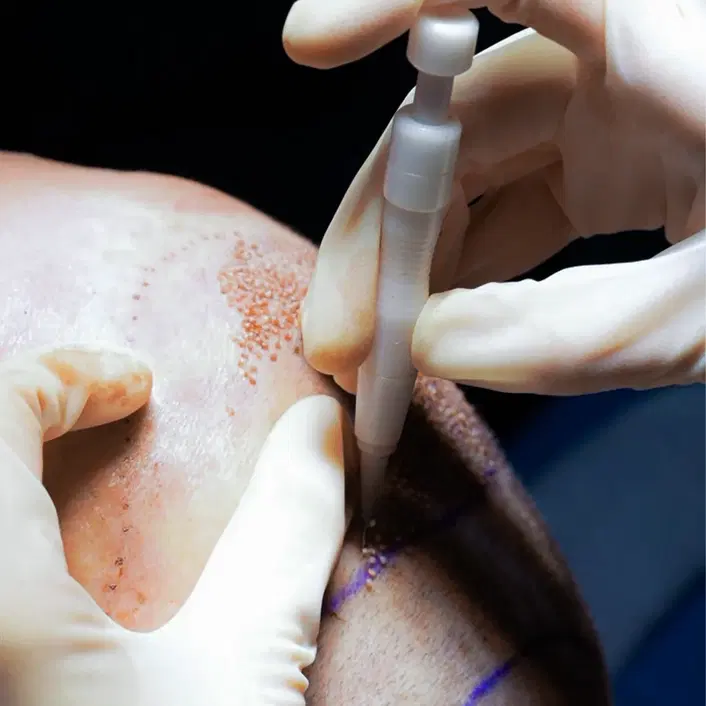
With DHI-style implantation, harvested grafts are loaded into a pen-shaped implantation instrument. The tip of the device can be used to create the recipient opening and place the follicular unit as part of the same implantation movement. Implanter devices were developed to give surgeons another way to control graft insertion without relying exclusively on forceps placement into previously prepared recipient sites.
This distinction is worth understanding because advertisements sometimes present DHI and FUE as completely unrelated operations. In practice, a procedure described as DHI may still use FUE to obtain the grafts. The “DHI” part generally refers most directly to implantation.
The Consultation Comes Before the Technique
Successful hair transplantation begins with deciding whether transplantation is appropriate in the first place.
The medical team should assess the pattern and progression of hair loss, donor density, scalp condition, hair shaft characteristics, previous procedures, age, expectations, and possible causes of ongoing shedding. Someone with a strong donor area and a stable pattern of androgenetic hair loss presents a very different planning situation from someone with diffuse thinning throughout the donor region.
Hair characteristics also affect the visual result. Hair thickness, curl, color contrast with the scalp, and the number of hairs within each follicular unit influence how much apparent coverage can be created from a limited number of available grafts.
This is why the first question should not simply be, “How many grafts can you implant?” A responsible plan considers how many grafts can be safely removed while preserving the donor area for the future.
Who May Be a Suitable Candidate for DHI?
DHI can be considered for selected men and women experiencing permanent forms of hair loss, but not everyone who notices thinning is automatically a good surgical candidate. The stability of hair loss, quality of the donor area and realistic long-term planning matter more than simply wanting greater density.
Typical factors considered before treatment include:
A sufficiently strong donor area with enough healthy follicular units to meet realistic coverage goals.
A suitable diagnosis, such as appropriately selected cases of androgenetic hair loss.
Realistic expectations about density, hairline position and the number of sessions that may be needed.
A healthy scalp without an uncontrolled inflammatory or infectious condition.
A stable long-term plan, particularly in younger patients whose native hair may continue to thin.
An understanding of donor limitations, since removed follicles do not regenerate in the harvested donor location.
A willingness to follow postoperative instructions during the early healing period.
An inadequate donor supply and unrealistic expectations are recognized reasons for caution when considering individual follicular-unit harvesting.
Hairline Design Is More Important Than a Fashionable Name
One of the most visible parts of a hair transplant is the frontal hairline. A technically successful transplant can still look unnatural if the hairline is too low, too straight or poorly matched to the patient's facial proportions.
Natural hairlines are not normally perfect lines. They include subtle irregularity, changing density and carefully selected follicular units. Single-hair grafts are often particularly useful around the leading edge, while larger follicular units can contribute to density farther behind.
The direction of implanted hairs matters as much as their location. Hair should emerge at angles that complement surrounding native hair. Temple regions, frontal zones and crown areas each have different directional patterns.
An implanter pen can assist with controlled placement, but the device itself does not design the hairline. Planning remains a medical and aesthetic skill. This is one reason patients should be cautious when a clinic focuses heavily on the tool while providing very little information about who plans and performs the procedure.
What Happens on the Day of a DHI Procedure?
A DHI hair transplant usually involves several stages. The exact workflow can vary according to the clinic, the number of grafts and the patient's individual plan.
Before harvesting begins, the hairline and treatment zones are reviewed. The donor area is prepared, and local anesthesia is commonly used. Individual follicular units are then harvested from the donor region using small punches when an FUE approach is used. Modern FUE harvesting commonly uses punches in approximately the sub-millimeter to low-millimeter range.
The harvested grafts must be handled carefully while they are outside the body. They are organized and prepared for implantation rather than simply being treated as identical “hair roots.”
During the DHI implantation stage, follicles are placed into implanter devices and transferred into the planned recipient areas. The team works according to the intended density, direction and distribution.
A large session can take several hours. The duration depends on the number of grafts, donor characteristics, the complexity of the design and the size of the medical team.
Does DHI Give Better Density Than FUE?
It is difficult to answer this question simply because the terminology often compares two different parts of hair transplant surgery.
FUE primarily describes a method used to harvest follicular units, while DHI generally refers to an implantation approach. A patient can therefore undergo FUE harvesting followed by implantation with a pen device.
Final density depends on many variables, including the number of suitable grafts available, hair characteristics, recipient-area blood supply, spacing, graft survival, existing native hair and surgical planning.
An implanter can be useful for precise placement, but no device can create an unlimited number of follicles. If the donor area can safely provide a certain number of grafts, changing the implantation label does not create additional donor supply.
For this reason, claims such as “DHI always produces twice the density” should be treated cautiously unless the claim is supported by the individual patient's measurements and a realistic treatment plan.
Donor Area Management Can Shape the Long-Term Result
Patients naturally focus on the front of the scalp because this is where they hope to see new hair. Yet the donor area deserves just as much attention.
With FUE harvesting, each follicular unit is removed through a small circular opening rather than through a long strip incision. This avoids the characteristic linear scar associated with strip harvesting, but it does not mean the donor area is completely scar-free. Tiny extraction scars can remain.
Overharvesting is another concern. Removing too many follicles from a limited zone can produce an uneven or visibly depleted appearance. Published complication literature describes donor depletion, pinpoint scarring and patchy donor appearance among potential problems when harvesting is poorly planned.
A good hair transplant therefore treats donor hair as a limited resource rather than simply trying to achieve the largest possible graft count in one session.
Recovery After DHI Hair Transplantation
The first few days after transplantation usually involve visible signs of healing. Small crusts can develop around implanted grafts, while redness, mild swelling, itching or tenderness may occur around the donor and recipient areas.
Pain following individual follicular-unit harvesting is generally described as mild and temporary in many cases, although patient experiences vary. Temporary altered sensation can also occur in the donor region.
Patients receive clinic-specific instructions regarding washing, sleeping position, physical activity and scalp care. These instructions should take priority over generic advice found online because postoperative protocols can vary.
The transplanted hairs may later shed while the follicles remain beneath the skin. This can worry patients who expect every newly implanted hair to remain continuously visible. Hair transplantation is a gradual process, and the cosmetic result is assessed over months rather than days.
When Will the New Hair Grow?
Hair transplant results require patience. The immediate appearance after surgery does not represent final density.
After the early healing period, many transplanted shafts enter a shedding phase. New growth develops gradually from surviving follicles. Early regrowth may initially appear fine or uneven before maturing over time.
Patients should therefore be skeptical of marketing that promises a final result within only a few weeks. Photography under consistent lighting and from comparable angles is a much more useful way to monitor progress.
The crown can also take longer to create a visually satisfying appearance because of its larger surface area and spiral hair pattern. Final cosmetic assessment is usually a long-term process rather than a single fixed date that applies to every patient.
What Should You Check Before Choosing a DHI Clinic in Turkey?
Travel packages, hotel transfers and translators can make treatment abroad easier, but they are not substitutes for medical quality. Patients should know who is responsible for diagnosis, hairline planning, donor harvesting, recipient-site decisions and postoperative management.
Before booking, it is reasonable to check:
Who the responsible physician is and which stages of the operation that physician personally performs or supervises.
Whether the healthcare facility is currently authorized to provide international health tourism services. Current official authorization lists for hospitals, medical centers, private practices and other providers are publicly maintained.
How donor density is assessed and how the clinic decides the safe graft number.
Whether the diagnosis of hair loss is established before surgery, rather than immediately offering transplantation to every inquiry.
Who performs graft harvesting and implantation, especially when large teams are involved.
What happens if a complication develops after you return home, including how medical follow-up is arranged.
Whether before-and-after photographs are standardized, rather than relying on different lighting, hair length or styling to exaggerate results.
What the quoted package actually includes, so medication, follow-up, accommodation and additional treatment costs are clear before travel.
Turkey currently regulates international health tourism and maintains authorization requirements for healthcare providers serving international patients.
Possible Risks Should Be Part of the Conversation
Hair transplantation is surgery, even when advertisements use phrases such as “scarless,” “non-invasive” or “lunchtime procedure.”
Potential problems following FUE-based hair transplantation can include pain, itching, swelling, folliculitis, infection, temporary sensory changes, visible donor scarring, donor overharvesting, buried grafts, cysts and, rarely, tissue necrosis.
Poor cosmetic planning can also be a significant complication. An unnatural hairline, incorrect direction, uneven density or exhausted donor supply may be difficult to correct later.
Patients with a history of abnormal scarring should mention it during consultation. Keloid formation after FUE is considered uncommon, but published cases demonstrate that it can occur.
The purpose of discussing these risks is not to suggest that complications are expected. It is to make clear that choosing an experienced medical team remains important regardless of whether the procedure is called DHI, FUE or another branded term.
DHI Without Shaving Is Not Suitable for Everyone
Some clinics advertise “unshaven DHI” or partial-shave procedures. In selected cases, keeping more of the existing hair long may make the early postoperative appearance easier to conceal.
However, shaving strategy depends on donor access, graft numbers, hair length, recipient area and the team's technique. A large transplant may be considerably more difficult to perform without adequate donor preparation.
Patients who strongly want an unshaven procedure should discuss whether that preference could limit graft harvesting, increase procedure time or make postoperative care more difficult.
A useful consultation explains both the cosmetic convenience and the technical trade-offs instead of promising that every patient can undergo the same method.
DHI Hair Transplant Cost in Turkey Depends on More Than Graft Count
Pricing varies widely across Turkey, and the cheapest quotation is not necessarily the best value.
The total cost may reflect the physician's involvement, facility standards, number of grafts, complexity of the case, anesthesia and medical supplies, postoperative follow-up, accommodation and transportation services.
Patients should also be careful with extremely precise graft promises made before the scalp has been properly examined. Photographs can help with preliminary planning, but donor density and scalp characteristics often require closer assessment.
A sensible quotation should be connected to a treatment plan rather than simply a sales target.
Medical Treatment May Still Matter After Surgery
A transplant redistributes existing follicles; it does not automatically stop the progression of androgenetic hair loss in the non-transplanted hair.
This is particularly important for younger patients. A hairline transplanted at age 25 may remain while the native hair behind it continues to thin, potentially creating an unnatural pattern years later.
Long-term planning should therefore consider the expected progression of hair loss and whether medical management is appropriate. Treatment decisions depend on diagnosis, medical history and individual risk, so they should be discussed with a qualified clinician rather than copied from another patient's routine.
Hair transplantation works best when it is considered part of a long-term hair-loss strategy rather than a one-day cosmetic event.
A Good DHI Result Starts With Planning, Not the Pen
DHI hair transplant in Turkey can be a practical option for appropriately selected patients seeking surgical hair restoration. The implantation pen may provide useful control during graft placement, but it does not replace careful diagnosis, donor management or natural hairline design.
It is also important to understand the terminology. DHI commonly describes the implantation stage, while individual graft harvesting may still be performed through an FUE approach.
For international patients, Turkey offers a broad choice of hair transplant providers, which makes comparison especially important. Current health-tourism rules include authorization requirements for healthcare providers treating international patients, and official provider lists are maintained for verification.
The most useful questions are therefore not simply “Is DHI better?” or “How many grafts can I get?” They are whether the diagnosis is correct, whether the donor area can safely support the proposed plan, who is medically responsible for the procedure, how the hairline has been designed and what follow-up is available after returning home.
A natural-looking transplant is the result of thousands of small decisions involving graft selection, direction, spacing and long-term planning. The implanter is one tool within that process. Choosing the right medical plan matters considerably more than choosing the most fashionable procedure name.
Note: This article is intended for general information and does not replace an individual medical assessment. Hair transplant suitability, graft numbers, surgical technique and postoperative care should be determined after evaluating the patient's hair-loss diagnosis, donor area and overall health.