
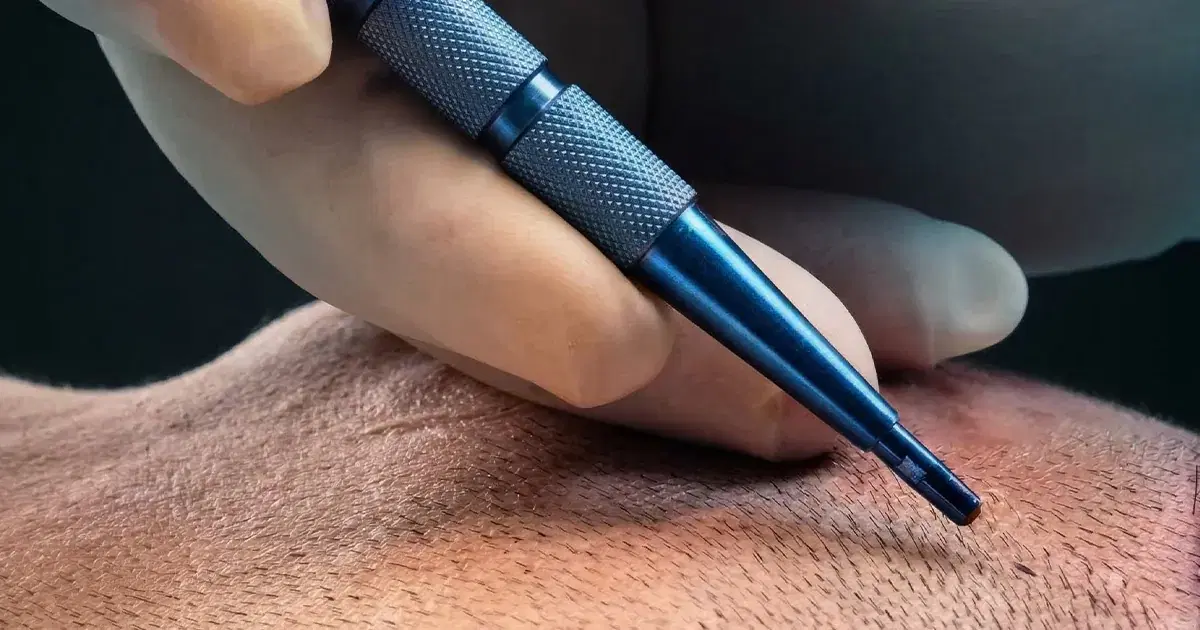
What Makes Sapphire FUE Different?
A hair transplant contains several separate stages, and the names used in advertising can sometimes blur the differences between them.
During FUE, individual follicular units are removed from a donor region that is expected to retain hair over time. The back and sides of the scalp are commonly used when they provide suitable density and stability. These follicles are then prepared for transplantation into thinning or bald areas.
The sapphire part comes later.
Before grafts are implanted, recipient sites need to be created in the area being restored. In Sapphire FUE, this step is performed with small blades manufactured from synthetic sapphire rather than conventional steel blades. The sites need to match the dimensions of the follicular grafts and follow the planned angle and direction of the new hair.
A study comparing different microblade shapes found that a 30-degree sapphire blade produced a smaller calculated area of tissue injury than several other blade configurations tested. The result supports the idea that blade geometry matters, but it does not by itself establish that sapphire blades always lead to superior graft survival or visibly better final density in every patient.
That nuance matters because the tool is only one part of the procedure.
Good Results Begin With the Hair-Loss Diagnosis
Before deciding between Sapphire FUE, standard FUE, DHI, or another implantation approach, the cause of hair loss should be understood.
Hair transplantation is most commonly considered for suitable cases of androgenetic hair loss, but not every type of shedding should be treated surgically. Inflammatory scalp disease, active scarring alopecia, unstable diffuse hair loss, or a weak donor region may make transplantation inappropriate or require treatment before surgery. Current surgical reviews emphasize diagnosis, donor evaluation, medical optimization, and realistic patient selection before transplantation.
This is particularly important for younger patients. Someone may have enough donor hair to rebuild a low frontal hairline today, yet continue losing native hair behind that transplanted area over the following decade.
A successful plan therefore considers not just where the hair is missing now, but where future thinning is likely to occur.
Who May Be a Suitable Candidate for Sapphire FUE?
A good candidate needs more than a visible bald area. The donor supply, hair-loss pattern, scalp health, age, expectations, and possible future progression all influence whether transplantation makes sense. The technique should be chosen after candidacy is established rather than being used as the starting point.
Factors commonly considered include:
A sufficiently strong donor area with enough stable follicular units to support the proposed restoration.
A suitable diagnosis of permanent hair loss for which transplantation is considered appropriate.
Realistic expectations about density, particularly when the recipient area is large.
Healthy donor and recipient skin without uncontrolled infection or inflammation.
An appropriate long-term hairline plan that takes future hair loss and ageing into account.
Enough donor reserve for possible future treatment, since harvested follicles are a limited resource.
General medical suitability for an elective surgical procedure and the ability to follow postoperative instructions.
An understanding that Sapphire FUE does not guarantee a specific graft survival percentage or a scar-free result.
Modern guidance on hair transplantation stresses patient selection, stable donor supply, medical history, and long-term planning rather than selecting candidates solely by graft count.
The Sapphire Blade Does Not Harvest the Grafts
One of the most common misunderstandings is that Sapphire FUE means follicles are extracted with sapphire blades.
That is generally not what the term describes.
Follicular units are harvested using an FUE punch. The punch separates each follicular unit from the surrounding donor tissue so it can be removed individually. The sapphire blade is then associated with creating recipient sites in the area where the follicles will be implanted.
This distinction also explains why two clinics offering “Sapphire FUE” may perform noticeably different procedures. They may use different FUE punches, graft-storage protocols, blade dimensions, implantation methods, density strategies, and medical teams.
The presence of a sapphire blade does not standardize the entire operation.
Recipient-Site Design Can Influence the Final Appearance
Recipient-site creation is one of the most important stages of a hair transplant because the small channels help determine where transplanted hairs emerge and how they are oriented.
Hair direction varies across the scalp. Frontal hairs usually leave the skin at relatively shallow angles, while the crown follows a more complex whorl pattern. If recipient sites are created at unnatural angles, transplanted hair may grow upright or conflict with surrounding native hair.
Spacing also matters. The goal is not simply to create the largest possible number of channels in the smallest possible area.
Recipient-site design must preserve adequate tissue and blood supply while creating enough density to produce useful visual coverage. Surgical literature on slit design emphasizes that vascular preservation, spacing, direction, angle, and graft dimensions all contribute to graft survival and appearance.
A sapphire blade can be a precise tool for this stage, but precision still depends on how the instrument is used.
Hairline Design Matters More Than the Blade Material
Most people judging a transplant will never know whether the recipient sites were made with sapphire or steel. They will notice whether the hairline looks natural.
A natural frontal hairline normally contains subtle irregularities rather than appearing as a perfectly straight border. Single-hair follicular units are often placed toward the leading edge, while grafts containing more hairs can contribute density farther behind.
The height of the hairline is equally important. Creating an extremely low hairline may use a large number of grafts and reduce the donor supply available for future thinning.
A conservative design that fits facial proportions and age often has greater long-term value than a dramatic hairline intended mainly to look impressive immediately after surgery.
Sapphire FUE should therefore be viewed as a technical option within a broader artistic and medical plan, not as a substitute for good design.
Donor Management Determines What Is Possible
Every hair transplant has a natural limit: the donor supply.
Follicles removed through FUE do not simply regenerate at their original extraction points. If harvesting is spread carefully across a strong donor zone, the remaining hair can often camouflage the small extraction sites well. If too many grafts are removed, visible donor thinning can develop.
Overharvesting is one of the characteristic complications associated with FUE. It may create an irregular or “moth-eaten” appearance in the donor region and can reduce the number of follicles available for future procedures.
This is why a promise of “maximum grafts” should not automatically be interpreted as an advantage.
The better question is how many grafts can be removed while leaving the donor region looking natural and preserving future options.
What Happens on the Day of Sapphire FUE?
The procedure usually begins with photography, hairline review, donor assessment, and marking of the recipient zones.
The donor area is prepared, and local anesthesia is commonly used. Individual follicular units are then harvested using FUE. After removal, grafts are sorted and protected while recipient sites are prepared.
Sapphire blades of suitable dimensions can then be used to create the recipient channels. The intended number of sites, direction, angle, and distribution are based on the treatment plan.
Grafts are subsequently placed into those channels.
The procedure may take several hours, particularly when thousands of grafts are involved. A longer procedure is not necessarily a sign of poor technique, just as a very fast procedure is not proof of efficiency. Graft number, donor difficulty, hair characteristics, team structure, and treatment area all influence operating time.
Does Sapphire FUE Heal Faster?
This is one of the most common marketing claims surrounding the technique.
Smaller and accurately created recipient sites may theoretically reduce unnecessary tissue injury. Experimental work comparing recipient-site blade geometry supports the idea that the design and angle of a blade can change the size of the wound created.
However, healing is affected by much more than blade material. Recipient-site density, depth, surgical trauma, individual skin characteristics, smoking, postoperative care, infection, and the size of the treated area can all influence recovery.
It is therefore more accurate to say that sapphire blades may allow precise recipient-site creation when used appropriately, rather than promising that every Sapphire FUE patient will heal faster than every patient treated with another method.
Marketing phrases such as “zero trauma” or “completely painless healing” should be treated cautiously because hair transplantation still involves thousands of small surgical wounds.
Early Recovery After the Procedure
The scalp usually looks most obviously treated during the first several days.
Tiny crusts can form around the implanted hairs, while the donor region contains small extraction sites. Redness, tenderness, itching, swelling, or temporary changes in sensation can occur. These symptoms often improve as healing progresses, although recovery varies between patients.
The recipient area should not be scratched or aggressively washed during early healing. Patients normally receive instructions about washing, sleep position, physical activity, hats, sun exposure, and medication.
These clinic-specific instructions matter because grafts are particularly vulnerable during the initial postoperative period.
Returning to work depends on the person's job, hairstyle, degree of redness, swelling, and comfort with the visible signs of surgery rather than on a single universal recovery day.
Transplanted Hair Can Shed Before New Growth Appears
One of the most confusing stages occurs several weeks after surgery, when many transplanted hair shafts may shed.
This does not automatically mean the grafts have failed.
Hair transplantation moves follicles, and the visible shafts can pass through a shedding phase before new growth develops. The final result therefore cannot be judged during the first few weeks.
New hairs emerge gradually over the following months. Early growth may appear fine, uneven, or less dense than expected before becoming more mature.
The crown may also appear slower to fill visually than a frontal hairline because its spiral pattern and larger surface area require a different distribution of grafts.
Hair transplantation is a long-term process even when the surgical procedure itself is completed in one day.
What Are the Risks of Sapphire FUE?
Changing the recipient-site blade does not remove the standard risks associated with hair transplant surgery.
Modern reviews describe possible complications including temporary pain, swelling, itching, infection, folliculitis, cyst formation, scarring, graft failure, visible donor depletion, unnatural hairlines, temporary shedding of existing hair, and sensory changes. Tissue necrosis is uncommon but has also been reported, particularly when surgical planning compromises blood supply.
Cosmetic complications can be just as important as medical ones. Incorrect graft direction, an excessively low hairline, poor density distribution, or depleted donor areas can remain visible long after temporary swelling has disappeared.
Sapphire blades do not eliminate these risks.
The safety of a transplant depends on appropriate candidacy, sterile technique, donor planning, recipient-site creation, graft handling, and postoperative care.
Sapphire FUE Cost in Turkey Is Not Based on the Blade Alone
The Sapphire FUE hair transplant cost in Turkey varies because the procedure price may include far more than the surgical instrument.
Graft requirements, donor complexity, surgeon involvement, treatment duration, clinic standards, medication, accommodation, transportation, translation services, and follow-up can all influence the quoted package.
Two people with the same degree of visible hair loss may also require different graft numbers because hair calibre, donor density, curl, scalp-to-hair colour contrast, and existing native density influence coverage.
For this reason, price comparisons work best when patients compare the underlying treatment plan rather than simply looking at cost per graft.
A suspiciously low price or unusually high graft promise deserves the same question: how has the medical plan been determined?
What Should You Check Before Choosing a Clinic in Turkey?
Travelling for hair transplantation adds practical questions that do not apply in exactly the same way when treatment is performed close to home. Turkey has a regulatory framework for international health tourism, and current official records list healthcare providers authorized to treat international health-tourism patients. The current list was updated on July 28, 2026.
Before paying a deposit, it is useful to clarify:
Who is medically responsible for your procedure and who performs or supervises the key surgical stages.
Whether the healthcare provider currently holds the relevant authorization for international health-tourism patients.
How your hair-loss diagnosis and donor density will be evaluated before the final graft number is decided.
Why Sapphire FUE is being recommended for your case rather than simply being sold as the premium package.
How the hairline, graft direction, and future hair-loss pattern have been planned.
How donor overharvesting will be avoided and what reserve will remain for future procedures.
What happens if a complication appears after you return home, including how medical follow-up is provided.
What the quoted package includes, such as medications, postoperative checks, accommodation, transfers, and additional treatment costs.
Choosing a provider should therefore involve medical verification as well as before-and-after photographs and travel convenience.
Sapphire FUE Is a Tool-Based Variation, Not a Guarantee
Sapphire FUE hair transplant in Turkey can be an appropriate option for selected patients who want surgical restoration of permanent hair loss. Its defining feature is the use of sapphire blades to prepare recipient sites after follicles have been individually harvested through FUE.
Research into recipient-site geometry suggests that blade shape and insertion angle can affect the amount of tissue involved during site creation. That makes precise instrumentation relevant. What current evidence does not justify is treating the word “sapphire” as a guarantee of higher graft survival, faster healing, greater density, or a more natural result for every patient.
The most important factors remain less marketable but more meaningful: the correct diagnosis, a strong donor area, conservative harvesting, realistic graft numbers, careful hairline design, natural direction, and appropriate postoperative management.
This is particularly important for patients travelling to Turkey, where the number of available hair transplant packages can make procedures appear more standardized than they really are. Current authorization can be verified before treatment, but patients should also understand exactly who is responsible for their surgery and how their long-term hair-loss pattern has been incorporated into the plan.
A sapphire blade can be a useful surgical instrument. It cannot compensate for a poorly chosen candidate, an exhausted donor area, or an unnatural design.
The strongest Sapphire FUE hair transplant results therefore begin long before the blade touches the scalp: with diagnosis, planning, and a realistic understanding of what a limited donor supply can achieve.
Note: This article is intended for general information and does not replace an individual medical consultation. Suitability for Sapphire FUE, graft numbers, donor harvesting, hairline design, and postoperative care should be determined after a personal assessment of the hair-loss diagnosis, scalp, donor region, and medical history.