
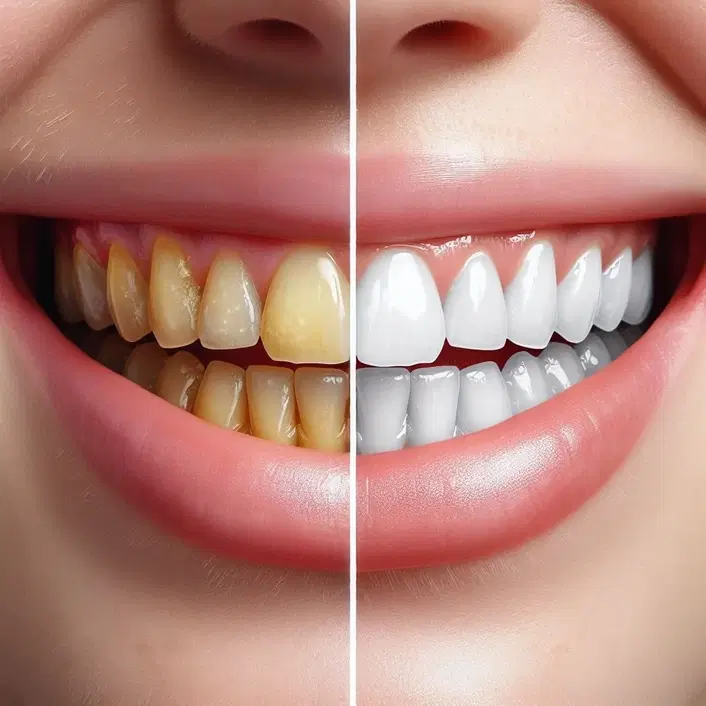
What Is Professional Teeth Whitening?
Professional teeth whitening uses bleaching agents that penetrate the tooth structure and interact with coloured compounds responsible for discoloration. Hydrogen peroxide and carbamide peroxide are commonly used for this purpose. As these agents interact with staining molecules, the colour becomes less concentrated and the teeth appear lighter.
This process is different from simply polishing the teeth. Professional cleaning can remove plaque, calculus and some external surface stains, while bleaching changes the colour of the natural tooth itself. Someone with staining from coffee or tobacco may benefit from professional cleaning before whitening, but cleaning alone does not necessarily produce the same colour change as bleaching.
How much lighter the teeth become varies. The original shade, type of discoloration, enamel and dentin characteristics, treatment method and individual biological response all influence the final appearance. For this reason, a specific number of shades should not be guaranteed before treatment.
Tooth Discoloration Has More Than One Cause
Teeth can gradually become darker for several reasons. Coffee, tea, tobacco and strongly coloured foods can contribute to external staining, while natural ageing changes how the underlying dentin shows through the enamel. Some medications, previous dental trauma and developmental changes can also cause discoloration that originates deeper within the tooth.
These different causes do not respond equally to whitening. Yellow-toned natural teeth often respond more predictably than some grey or deeply discoloured teeth. Teeth affected by trauma or certain medication-related stains can require a more individualized plan, and severe intrinsic discoloration may sometimes be better managed with another cosmetic treatment.
A consultation should therefore identify why the teeth look darker before deciding how aggressively they should be whitened.
Who May Be Suitable for Teeth Whitening?
Professional whitening can be considered for many adults who want to brighten their natural teeth, but suitability depends on oral health and the type of discoloration present. Existing restorations and sensitivity should also be evaluated because they can influence both the treatment and the final colour match.
Common considerations include:
Natural teeth that have gradually darkened or yellowed and are likely to respond to peroxide-based whitening.
Surface staining from foods, drinks or tobacco when professional cleaning and whitening are considered appropriate.
Healthy teeth and gums, without untreated decay or significant active gum inflammation that should be addressed first.
Realistic expectations, particularly because not every tooth can be changed to an extremely bright white shade.
Existing crowns, veneers or fillings that have been identified in advance, since these restorations will not whiten like natural teeth.
A manageable level of tooth sensitivity, or a whitening plan adapted for someone who already experiences sensitivity.
A willingness to follow the recommended treatment duration, rather than repeatedly using whitening products in an attempt to achieve an unnaturally white result.
An understanding that whitening is temporary, and that future staining and natural ageing can gradually influence colour again.
A patient with significant dental pain, untreated cavities or unexplained discoloration should be assessed before cosmetic bleaching begins. Whitening can improve colour, but it cannot treat the underlying cause of dental disease.
In-Office Whitening Offers a Faster Approach
In-office whitening is performed in a dental setting using professional bleaching materials. The gums and surrounding soft tissues are protected before the whitening agent is applied to the teeth. Professional systems often use higher concentrations than typical over-the-counter products, which allows a visible change to occur within a relatively short appointment.
This makes professional teeth whitening in Turkey convenient for international patients who have limited time. However, faster treatment should not be confused with unlimited whitening. Higher-concentration products can increase the chance or intensity of temporary tooth sensitivity in some people.
The dentist may therefore adjust the whitening method according to existing sensitivity, starting shade and the response of the teeth during treatment.
Dentist-Supervised Home Whitening Takes a Different Route
Another option is professionally supervised whitening using custom-made trays and bleaching gel at home.
The trays are designed to fit the patient's teeth so the whitening material can be applied in a controlled way. Treatment usually takes place over several days or weeks rather than during one clinic session.
A slower approach is not necessarily less effective. Research comparing different peroxide formulations shows that multiple whitening protocols can produce meaningful colour improvement, although treatment speed and sensitivity can differ between concentrations.
For international patients, dentist-supervised trays may also provide a way to continue treatment after returning home, provided clear instructions are given and appropriate follow-up is available.
Whitening Does Not Work on Every Tooth in the Same Way
A frequent misconception is that bleaching will make everything visible in the smile lighter.
Whitening products act on natural tooth structure. Porcelain veneers, ceramic crowns, composite fillings and similar restorations do not change colour in the same way. If several front teeth contain restorations, whitening the surrounding natural teeth may therefore create a noticeable colour difference.
This is particularly important for patients considering whitening before veneers or crowns. When both treatments are planned, whitening is often discussed before the final shade of the new restorations is selected so that the ceramic or composite can be matched to the brighter natural teeth.
Existing restorations should therefore be identified during the first examination rather than after the whitening session has already been completed.
One Dark Tooth May Need a Different Approach
A single tooth that has become dark after trauma or previous root canal treatment is different from general yellowing across the entire smile.
Standard external whitening may not correct this type of discoloration predictably. In selected non-vital teeth, internal bleaching can be considered by placing an appropriate whitening material inside the tooth under professional control.
The cause of the colour change should first be investigated. A suddenly darkened tooth may have a history of trauma or internal pulp changes that deserve examination rather than immediate cosmetic masking.
This is why a personalized approach is preferable to automatically applying whitening gel to every tooth.
Tooth Sensitivity Is the Most Familiar Side Effect
Temporary sensitivity is one of the most commonly reported effects of teeth whitening. Patients may notice short, sharp sensations when drinking something cold or breathing cool air. Gum irritation can also occur if bleaching material contacts the soft tissues.
Sensitivity does not affect everyone to the same degree. Peroxide concentration, treatment duration, pre-existing sensitivity and the whitening protocol can influence the experience. Recent evidence suggests that higher-concentration home products may slightly increase sensitivity compared with lower-concentration approaches, although the exact response remains individual.
Sensitivity is usually temporary. If discomfort becomes strong, persistent or different from ordinary whitening sensitivity, the teeth should be reassessed because decay, cracks or another dental problem could also be responsible.
Stronger Gel Is Not Automatically Better
It is easy to assume that the highest peroxide concentration will provide the best whitening result. Research does not support such a simple relationship.
Higher concentrations can sometimes produce faster early colour changes, while lower-concentration protocols may reach comparable results when used for an appropriate duration. Different products can also have different sensitivity profiles.
This means whitening should not become a competition to use the strongest available product.
Repeatedly bleaching the teeth beyond the recommended protocol can increase sensitivity and irritate the gums. Excessive or inappropriate use may also negatively affect dental tissues, which is why professional instructions and product-specific directions matter.
Whitening Toothpaste Works Differently
Whitening toothpaste is often marketed alongside professional bleaching, but the two should not be expected to produce identical results.
Many whitening toothpastes primarily help remove external surface stains through polishing or abrasive ingredients. They do not necessarily bleach the deeper colour of the natural tooth in the same way as hydrogen peroxide or carbamide peroxide systems.
They can nevertheless be useful as part of routine oral care when appropriate. Someone mainly concerned about recent coffee or tea staining may notice an improvement in surface appearance, while a patient seeking a substantial change in natural tooth shade will usually need a different whitening approach.
The term “whitening” therefore covers products that work in different ways.
Results Do Not Stay Identical Forever
Professional whitening can produce a noticeable improvement, but the result is not permanently fixed.
Coffee, tea, tobacco and other staining habits can gradually affect the appearance again. The natural colour of teeth also changes over time. Individual maintenance needs therefore vary according to lifestyle, initial shade and the degree of brightness the patient wants to maintain.
This does not mean whitening should be repeated constantly.
Touch-up treatment should be based on individual need and professional guidance rather than following a rigid calendar. More frequent bleaching is not automatically better and may increase unnecessary sensitivity or irritation.
Good oral hygiene and professional cleaning when indicated can also help reduce surface staining between whitening treatments.
Extremely White Teeth Are Not Always Achievable
Natural tooth colour depends partly on the enamel and the underlying dentin. Whitening can lighten that existing colour, but it cannot make every tooth reach every shade on a cosmetic shade chart.
Some social-media images also exaggerate expectations through strong lighting, filters or editing.
Patients who want an extremely bright, uniform colour that natural teeth cannot achieve through bleaching may eventually consider restorations such as veneers. That is a different decision because veneers require a restorative treatment plan and may involve permanent alteration of tooth structure.
Whitening has the advantage of changing colour without covering the natural tooth with ceramic, so accepting a slightly less dramatic result can sometimes preserve a much more conservative treatment approach.
Teeth Whitening Cost in Turkey Depends on the Method
There is no single universal teeth whitening cost in Turkey because clinics may offer different treatment protocols.
In-office whitening, custom take-home trays and combined approaches involve different materials and clinical time. Some quotations may also include professional cleaning before bleaching, while others price cleaning separately.
International patients should therefore check what the quoted treatment actually includes rather than comparing only the total price.
A low-cost whitening package has limited value if the teeth have not first been examined for decay, gum disease or restorations that will not respond to the bleaching material.
What Should You Check Before Teeth Whitening in Turkey?
Travelling for cosmetic dental treatment makes it useful to understand both the procedure and the facility providing it. Current records dated July 28, 2026 list healthcare providers authorized to treat international health-tourism patients in Turkey.
Before booking teeth whitening in Turkey, it is sensible to clarify:
Whether your teeth and gums will be examined before whitening, rather than beginning treatment immediately after arrival.
Which whitening method will be used and whether treatment is performed in-office, with home trays or through a combined protocol.
Whether existing crowns, veneers and fillings have been identified, particularly if they are visible when you smile.
How sensitivity will be managed if you already have sensitive teeth or develop discomfort during treatment.
Whether professional cleaning is included, when surface deposits or staining need to be addressed before bleaching.
What level of colour change is realistic for your starting shade, rather than relying on a guaranteed number of shades.
Whether the facility currently holds the appropriate authorization for treating international health-tourism patients.
What follow-up is available after you return home, especially if sensitivity, gum irritation or an unexpected colour difference develops.
Current authorization is one useful verification step, but the dental examination and individual treatment plan remain central to safe whitening.
A Brighter Smile Should Still Look Like Your Smile
Teeth whitening in Turkey can be a conservative cosmetic option for patients who want to brighten natural teeth without immediately turning to veneers or crowns. Peroxide-based professional whitening can reduce many common types of discoloration, while in-office and dentist-supervised home protocols offer different balances between speed, convenience and sensitivity.
Its limitations are just as important as its benefits. Whitening does not change the colour of ceramic crowns, veneers or fillings, and some types of deep discoloration respond less predictably than ordinary yellowing.
Temporary tooth sensitivity and gum irritation can occur, particularly with stronger bleaching protocols, so the treatment should be adapted to the individual rather than simply using the highest available concentration.
For patients travelling internationally, the best professional teeth whitening in Turkey is therefore not necessarily the treatment promising the most dramatic shade change in one appointment. It is the treatment that starts with healthy teeth and gums, uses an appropriate bleaching protocol, takes existing dental restorations into account and leaves the patient with realistic expectations about maintenance.
A good whitening result should make the smile look fresher without creating the impression that every natural variation in tooth colour needs to disappear.
Note: This article is intended for general information and does not replace an individual dental examination. Suitability for teeth whitening, bleaching concentration, management of sensitivity and treatment of dental discoloration should be determined after assessment of the teeth, gums and existing restorations.