
Female Hair Loss Does Not Always Follow a Clear Balding Pattern
Male-pattern hair loss often creates recognisable areas of recession or baldness while leaving a relatively stable donor zone around the back and sides of the scalp. Female-pattern hair loss is frequently less straightforward.
Women may notice that their centre part is gradually becoming wider, more scalp is visible under bright light, or overall density through the top of the head has decreased. The frontal hairline can remain relatively intact even while the hair behind it becomes thinner.
In some women, thinning can also affect parts of the traditional donor region. This matters because transplantation depends on moving follicles that are expected to remain stable over time. If the donor hairs are also undergoing progressive miniaturisation, using them for transplantation may create disappointing long-term density. Current clinical reviews therefore emphasise donor preservation and careful evaluation of diffuse thinning in female patients.
That difference makes diagnosis one of the most important stages of female hair restoration.
Finding the Cause Comes Before Booking Surgery
Hair loss in women can have many causes. Female-pattern hair loss is only one possibility. Significant shedding may also occur after major illness, rapid weight change, nutritional problems, hormonal changes, childbirth, severe stress, some medications or inflammatory scalp conditions.
Certain autoimmune and scarring forms of hair loss require a completely different approach. Transplantation into an area with active inflammatory disease can produce poor growth and may worsen the overall problem.
This is why surgery should not automatically be the first treatment offered to every woman who sends photographs of thinning hair.
The pattern and duration of loss, family history, scalp appearance, medical history and current medications may all need to be reviewed. In appropriate cases, additional medical investigation can help identify potentially treatable contributors to hair loss.
Once the diagnosis is clear and the pattern is considered sufficiently stable, transplantation can be discussed as part of a longer-term strategy.
Who May Be Suitable for a Female Hair Transplant?
Not every woman with thinning hair needs or benefits from surgery. The strongest candidates usually have a reasonably defined recipient area and a donor zone containing enough healthy, stable follicles. Realistic expectations are equally important because transplantation redistributes existing hair rather than creating an unlimited new supply.
Factors that may support candidacy include:
A strong and stable donor area with sufficient density at the back or sides of the scalp.
A confirmed type of permanent hair loss that is appropriate for surgical restoration.
Localised thinning or recession, such as a naturally high hairline, widened frontal area or certain stable areas of permanent loss.
Realistic expectations about density, particularly when thinning affects a large surface area.
Healthy scalp tissue without uncontrolled inflammation or infection.
Stable hair-loss progression, or a medical plan to manage ongoing native-hair thinning when appropriate.
Adequate donor reserves for the future, since transplanted grafts use a limited follicular resource.
An understanding of the recovery process, including temporary shedding and gradual regrowth.
Women with extensive diffuse miniaturisation throughout both the top of the scalp and donor regions may be much more difficult transplant candidates. The decision should therefore be based on scalp examination and long-term donor stability rather than simply on how thin the hair appears in photographs.
The Donor Area Matters Even More in Diffuse Thinning
The donor zone is effectively the supply bank for any hair transplant.
During an FUE-based procedure, individual follicular units are removed from selected donor regions and transferred elsewhere. Those grafts cannot simply be replaced by the body at the extraction points. Every removal therefore needs to be planned carefully.
In women with diffuse hair loss, it is especially important to determine whether the donor area itself is stable. A scalp may initially look dense because long hair covers it well, while close examination reveals significant miniaturisation between stronger follicles.
If too many grafts are removed from an already weak donor area, the hair at the back of the scalp may become visibly thinner after surgery.
Good female hair-transplant planning therefore prioritises donor preservation rather than maximising the graft number in a single session. This long-term approach is highlighted in recent reviews specifically addressing transplantation in women.
Hairline Lowering Requires More Than Drawing a New Border
Some women considering transplantation do not have significant hair loss at all. Their main concern may be a naturally high forehead, uneven frontal hairline or temporal recession.
Hair transplantation can sometimes be used to create a lower or more rounded frontal shape, but the design must fit the face.
The height and curvature of the new hairline should take into account forehead proportions, existing temples, facial shape and future ageing. A hairline that looks dramatically low at age 25 may not necessarily remain natural later in life.
The first rows also require careful graft selection. Fine single-hair follicular units generally create a softer transition, while larger units can be positioned farther behind to increase visual density.
A natural female hairline is not usually a perfectly solid geometric line. Subtle irregularities and changing density help prevent an artificial appearance.
Density Restoration Is Different From Filling a Completely Bald Area
Many female patients still have a significant amount of native hair within the area that needs treatment. The goal is often to increase the appearance of density rather than rebuild a completely bald scalp.
This makes recipient-site planning more delicate.
The medical team must implant new follicles between existing hairs while protecting the native follicles already present. Simply trying to place the highest possible number of grafts into every square centimetre can increase trauma and does not automatically produce a better result.
Hair calibre also influences visual coverage. Thicker hairs, curl and lower contrast between hair colour and scalp can create a fuller appearance with fewer follicles, while very fine straight hair may require a different density strategy.
For this reason, two women with similar-looking thinning may receive different graft recommendations.
FUE Is Commonly Used in Female Hair Transplantation
Many modern female procedures use an FUE-based harvesting technique.
With FUE, individual follicular units are separated from the donor scalp and removed one by one rather than through a long strip incision. The extracted grafts are then organised and implanted into the planned areas.
FUE avoids the characteristic long linear donor scar associated with strip harvesting, although it should not be described as completely scarless. Each follicular-unit extraction still leaves a very small healing point.
One of the advantages for female patients is flexibility in donor preparation. Depending on the required number of grafts and hair length, it may be possible to shave only small concealed sections rather than the entire scalp.
The exact approach should be chosen according to surgical access and donor safety rather than simply because one method sounds more discreet.
Does a Woman Need to Shave Her Hair Before the Procedure?
Not necessarily. Many women are understandably reluctant to shave their hair before transplantation, especially when they have spent years styling it to conceal thinning.
A partial-shave technique may allow small donor sections to be trimmed underneath longer hair. Once the surrounding strands fall back into place, the shaved region can be less noticeable.
Fully unshaven or long-hair harvesting techniques can also be considered in selected patients, but they are technically more demanding and may not be practical for every graft number or donor pattern.
Preserving hair length should not compromise accurate follicle harvesting or safe donor management. When a large session is required, some degree of donor trimming may make the procedure more efficient and controlled.
The consultation should therefore explain exactly what will be shaved rather than simply advertising the operation as “no-shave.”
What Happens During a Female Hair Transplant?
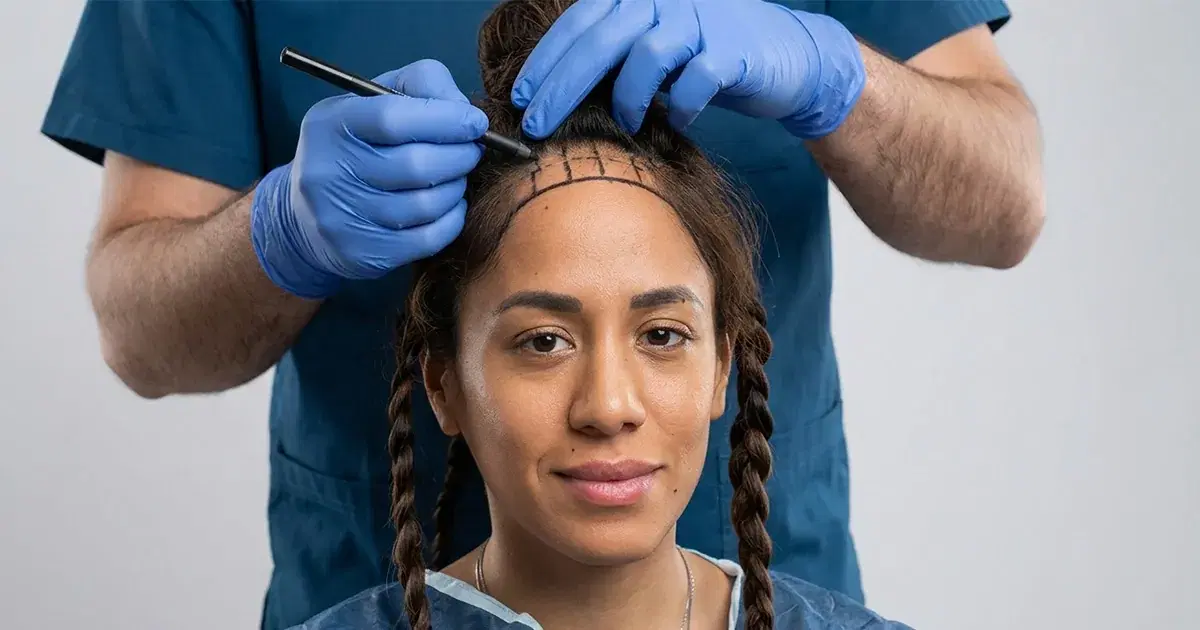
The treatment day generally begins by reviewing the recipient plan and marking the areas where grafts will be placed. The donor region is prepared according to the harvesting method, and local anaesthesia is commonly used.
Follicular units are then removed individually when FUE harvesting is performed. The grafts are examined and organised so that appropriate follicular units can be used in different parts of the recipient area.
Fine single-hair grafts may be particularly useful around a newly designed frontal edge, while follicular units containing more hairs can contribute greater visual coverage farther behind.
Recipient openings are created according to the desired hair direction and distribution, or grafts may be inserted with an implantation device depending on the selected technique.
The entire procedure can take several hours. Duration depends on the number of grafts, donor access, whether the hair is shaved and the complexity of the recipient area.
Existing Hair Can Temporarily Shed After Surgery
Women undergoing density transplantation should understand the possibility of temporary shedding around the treated area.
Surgery creates temporary stress within the scalp, and some existing hairs close to the transplanted region may enter a shedding phase. This does not always mean that permanent follicles have been damaged.
Transplanted hair shafts can also fall out during the early postoperative period before the follicles begin producing new growth.
This stage can feel alarming, particularly for someone who already feels self-conscious about thinning hair. The transplant often looks less impressive several weeks after surgery than it did immediately after implantation.
Hair transplantation therefore requires patience. New growth occurs gradually over the following months, and the final visual result cannot be evaluated shortly after the procedure.
Female Hair Transplant Results Develop Gradually
New hair does not appear at full thickness overnight.
Initial growth can be fine, soft or uneven. Different transplanted follicles enter active growth at different times, so one part of the scalp may look more developed than another during the early months.
Over time, successful transplanted hairs can become longer and more mature. Styling also begins to improve as the hairs gain length and blend with surrounding native hair.
The final appearance depends not only on how many grafts survive but also on the continued condition of the woman's original hair.
If native female-pattern hair loss continues after surgery, untreated surrounding areas may become thinner even while transplanted follicles remain. This is one reason medical management and long-term follow-up can remain important after a technically successful procedure.
Hair Transplantation Does Not Treat Every Cause of Female Hair Loss
Surgery redistributes hair. It does not correct all of the biological processes that cause shedding.
If a woman is losing hair because of an active inflammatory condition, significant nutritional deficiency, temporary post-illness shedding or another reversible cause, transplantation may not address the underlying problem.
Similarly, transplanting into an actively progressing form of diffuse hair loss can result in poor visual balance later because the surrounding native hairs may continue disappearing.
Medical treatment may be recommended before transplantation to stabilise hair loss or improve existing density. Current reviews of female-pattern hair loss describe surgery as an option for appropriately selected patients rather than a universal first-line treatment.
A clinic that offers surgery immediately without discussing the cause of hair loss should therefore raise questions.
Possible Risks Need to Be Discussed Before Travel
Hair transplantation is generally performed as an elective procedure, but it is still surgery.
Early effects can include soreness, redness, swelling, itching, crusting and temporary scalp sensitivity. Folliculitis, infection, prolonged redness, visible donor depletion, scarring and poor graft growth are among the potential complications of hair transplantation.
Aesthetic problems are equally relevant. Poorly designed hairlines, unnatural graft direction, uneven density or aggressive donor harvesting may be difficult to correct later.
Female patients undergoing transplantation between existing hairs also need realistic counselling about temporary shedding.
A proper consultation should discuss possible complications before payment or travel arrangements are finalised rather than presenting transplantation as a guaranteed cosmetic service.
What Should You Check Before Choosing a Clinic in Turkey?
Turkey has an established international health-tourism system, but patients should still verify the provider they plan to use. The current official list of healthcare providers authorised for international health tourism was updated on July 28, 2026, and the regulatory framework requires providers operating in this field to hold the relevant authorization.
Before booking a female hair transplant in Turkey, it is useful to clarify:
Who will diagnose the cause of your hair loss before surgery is approved.
Who is medically responsible for the procedure and which stages that person performs or directly supervises.
Whether the healthcare provider currently holds the required authorization for international patients.
How donor stability will be assessed, particularly if your thinning is diffuse.
Why the recommended graft number is appropriate and how much donor reserve will remain afterward.
Whether shaving is necessary, and exactly which areas will be trimmed.
How the frontal design and density plan will be adapted to a female hairline, rather than copied from a standard template.
What medical support is available after you return home, including what to do if excessive redness, infection, unexpected shedding or another complication develops.
International health-tourism rules also set requirements concerning patient information, documentation and healthcare-facility authorization, which makes current provider verification a practical part of planning treatment abroad.
Price Should Not Be the Main Measure of Value
The cost of a female hair transplant in Turkey can vary considerably.
Price may reflect graft numbers, procedure time, unshaven techniques, physician involvement, clinic standards, accommodation, transfers and follow-up arrangements.
Comparing package prices without comparing medical plans can be misleading. One patient may require a small frontal restoration, while another needs a broader density procedure across the central scalp.
An unusually high graft count is not necessarily a better deal either. Female patients with limited or diffusely thinning donor areas can be harmed by overly aggressive harvesting.
A useful quotation should therefore explain the proposed treatment area, estimated graft requirement, donor strategy and included services.
The Best Female Hair Transplant Starts With the Diagnosis
Female hair transplant in Turkey can provide a meaningful improvement for appropriately selected women, but female hair restoration cannot simply copy the standard approach used for male-pattern baldness.
Women often retain hair throughout the thinning region and may show more diffuse changes across the scalp. This makes it especially important to confirm that the donor area is stable and that surgery addresses a permanent form of hair loss. Recent research involving women treated with hair transplantation reinforces the need for careful selection and individualised planning.
The goal should also be realistic. Hair transplantation moves a limited number of follicles from one area to another. It can improve coverage, reshape a hairline or increase visual density, but it cannot restore unlimited thickness across a very large scalp with a weak donor supply.
For international patients travelling to Turkey, medical planning should come before hotel packages, airport transfers or promotional graft numbers. Provider authorization can be checked against current records, while consultation should establish who is responsible for diagnosis, donor management, hairline design and postoperative care.
A successful female hair transplant is ultimately built on four things: the correct diagnosis, a stable donor area, conservative graft planning and a design that works naturally with the woman's existing hair.
When those foundations are in place, transplantation can become one part of a long-term hair restoration strategy rather than simply a one-day cosmetic procedure.
Note: This article is intended for general information and does not replace an individual medical assessment. Female hair loss can have many causes, and suitability for transplantation should be determined after evaluating the diagnosis, donor region, scalp health, ongoing hair loss and medical history.