
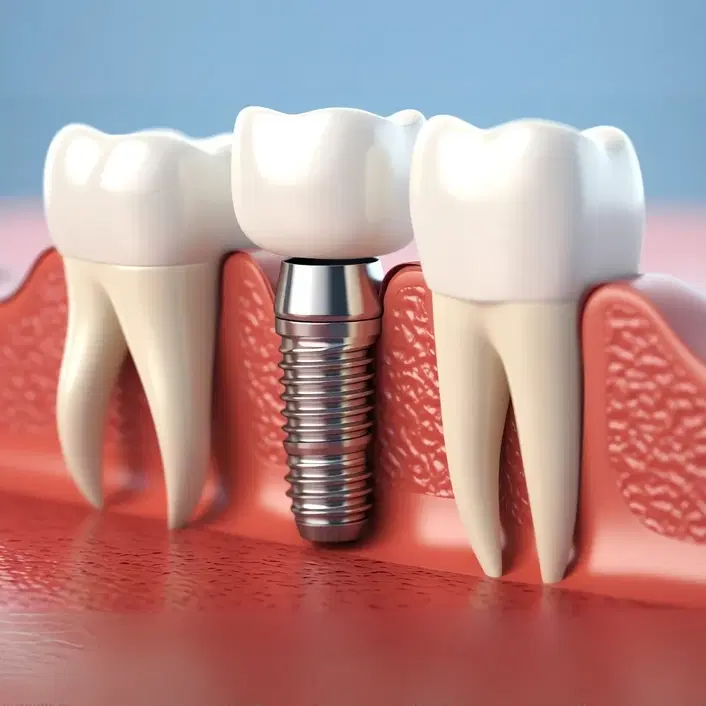
How Does a Dental Implant Replace a Missing Tooth?
A conventional implant restoration usually contains three main parts: the implant positioned within the bone, the abutment connecting the implant to the restoration and the visible crown or bridge.
After implant placement, the surrounding bone gradually establishes a close connection with the implant surface. This process is known as osseointegration and provides the stability needed for the implant to support chewing forces. Healing before final restoration commonly takes roughly two to six months, although treatment timing varies according to implant stability, bone condition, treatment location and the clinical plan.
This healing period explains why a dental implant is not always a one-appointment treatment.
In selected situations, a temporary tooth can be attached relatively quickly. In others, allowing the implant to heal before placing the final crown offers a more appropriate approach. Immediate placement or loading can work successfully in carefully selected cases, but current evidence does not support treating it as the correct option for every patient.
Who May Be Suitable for Dental Implants?
Implant suitability depends on much more than having a missing tooth. The dentist needs to evaluate the health of the mouth, available bone, medical history and ability to maintain the implant after treatment. Individual risk assessment is particularly important because an implant that looks successful immediately after treatment still needs healthy surrounding tissues years later.
Factors commonly considered include:
One or more missing teeth where implant-supported restoration is considered an appropriate replacement option.
Sufficient healthy jawbone to support an implant, or a situation where additional bone treatment can reasonably be planned.
Healthy or controlled gums, without untreated active periodontal infection around the proposed treatment area.
Good daily oral hygiene, since plaque accumulation around implants can contribute to inflammation.
Realistic expectations about treatment duration, maintenance and the possibility of future complications.
A medical history compatible with dental surgery, following individual assessment of conditions and medications that may influence healing.
A willingness to attend long-term dental reviews, even when the implant feels completely normal.
Understanding of smoking-related risk, since tobacco use is associated with poorer implant outcomes and increased concerns around peri-implant health.
Being unsuitable today does not always mean implants can never be considered. Gum disease may first need treatment, for example, or the treatment plan may need to change after medical evaluation.
Bone Quality Can Change the Treatment Plan
A dental implant relies on the jawbone for support, which makes the condition of the bone one of the central parts of planning.
When a tooth has been missing for a long time, the ridge in that area may have changed in height or width. Some patients naturally have limited bone in a particular location, while previous infection or periodontal disease may also affect the available tissues.
This does not automatically rule out implant treatment.
Depending on the situation, additional procedures may be considered to create a more suitable foundation. This can mean a longer treatment process than the patient initially expected. A treatment quote that includes only the implant itself may therefore not represent the full plan if additional surgical work becomes necessary.
Long-term research also shows that implants can perform well in both grafted and non-grafted sites when treatment is appropriately planned, although individual outcomes remain dependent on many clinical factors.
Healthy Gums Matter Just as Much as Healthy Bone
It is easy to think of implants primarily as a bone treatment, but the gum tissues surrounding them are equally important.
Natural teeth can develop gingivitis and periodontitis. Dental implants can develop comparable inflammatory problems known as peri-implant mucositis and peri-implantitis.
Peri-implant mucositis involves inflammation of the soft tissue around an implant. If disease progresses into peri-implantitis, supporting bone can also be lost. Poor plaque control and a previous history of periodontitis are important concerns, while smoking can further increase risk.
An implant should therefore never be considered a maintenance-free replacement for a natural tooth.
Regular brushing, interdental cleaning and professional review remain important after the final crown has been fitted.
Immediate Dental Implants Are Not Suitable for Every Extraction
Patients travelling for treatment often ask whether a damaged tooth can be removed and replaced with an implant on the same day.
Sometimes it can.
Immediate implant placement means positioning the implant at or around the same treatment stage as tooth extraction rather than waiting for the extraction site to heal completely. In appropriate cases, this can shorten the overall pathway and may offer aesthetic advantages. Current research reports high survival in carefully selected immediate-placement cases.
The phrase “same-day implant,” however, can mean several different things. It may describe immediate implant placement, immediate placement of a temporary tooth or both.
The ability to do this depends on factors such as available bone, implant stability, infection and the location being treated. A treatment should not be forced into a same-day schedule simply because the patient has booked a short trip.
The Implant and the Crown Have Different Jobs
Patients sometimes refer to the entire replacement tooth as “the implant,” but distinguishing the parts is useful when comparing treatment plans.
The implant itself is the component positioned within the jaw. The crown is the visible restoration above the gum. Between them is usually an abutment that provides the connection.
A technically successful implant can therefore still have a restoration-related problem later. A crown can wear, chip or require replacement without necessarily meaning that the implant inside the bone has failed.
This distinction is particularly important when comparing guarantees. A clinic may use different terms for the implant fixture, prosthetic components and ceramic restoration.
Patients should understand exactly which part of the treatment any warranty or follow-up agreement covers.
How Long Does Dental Implant Treatment Take?
There is no universal timeline for dental implant treatment in Turkey.
A straightforward single-tooth case with good bone can follow a very different schedule from full-mouth rehabilitation requiring extractions, bone procedures and several implants.
After placement, conventional healing before final restoration often takes approximately two to six months as osseointegration develops.
Some carefully selected implants can be restored earlier or even receive a temporary restoration immediately. Research comparing different loading schedules shows that immediate and conventional approaches can both work in selected cases, which is why treatment should be based on clinical conditions rather than a universal promise of “teeth in one day.”
International patients should clarify whether their treatment requires one trip or several visits before making travel arrangements.
Temporary Teeth and Final Teeth Are Not the Same
When immediate temporary teeth are provided, their purpose is often to maintain appearance and limited function while healing occurs.
They should not automatically be considered the final restoration.
After the implants and surrounding tissues have stabilized, the definitive teeth can be planned according to bite, shape, colour, gum contours and the position of the implants.
This later stage matters aesthetically. A dental implant placed in the correct position gives the restorative dentist greater flexibility when designing a natural-looking crown.
Implant placement should therefore begin with the intended final tooth position in mind rather than placing the implant first and deciding what the crown should look like afterward.
Smoking Can Affect Implant Success
Smoking is one factor patients should discuss openly before implant treatment.
Recent evidence continues to associate smoking with implant complications and an increased risk of early implant failure, particularly among heavier smokers. It can also negatively affect periodontal and peri-implant tissues and may influence the suitability of more extensive regenerative procedures.
This does not mean every person who smokes will lose an implant.
It means the risk profile is different and should be considered during treatment planning. Patients should follow individual professional advice regarding smoking cessation rather than simply reducing tobacco use for a day or two around surgery.
Vaping and other nicotine use should also be mentioned during the medical history rather than assumed to be irrelevant.
Dental Implants Can Last for Many Years, but They Are Not Indestructible
Dental implants are frequently described as a permanent solution. A better description is a long-term tooth-replacement treatment with the potential to function for many years when conditions remain favourable.
Long-term studies report high implant survival, with analyses of implant-supported restorations showing survival above 90% at around ten years in many studied populations. Results vary according to implant location, restoration type, patient factors and maintenance.
Survival also does not mean an implant has remained completely problem-free.
An implant can still require treatment for inflammation around the surrounding tissues, or the crown and prosthetic components may require repair.
No ethical treatment plan can promise that an implant will definitely last for life.
Peri-Implantitis Can Develop Years After Treatment
An implant that feels strong does not necessarily need less dental care.
Inflammation around an implant can begin with bleeding or swelling of the gums and can progress to loss of supporting bone. Warning signs can include bleeding during cleaning, swollen gums, unpleasant taste or bad breath and, in more advanced situations, movement of the implant-supported restoration.
One difficulty with peri-implant disease is that patients may not notice it during the earliest stages.
Routine examinations allow the surrounding gums, cleaning access and bone levels to be monitored. Good home oral hygiene and professional maintenance therefore continue after implant treatment is complete.
For dental tourists, this long-term maintenance usually needs to continue with a local dentist after returning home.
Dental Implant Cost in Turkey Depends on the Full Treatment Plan
There is no meaningful single dental implant cost in Turkey because patients requiring implants do not all require the same treatment.
A single missing tooth may involve one implant, abutment and crown. A patient missing several teeth may instead be treated with an implant-supported bridge. More extensive tooth loss can require a completely different restorative design.
Bone procedures, extractions, temporary restorations, the number of implants, final restorative material and treatment complexity can all influence the overall price.
This is why advertisements giving only an “implant price” can be difficult to compare.
Before accepting a quotation, the patient should understand whether it includes the implant fixture, abutment, temporary teeth, final restoration, imaging, surgical procedures and follow-up.
What Should You Check Before Choosing Dental Implants in Turkey?
Patients travelling internationally should evaluate the clinical plan as carefully as the price. Current regulations require healthcare providers operating within international health tourism to hold the appropriate authorization, and the current authorized-provider records were updated on July 28, 2026.
Before booking treatment, it is useful to clarify:
Who will perform the implant surgery and who will design and fit the final restoration.
Whether the dental facility currently holds the relevant authorization for international health-tourism treatment.
Which implant system and components will be used, including documentation that can be kept after treatment.
Whether the quoted plan includes all treatment stages, rather than only the implant fixture.
Whether bone grafting or another additional procedure may be necessary after clinical and radiographic assessment.
How many visits are realistically required, especially if implant healing must take place between surgery and the final restoration.
What happens if an implant does not integrate or a complication appears after you return home.
How long-term maintenance will be coordinated, particularly when routine reviews will take place in another country.
Current authorization records are a useful starting point, but treatment quality also depends on diagnosis, planning, clinician experience, restorative design and long-term follow-up.
Travelling Home Does Not End Implant Care
Dental tourism creates a practical challenge: the person placing the implant may be hundreds or thousands of kilometres away once healing begins.
Patients should therefore leave with clear records of what has been placed. Implant system information, component details, radiographs and the treatment summary can become useful if another dentist needs to provide maintenance or investigate a future problem.
Current international health-tourism rules also provide for patient documentation relating to diagnosis, examinations, treatment and post-discharge needs.
Follow-up should be planned before the return flight rather than only after symptoms appear.
If an implant area becomes increasingly painful, swollen or produces discharge, or if a temporary or final restoration becomes mobile, professional dental assessment should not be delayed while waiting for the next trip to Turkey.
Good Implant Dentistry Protects the Whole Mouth
Replacing a missing tooth can improve chewing, appearance and dental function, but implants should not be viewed as automatically superior to every natural tooth.
When a tooth can predictably be treated and maintained, extracting it solely because an implant appears easier is not always the most conservative strategy. Long-term evidence shows that appropriately treated natural teeth can perform extremely well and that implant survival should not be used as a reason to remove maintainable teeth unnecessarily.
Implant treatment makes the most sense when it solves a genuine tooth-replacement problem within a wider oral-health plan.
That means examining the gums, remaining teeth, bite and hygiene rather than focusing only on the empty space.
Successful Dental Implants Begin With Planning
Dental implants in Turkey can provide a stable, natural-looking solution for appropriately selected patients with missing teeth. The implant replaces the root component, while an abutment and crown or other restoration complete the visible tooth. After placement, the implant normally requires time to integrate with the surrounding bone before carrying the final restoration, although carefully selected cases may follow faster protocols.
The procedure should not be reduced to implant brand, graft count or the lowest package price.
Bone availability, periodontal health, implant position, smoking status, restorative design and long-term oral hygiene all influence the outcome. Peri-implant disease can also develop after successful treatment, making maintenance important even years later.
For international patients choosing dental implants in Turkey, current facility authorization, clinician responsibility, implant documentation, number of required visits and follow-up after returning home should all be understood before treatment begins.
The best implant treatment is not necessarily the plan using the greatest number of implants or the fastest possible timeline. It is the plan that replaces missing teeth predictably, preserves healthy tissues and remains practical to maintain long after the dental trip has ended.
Note: This article is intended for general information and does not replace an individual dental examination. Dental implant suitability, bone requirements, implant timing, restorative options and follow-up should be determined after personal clinical and radiographic assessment.