
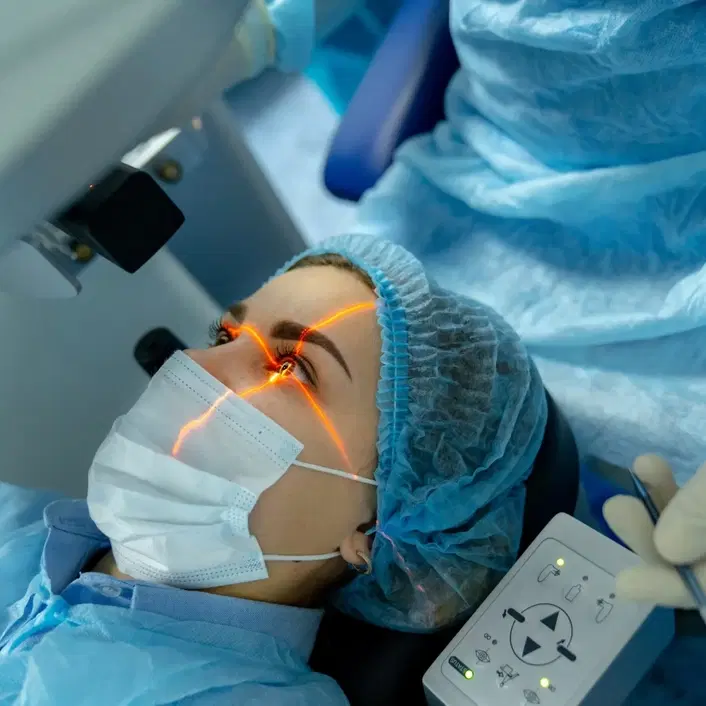
Refractive Surgery Changes How the Eye Focuses Light
Clear vision depends on light being focused accurately on the retina. In myopia, distant objects appear blurred because of the way the eye focuses incoming light. Hyperopia creates a different focusing problem, while astigmatism is associated with irregular focusing caused by the shape of the cornea or other optical components of the eye.
Glasses and contact lenses compensate for these refractive errors without permanently altering the eye. Refractive surgery takes another approach.
Corneal laser procedures change the curvature of the cornea so that its focusing power changes. Lens-based treatments correct the refractive error from inside the eye instead.
This distinction matters because someone who is unsuitable for one procedure is not automatically unsuitable for every form of refractive surgery.
Who May Be Suitable for Refractive Surgery?
Suitability is determined after a complete eye examination. A stable prescription is particularly important because operating while the refractive error is still changing can make the result less predictable. Corneal structure and eye health also need careful assessment before elective surgery is approved.
Factors commonly considered include:
A reasonably stable glasses or contact-lens prescription, rather than vision that is continuing to change significantly.
Healthy and appropriately shaped corneas if a corneal laser procedure is being considered.
Adequate corneal thickness for the amount and type of correction planned.
No suspicious signs of keratoconus or another corneal ectatic condition that could make laser treatment unsafe.
A manageable ocular surface, because significant dry-eye disease may need treatment before surgery.
A refractive error that falls within an appropriate treatment range for the selected technique.
Realistic expectations about spectacle independence, including the possibility that glasses may still be useful for certain tasks.
General and ocular health compatible with elective surgery, based on individual examination and medical history.
An online consultation can provide preliminary information, but it cannot replace corneal imaging and an in-person examination. A final surgical recommendation should come only after the eye has actually been measured.
LASIK Creates a Corneal Flap Before Reshaping the Eye
LASIK is one of the best-known forms of refractive surgery. During treatment, a thin corneal flap is created and lifted. An excimer laser then reshapes the underlying corneal tissue according to the planned refractive correction before the flap is repositioned.
One attraction of LASIK is relatively rapid visual recovery. Many patients achieve useful vision quickly, although temporary blur, watering and discomfort can occur immediately afterward.
The flap also creates considerations that do not exist in exactly the same way with flap-free procedures. Patients are advised not to rub the eye during early healing, and the structural characteristics of the cornea need to be evaluated carefully before surgery.
LASIK is not automatically the best option simply because it offers fast recovery. The correct procedure depends on the individual cornea.
PRK Uses the Corneal Surface Instead
PRK reshapes the cornea without creating a LASIK-style flap.
The outer epithelial layer is removed so an excimer laser can treat the underlying corneal surface. The epithelium then regenerates during recovery.
Because the surface needs time to heal, early recovery is usually less comfortable than LASIK. Vision can also take longer to become clear and stable. However, PRK remains an important refractive option and can provide refractive accuracy and visual outcomes comparable with LASIK in appropriately selected patients.
For some corneal profiles or lifestyles, avoiding a permanent flap may be valuable. That does not mean PRK is universally safer or better; it simply has a different balance of advantages and recovery considerations.
A patient comparing laser eye surgery in Turkey should therefore ask why one technique is being recommended rather than choosing according to recovery speed alone.
SMILE Takes a Small-Incision Approach
SMILE, or Small Incision Lenticule Extraction, corrects refractive error through a different technique.
A femtosecond laser creates a thin lenticule inside the cornea together with a small access incision. The surgeon removes the lenticule through this opening, changing the corneal curvature without creating the broader flap used in LASIK.
Modern comparative evidence indicates that SMILE and LASIK can both achieve strong safety and effectiveness outcomes for appropriately selected myopic patients. Some studies suggest differences in astigmatic accuracy and optical aberrations, while neither procedure is universally superior in every clinical situation.
Recent evidence also suggests that SMILE may produce more favourable early tear-film measurements than flap-based LASIK in some patients. This advantage should not be interpreted as meaning that dry eye cannot occur after SMILE.
Corneal Mapping Can Change the Entire Plan
One of the most important parts of refractive surgery happens before the patient enters the operating room.
Corneal imaging allows the surgeon to evaluate the shape and thickness of the cornea. A patient may have apparently healthy eyes and excellent corrected vision while still showing subtle structural patterns that make elective laser treatment inappropriate.
This matters because rare cases of postoperative corneal ectasia have been reported after PRK, LASIK and SMILE. Ectasia involves progressive weakening and distortion of the cornea and can significantly affect vision.
Proper screening aims to identify eyes that may be vulnerable before tissue is permanently altered.
A clinic's preoperative assessment is therefore at least as important as the laser technology advertised on its website.
Dry Eye Deserves Attention Before Surgery, Not Only Afterward
Laser refractive surgery can temporarily disturb the corneal nerves and tear-film system, making dry-eye symptoms an important part of preoperative assessment and postoperative care.
Someone who already experiences burning, gritty sensations, fluctuating vision or difficulty wearing contact lenses should mention these symptoms before surgery.
Postoperative dry eye remains a recognized issue after corneal refractive procedures, even though the frequency and severity can differ between techniques. Current research continues to examine ways of identifying and managing ocular-surface problems around refractive surgery.
Treating an unstable ocular surface before surgery can also improve the accuracy of preoperative measurements.
The best time to discover significant dry eye is therefore before the treatment plan has been finalized.
Night Vision Is Part of Visual Quality
Reading the smallest line on an eye chart does not tell the entire story about vision after surgery.
Patients may notice halos, glare, starbursts or difficulty seeing in low-light environments after refractive treatment. These symptoms can improve as the eye heals, but they can occasionally remain troublesome. Visual-quality changes and higher-order optical aberrations have been documented after several refractive techniques.
This is particularly relevant for people who spend considerable time driving at night or whose occupation depends on demanding low-light vision.
A consultation should therefore cover lifestyle rather than focusing only on the prescription number.
For some patients, obtaining excellent daytime unaided vision while accepting temporary night halos may be a reasonable trade-off. For others, the same compromise may be much less acceptable.
Glasses-Free Vision Cannot Be Guaranteed for Life
Refractive surgery can substantially reduce dependence on glasses, but the operation does not stop the eye from changing with age.
A small residual prescription may remain immediately after treatment, and refractive changes can also occur later. Some patients may eventually benefit from an enhancement, while others simply use glasses for selected situations.
Presbyopia creates another consideration. As the natural lens ages, focusing on near objects becomes more difficult. A patient who receives excellent distance correction while young can therefore still require reading glasses later in life.
The aim of refractive surgery should be described as reducing dependence on corrective lenses rather than guaranteeing that glasses will never be needed again.
That wording may sound less dramatic, but it gives patients a more realistic picture of long-term vision.
Phakic Lenses Offer an Alternative for Selected Eyes
Not every refractive treatment requires removal of corneal tissue.
A phakic intraocular lens can be implanted inside the eye while leaving the natural crystalline lens in place. These lenses can provide another option for selected patients, particularly those with moderate to high myopia who meet the anatomical requirements for implantation.
Because this is intraocular surgery, it carries a different risk profile from LASIK, PRK or SMILE. Potential concerns include cataract formation, increased eye pressure, inflammation, retinal complications and effects on corneal endothelial cells.
Phakic lens surgery should therefore not be described simply as “laser surgery without a laser.” It is a different operation with different measurements and long-term monitoring needs.
For some patients who are poor candidates for corneal laser correction, however, it can provide a valuable alternative.
Lens Replacement Becomes Relevant Later in Life
Older patients, particularly those already experiencing presbyopia or early lens changes, may be offered refractive lens exchange instead of corneal laser treatment.
This operation removes the natural crystalline lens and replaces it with an artificial intraocular lens. Depending on the implant selected, the goal may include distance correction, astigmatism management and reduced dependence on reading glasses.
Modern refractive lens exchange can provide strong visual outcomes in appropriately chosen patients, but it is intraocular surgery and permanently removes the natural lens.
The risk-benefit discussion therefore differs from corneal laser surgery in a young person with a clear natural lens. Retinal risks deserve particular attention in highly myopic patients considering elective lens replacement.
Age does not simply determine which procedure a patient receives, but it changes what needs to be considered.
Recovery Depends Heavily on the Procedure Chosen
There is no single recovery timeline for refractive surgery in Turkey.
LASIK often provides relatively rapid functional vision. SMILE can also produce a quick return to useful vision, although clarity may continue to improve as the cornea settles. PRK typically requires a longer early healing period because the corneal epithelium has to regenerate. Lens-based surgery follows a different postoperative pathway altogether.
Temporary blur and fluctuations do not necessarily indicate a poor result.
What matters is whether the eye is healing according to the expected pattern. Increasing pain, significant redness, discharge or a sudden deterioration in vision should be assessed promptly rather than attributed automatically to normal recovery.
International patients should understand these warning signs before leaving the country.
The Lowest Advertised Price Tells Very Little About the Surgery
There is no single meaningful refractive surgery cost in Turkey because the term covers several different procedures.
LASIK, PRK, SMILE, phakic lens implantation and refractive lens exchange require different technology, surgical steps, diagnostic testing and follow-up. The treatment may also be quoted per eye or as a bilateral package.
The useful comparison is not simply the headline price.
Patients should determine whether detailed corneal imaging, eye examination, medication, postoperative reviews and possible enhancement policies are included. The exact procedure should also be stated clearly rather than described only as “laser eye surgery.”
A more expensive treatment is not automatically better, but a cheaper package is not a benefit if it shortens the diagnostic process that determines whether surgery is safe.
What Should International Patients Check Before Refractive Surgery in Turkey?
Refractive surgery is elective, which gives patients time to investigate both the proposed procedure and the healthcare facility. Current authorization records are maintained for healthcare providers treating international health-tourism patients in Turkey.
Before booking treatment, it is useful to clarify:
Who performs the complete preoperative examination and who makes the final decision about surgical suitability.
Which procedure is being recommended and why, including why alternatives such as LASIK, PRK, SMILE or a lens-based option are less appropriate.
Whether detailed corneal mapping and thickness measurements are included before corneal laser surgery is approved.
Who personally performs the operation rather than communicating only through a travel or patient coordinator.
How dry eye, pupil size and night-vision expectations are assessed before treatment.
What the clinic's policy is if a residual prescription remains, including when an enhancement might or might not be considered.
How many postoperative examinations are needed before travelling home and where later follow-up will take place.
Whether the healthcare provider currently holds the relevant authorization for international health-tourism treatment.
Current authorization is a useful verification step, but it does not replace the need to understand the individual surgeon, diagnostic process and follow-up pathway.
Flying Home Should Not End Eye Care
The operation may take minutes, but postoperative care extends beyond the surgical appointment.
Patients should receive clear instructions about eye drops, rubbing the eyes, returning to exercise, swimming, makeup and other activities that may need temporary restriction. The exact advice varies according to the procedure.
A postoperative examination should also be completed according to the surgeon's schedule before travel plans take priority.
After returning home, patients need access to local eye care if unexpected symptoms develop. A sudden deterioration in vision, increasing pain or significant redness should not be managed through photographs and messages alone.
Requesting copies of preoperative measurements, the surgical report and postoperative findings can make future care easier if another ophthalmologist needs to examine the eyes.
The Best Procedure Is the One That Fits the Eye
Refractive surgery in Turkey can offer suitable patients significant freedom from glasses and contact lenses, but there is no single technique that deserves to be called the best for everyone.
LASIK offers fast recovery and has a long clinical history. PRK avoids a corneal flap but usually requires a slower early recovery. SMILE uses a small-incision lenticule technique and can provide strong outcomes for appropriate myopic corrections. Comparative research shows that these procedures can all be effective when patients are properly selected, while each has its own practical and optical characteristics.
Patients who are poor candidates for corneal laser surgery may still have lens-based alternatives, but those procedures introduce an entirely different set of considerations.
The quality of the final result therefore begins with diagnosis, not technology branding. Detailed corneal assessment, stable refraction, healthy ocular surfaces, realistic expectations and dependable postoperative care all matter.
For international patients, good refractive surgery in Turkey should ultimately mean more than being able to read an eye chart without glasses the following morning. It should mean choosing a procedure that respects the structure of the eye, provides a realistic balance between visual freedom and potential side effects, and remains supported by appropriate follow-up after the patient has returned home.
Note: This article is intended for general information and does not replace an individual ophthalmic examination. Suitability for LASIK, PRK, SMILE, phakic intraocular lenses, refractive lens exchange or another refractive procedure should be determined after a complete eye examination and individualized risk assessment.