
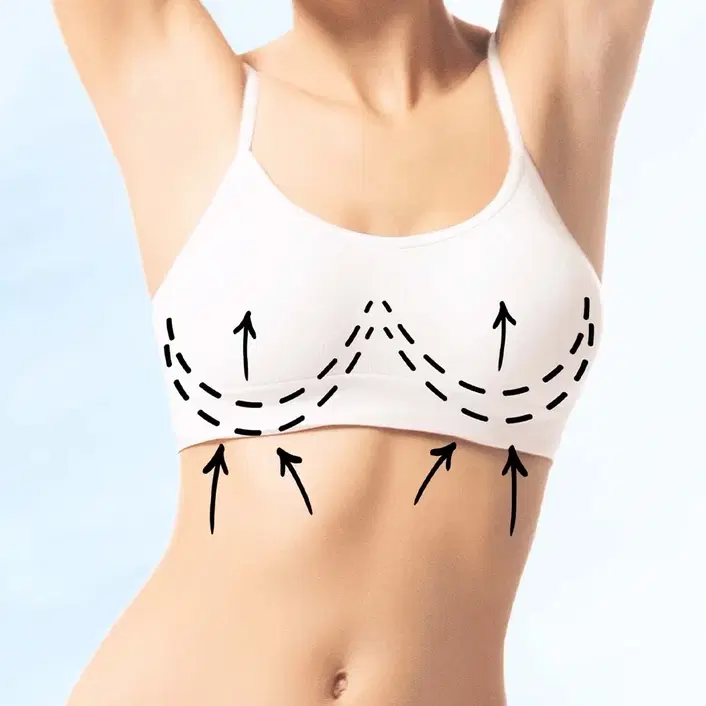
Why Do Breasts Begin to Sag?
Breast shape is influenced by skin, breast tissue, weight, pregnancy, hormonal changes and the natural ageing process. Over time, the skin and supporting tissues can gradually lose their ability to hold the breast in its previous position.
Pregnancy may stretch the breast envelope as breast volume changes. After pregnancy and breastfeeding, volume can decrease while the skin remains stretched. Significant weight loss can create a similar effect.
Ageing also affects tissue elasticity. Gravity continues acting on the breast over many years, and a naturally heavier breast may develop sagging sooner than a smaller, lighter breast.
There is no single cause that applies to every patient. This is why a breast lift should be planned according to the existing anatomy rather than age alone.
Who May Be Suitable for a Breast Lift?
Breast lift surgery can be considered when the main concern is breast position rather than simply breast size. During consultation, the surgeon evaluates skin quality, breast volume, nipple position, asymmetry, general health and expectations before deciding whether mastopexy is appropriate.
Typical factors considered include:
Noticeable breast sagging with the breast tissue sitting lower than desired.
Nipples that have moved downward as the breast envelope has stretched.
Loss of shape after pregnancy, breastfeeding or weight change.
Uneven breast position, where one breast sits lower than the other.
Relatively stable weight, because major future fluctuations can alter the result.
Realistic expectations about scars, symmetry and long-term changes.
Suitable general health for elective surgery and anaesthesia.
An understanding that pregnancy and ageing can change the breasts again even after a successful operation.
A breast lift should not be considered simply because the breasts have changed from their appearance several years earlier. The decision should be based on whether the current shape genuinely bothers the patient and whether surgery can reasonably achieve the requested change.
A Breast Lift Does Not Necessarily Make the Breast Smaller
Patients sometimes worry that removing skin during mastopexy will significantly reduce breast size.
A standard breast lift mainly reshapes and redistributes existing tissue while removing excess skin. Some patients perceive their breasts as slightly smaller afterward because the shape becomes more compact, but mastopexy is not the same procedure as breast reduction.
If a patient has very heavy breasts and wants both lifting and a meaningful reduction in volume, breast reduction may be a more appropriate operation.
The distinction should be discussed before surgery because “higher,” “smaller” and “fuller” describe different goals. A consultation works best when the patient explains which of these changes actually matters most.
Breast Lift With Implants Is a Different Treatment Plan
A breast lift can raise the existing breast, but it cannot create unlimited volume in the upper part of the breast.
Some patients have enough natural breast tissue to achieve the shape they want with mastopexy alone. Others have both sagging and significant volume loss and want a fuller upper breast. An implant may be considered in those cases.
Combining a breast lift with augmentation adds another layer of planning because the surgeon must balance skin removal with the added volume created by the implant.
It also introduces implant-specific long-term considerations. Breast implants are not lifetime devices, and complications such as capsular contracture, rupture, infection, asymmetry and the possibility of additional surgery need to be considered separately.
More surgery is not automatically better. If adequate breast volume already exists, adding an implant simply because it is commonly advertised as part of a package may not serve the patient's goal.
The Nipple Position Helps Determine the Surgical Approach
One of the most important measurements during a breast lift consultation is the relationship between the nipple and the fold underneath the breast.
As sagging progresses, the nipple may gradually move downward. In more significant cases, it can point toward the floor rather than forward.
During mastopexy, the nipple and areola are generally repositioned as part of the breast reshaping. The amount of movement required influences the incision pattern and the amount of skin that needs to be removed.
This does not mean every patient with mild sagging needs extensive surgery. Limited sagging and substantial sagging require different strategies.
The surgical plan should therefore follow the anatomy rather than forcing every patient into the same incision pattern.
Breast Lift Scars Depend on How Much Correction Is Needed
Scarring is an unavoidable part of surgical breast lifting.
Different incision patterns can be used according to the degree of sagging, skin excess and reshaping required. A smaller lift may involve an incision concentrated around the areola, while more extensive correction can require a vertical scar extending downward from the areola. When considerable skin removal is needed, an additional incision can be placed within the breast fold.
It is understandable to prefer the shortest possible scar. However, choosing an incision that is too limited for the amount of sagging can compromise breast shape.
Scars normally change significantly as they mature. They can initially look pink, firm or prominent before gradually becoming softer and less noticeable. Individual healing varies, so a completely invisible scar cannot be promised.
Breast Shape Changes During the First Months
The appearance seen immediately after surgery is not the final breast shape.
Swelling can make the breasts look firm, high or slightly uneven during early recovery. The tissues gradually settle as swelling decreases and the skin adjusts to its new position.
Small differences between the breasts can also become more or less noticeable as healing progresses. Natural breasts are rarely perfectly symmetrical before surgery, and mastopexy cannot guarantee mathematically identical breasts afterward.
This is one reason early postoperative photographs should not be used to judge the final outcome.
Breast shape continues developing as tissues soften and scars mature. The surgeon's follow-up schedule helps distinguish normal healing changes from problems requiring additional assessment.
What Happens During Breast Lift Surgery?
Breast lift surgery is generally performed under anaesthesia. After the planned markings are confirmed, incisions are made according to the agreed technique.
Excess skin is removed and the breast tissue is reshaped to create better support and a higher contour. The nipple and areola can be repositioned, and an enlarged areola may sometimes be reduced as part of the operation.
The incisions are then closed, and postoperative dressings or a supportive bra may be used according to the surgical plan.
If breast implants are also being inserted, additional decisions involving implant size, position and pocket creation become part of the procedure.
The duration of surgery varies because a straightforward lift and a complex lift combined with augmentation are not equivalent operations.
The First Week Is Mainly About Healing
Soreness, swelling, tightness and bruising are common during the early postoperative period. The breasts may feel sensitive, while areas around the incisions can temporarily feel numb or unusually sensitive.
Patients are usually encouraged to follow specific instructions regarding dressings, showering, supportive garments, sleeping position and physical activity. Recovery advice needs to reflect the actual operation performed rather than a generic internet timetable.
Heavy lifting and strenuous activity are normally restricted during early healing. Returning to work depends on the type of job, the extent of surgery and how the individual is recovering.
A desk-based role and physically demanding work naturally require different timelines.
Pregnancy Can Change the Result Later
A breast lift does not prevent future pregnancy, but pregnancy can change a lifted breast.
Breast volume may increase during pregnancy and decrease afterward. The skin can stretch again, potentially leading to recurrent sagging.
For someone actively planning pregnancy in the near future, it may therefore make sense to discuss whether postponing elective breast lifting would provide a more stable long-term result.
That does not mean every patient must wait until they are certain they will never become pregnant again. The decision depends on priorities, age, timing and the severity of the current concern.
The important point is understanding that mastopexy reshapes the breast at a particular moment; it cannot prevent future biological changes.
Can You Breastfeed After a Breast Lift?
Breastfeeding may still be possible after mastopexy, but surgery can potentially affect milk ducts, glandular tissue or nipple sensation depending on the technique used. For that reason, no surgeon should promise before surgery that breastfeeding ability will remain completely unchanged.
The discussion is especially important for patients who hope to have children later.
A surgical plan can take future breastfeeding goals into account, but the outcome cannot be guaranteed. Some women breastfeed successfully after a breast lift, while others may have difficulty producing or transferring enough milk.
This is a useful subject to raise during consultation rather than waiting until the day of surgery.
Nipple Sensation Can Change
The nipple and surrounding breast skin contain numerous sensory nerves. Because breast-lift surgery involves repositioning tissue, temporary changes in sensation can occur.
Some patients experience numbness, while others notice increased sensitivity during healing. Sensation may improve over time as tissues recover.
Permanent changes are also possible.
The likelihood depends partly on how extensive the operation is and the anatomy involved. This risk should be part of informed consent, particularly for patients for whom nipple sensation is an important personal concern.
Any sudden or unusual postoperative change should be discussed with the operating team rather than compared only with another patient's recovery experience.
The Main Risks Extend Beyond Scarring
Like every surgical procedure, mastopexy has possible complications.
Bleeding, infection, fluid collections, wound-healing difficulties, unfavourable scarring, asymmetry and changes in breast or nipple sensation can occur. Problems involving blood supply to the nipple or skin are less common but can be serious.
Anaesthetic complications and blood clots are additional general surgical concerns.
Risk is influenced by medical history, the extent of surgery and individual healing. Smoking and nicotine exposure are especially relevant in operations that depend on healthy blood flow to repositioned skin and breast tissues.
Patients should disclose their full medical history, medications, supplements and nicotine use before surgery instead of assuming a cosmetic operation requires less medical preparation.
A Lift Cannot Stop Future Sagging
Mastopexy can significantly improve breast position, but the breast continues to age afterward.
Gravity, hormonal changes, pregnancy, weight fluctuation and natural loss of skin elasticity can gradually alter the result. Even a breast that remains higher than before surgery may not look identical ten years later.
Maintaining a relatively stable weight can help protect the result, although no lifestyle choice can completely prevent ageing.
This is why descriptions such as “permanent breast lift” require context. Surgery creates a long-lasting anatomical change, but it cannot freeze the breast at one age forever.
The realistic goal is a better breast position from which normal ageing continues.
Travelling Home Needs to Be Included in the Recovery Plan
International patients sometimes plan surgery around cheap flight dates rather than medical recovery.
That approach deserves caution. Surgery and prolonged air travel both contribute to blood-clot concerns, and general guidance for cosmetic surgery abroad recommends avoiding flying for roughly five to seven days after procedures such as breast surgery, with individual surgical advice taking priority.
More complex surgery or individual risk factors may justify a different schedule.
Remaining locally also allows time for early postoperative assessment. A wound problem, collection of blood or other complication is much easier to review while the operating team is still accessible.
The flight home should therefore be part of preoperative planning, not an afterthought.
What Should You Check Before a Breast Lift in Turkey?
For patients travelling internationally, hotel accommodation and airport transfers can make the trip easier, but they do not indicate surgical quality. Current records are maintained for healthcare providers authorised to treat international health-tourism patients in Turkey, so provider status can be checked before booking.
Before paying a deposit, it is useful to clarify:
Who will personally perform the operation and who remains responsible for postoperative medical care.
Whether the healthcare provider currently has the appropriate authorization for treating international patients.
Which incision pattern is proposed and where the expected scars will be positioned.
Whether you need a lift alone, an implant, a reduction or a combination, and why that approach fits your anatomy.
How nipple position and existing asymmetry will be managed.
How long you should remain in Turkey after surgery before travelling home.
What happens if a complication appears after you return to your country, including how urgent medical review is arranged.
What the quoted price includes, particularly anaesthesia, hospital fees, medications, postoperative garments, follow-up and any additional procedures.
The most useful consultation should make the medical plan clearer, not simply make the package sound more attractive.
Breast Lift Cost in Turkey Depends on the Operation You Actually Need
There is no universal breast lift cost in Turkey because mastopexy ranges from relatively limited reshaping to complex operations combined with augmentation or reduction.
The final quotation may reflect the extent of skin removal, operating time, hospital services, anaesthesia, surgeon involvement, whether implants are used, postoperative garments, accommodation and transfers.
A package advertised as “breast lift with implants” should also identify the implant proposed rather than referring to it only as a premium option.
Comparing prices makes more sense after comparing procedures. A lift alone and an augmentation-mastopexy have different surgical requirements and different long-term considerations.
The lowest quotation should therefore not become the main decision-making tool.
A Better Breast Position Matters More Than Simply Looking Bigger
Breast lift in Turkey can be a suitable option for patients whose main concern is sagging, downward nipple position or loss of breast shape. The operation removes excess skin and reshapes supporting tissue to create a higher breast contour.
Its purpose should remain clear. A lift is not automatically an augmentation, and an implant is not automatically necessary. If the patient already has enough breast volume, mastopexy alone may provide the desired improvement. If volume has been lost, combining a lift with an implant can be considered, but implant-specific long-term risks then become part of the decision.
Scarring, temporary or permanent sensation changes, recurrent sagging and the potential effect on breastfeeding should all be discussed before surgery. International patients must also think beyond the operation itself by planning postoperative reviews and a safe return journey.
Ultimately, the most successful breast lift does not simply pull the breast as high as possible. It creates a proportionate shape that fits the patient's body, uses an appropriate incision pattern and respects the limitations of the skin and existing tissue.
For anyone considering breast lift surgery in Turkey, the most useful starting question is therefore not “How small can the scar be?” or “How much does the package cost?” It is whether the proposed operation solves the specific anatomical problem that is causing dissatisfaction in the first place.
Note: This article is intended for general information and does not replace an individual surgical consultation. Breast-lift suitability, incision pattern, implant use, anaesthesia, travel timing and postoperative care should be determined after a personal examination and full medical assessment.