
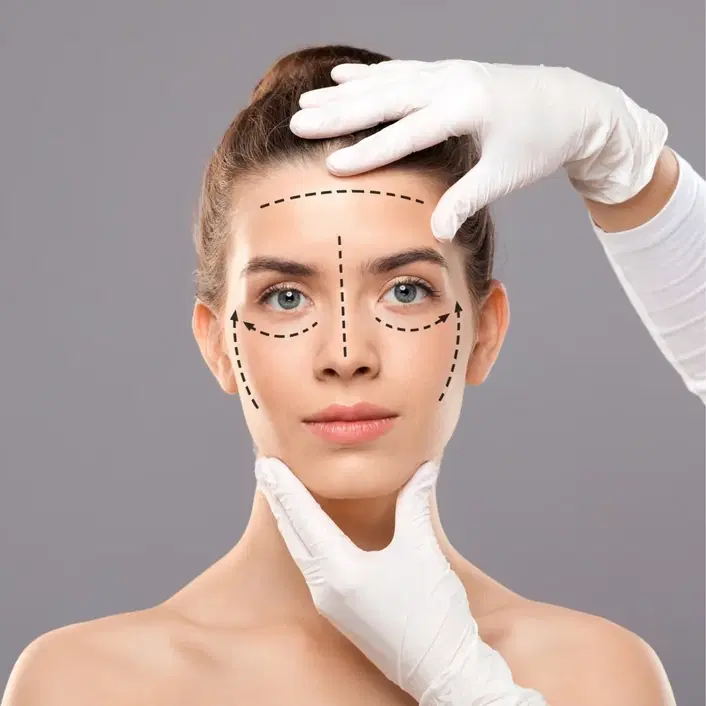
Facial Ageing Involves More Than Loose Skin
One of the biggest misconceptions about facelift surgery is that ageing occurs only because the skin becomes loose.
The face changes at several levels over time. Skin loses elasticity, facial fat can shift or decrease, deeper supporting tissues descend and the jawline can become less defined. Changes around the neck may develop at the same time. This is why modern facelift surgery generally involves more than simply pulling the skin backwards.
A well-planned facelift aims to reposition tissues in a way that fits the patient's natural anatomy. Excess skin can then be managed without relying on excessive tension at the surface.
This distinction matters aesthetically. Tightening only the skin too aggressively can create an operated or stretched appearance. Facial rejuvenation is generally more natural when deeper tissue position, volume and skin quality are considered separately.
What a Facelift Can and Cannot Improve
Facelift surgery is particularly useful for structural ageing of the lower and middle face. It can improve jowls, soften some deeper folds and restore a clearer transition between the face and neck. Depending on the technique, neck laxity can also be addressed during the same operation.
A facelift does not solve every sign of facial ageing.
Fine surface lines, pigmentation, sun damage and skin texture are different problems from tissue descent. Similarly, drooping upper eyelids, prominent under-eye bags or a low brow may require procedures specifically designed for those areas.
Facial volume loss is another separate issue. A person can have sagging tissue and hollow cheeks at the same time. In selected cases, volume restoration may therefore be discussed in addition to lifting.
The best treatment plan starts by identifying which ageing changes are actually bothering the patient rather than assuming that one procedure should correct everything.
Who May Be a Suitable Candidate for Facelift Surgery?
There is no universal “best age” for a facelift. Some people develop noticeable jowls and neck laxity relatively early, while others maintain strong facial support much longer. The decision is based more on anatomy, health and expectations than on a particular birthday.
A consultation generally considers several points before surgery:
Visible facial or neck laxity that cannot realistically be corrected to the same degree with nonsurgical treatments.
Reasonably good general health for elective surgery and anaesthesia.
Realistic expectations about improvement rather than perfect symmetry or permanent prevention of ageing.
Adequate skin and tissue quality for the proposed surgical plan.
A clear understanding of scars, recovery and possible complications.
Willingness to follow postoperative instructions, including activity restrictions and follow-up visits.
A stable personal decision made for the patient rather than because of pressure from another person.
An honest medical history, including previous facial surgery, fillers, medications, smoking and conditions that may affect healing.
A facelift is a significant elective operation. The consultation should therefore cover medical suitability as carefully as cosmetic goals.
SMAS Facelift Explained in Simple Terms
The term SMAS refers to a layer of connective and muscular tissue beneath the skin.
Many facelift techniques involve repositioning or tightening this deeper layer rather than relying only on skin tension. The exact method varies. The SMAS can be folded, tightened, repositioned or dissected to different degrees depending on the surgeon's technique and the patient's anatomy.
The reason this terminology matters is that deeper tissue support can influence the way the jawline and lower face are repositioned.
However, patients should be cautious about assuming that one branded version of SMAS surgery is automatically the best technique. The same operation name can involve slightly different surgical methods between surgeons.
What matters is how the proposed technique addresses the individual's ageing pattern and how safely it can be performed.
What Does “Deep Plane Facelift” Mean?
Deep plane facelift has become one of the most frequently searched terms in facial cosmetic surgery.
The technique involves dissection in a deeper anatomical plane so that certain facial soft tissues can be mobilised together rather than treating the skin as an isolated layer. It is particularly discussed in relation to repositioning the mid and lower face.
It is often marketed as more advanced or more natural than every alternative. Current evidence does not support treating the issue so simply. Recent comparisons indicate that both deep plane and SMAS-based facelift techniques can achieve strong long-term aesthetic outcomes and high satisfaction in appropriately selected patients.
The practical question is therefore not “Is deep plane always better?” but “Which approach suits my anatomy and what experience does the surgeon have with that technique?”
A fashionable surgical name cannot compensate for poor planning.
Mini Facelift Does Not Have One Universal Definition
The term mini facelift sounds straightforward but can describe different operations.
In general, it refers to a more limited procedure intended for patients with less extensive facial laxity. Incisions and tissue dissection may be shorter than in a more comprehensive face and neck lift.
The advantage can be a smaller operation for the right patient. The limitation is equally important: a limited procedure cannot be expected to correct extensive jowling or significant neck laxity to the same degree as a more comprehensive operation.
A patient should therefore ask what the surgeon actually plans to do beneath the skin rather than choosing the procedure because the word “mini” sounds easier.
Less surgery is beneficial when less surgery is genuinely enough.
Incisions Are Planned Around Natural Facial Boundaries
Facelift incisions are commonly placed around the ear and can extend into the hairline depending on the surgical technique and amount of correction required.
The intention is to position scars where they can become relatively inconspicuous after healing, but facelift surgery is not scar-free. Scar quality varies between individuals and can be affected by genetics, wound tension, infection, smoking and healing problems.
Careful incision planning is particularly important around the sideburn and hairline. Poor positioning can alter the natural hairline or make scars easier to see.
Scars usually evolve gradually rather than reaching their final appearance within the first few weeks. Early redness does not automatically indicate a poor long-term scar.
The Operation May Include the Neck
Many patients researching a facelift are actually most concerned about their jawline and neck.
Jowling can make the lower face appear heavier, while loose neck skin and visible neck bands can reduce the definition between the chin and neck. Depending on anatomy, these areas can be treated as part of a combined face and neck lifting strategy.
In some cases, addressing the face without adequately treating the neck can produce an imbalance. The face may look refreshed while the neck continues to show significant laxity.
Conversely, not every patient needs extensive neck surgery.
The consultation should determine whether the problem comes mainly from skin laxity, deeper neck structures, excess fat, tissue descent or a combination of these factors.
Recovery Changes From Week to Week
Facelift recovery should be viewed as a gradual process rather than a single day when someone suddenly looks “normal.”
During the early days, swelling, bruising, tightness, tenderness and temporary numbness can occur. The face may look uneven because swelling does not always resolve symmetrically.
By the second week, many patients notice substantial improvement, although bruising, swelling, tingling or tightness can still be present. Some people feel comfortable returning to social activities around this stage, while others need longer.
Residual swelling can continue to change for considerably longer, and the final contour should not be judged from early postoperative photographs.
International patients should build their travel plans around medical recovery rather than assuming they can have surgery and immediately continue a holiday itinerary.
Smoking Can Make Healing More Difficult
Good blood flow to the facial skin is extremely important during facelift recovery.
Because sections of skin and soft tissue are surgically elevated and repositioned, anything that compromises circulation can increase concern about delayed wound healing or skin problems. Smoking is therefore an important part of the preoperative discussion.
Patients should disclose nicotine use honestly, including cigarettes and other nicotine-containing products. Instructions about stopping before and after surgery should come directly from the operating surgeon because individual risk factors and techniques differ.
Trying to conceal nicotine use to avoid having an operation postponed can create an unnecessary safety risk.
Facelift Risks Should Be Understood Before Booking
All surgery carries risk, and facelift surgery involves structures that affect both facial appearance and movement.
Potential complications include bleeding or haematoma, infection, poor wound healing, skin loss, fluid accumulation, changes in sensation, persistent swelling and unfavourable scarring. Facial nerve injury can cause weakness and may be temporary or, less commonly, persistent. Hair loss can also occur around incision areas. Anaesthesia and blood-clot-related complications are additional general surgical risks.
Haematoma is one complication that may require early treatment. Significant swelling, increasing pain or a rapidly changing appearance after surgery should therefore be assessed rather than assumed to be part of normal recovery.
A good consultation does not avoid discussing complications because they are uncommon. It explains what warning signs matter and what would happen if a problem developed.
Previous Fillers and Facial Treatments Are Relevant
Many facelift patients have undergone nonsurgical facial treatments before deciding on surgery.
Previous fillers, threads, energy-based treatments, skin resurfacing procedures and earlier surgery should all be disclosed during consultation. These treatments can affect tissue characteristics and surgical planning.
This does not mean someone who has previously used fillers cannot have a facelift.
It simply means the surgeon benefits from knowing where products were placed, approximately when treatment occurred and whether any complications developed.
Bringing previous treatment records, when available, can be helpful for an international consultation.
What Should You Check Before Choosing a Facelift Clinic in Turkey?
Patients travelling abroad need to evaluate not only the operation but also what happens before and after it. Turkey currently maintains official authorization records for healthcare providers working with international health-tourism patients, with the relevant lists updated on July 28, 2026.
Before making a booking, it is sensible to clarify:
Who will personally perform your facelift and who is medically responsible for postoperative care.
Whether the healthcare provider currently holds the relevant authorization for treating international health-tourism patients.
Which facelift technique is actually proposed and why it fits your anatomy.
Whether neck surgery is included, if neck laxity is one of your main concerns.
Where the incisions are expected to sit and how the hairline will be protected.
How long you should remain locally after surgery before travelling home.
What happens if a complication develops after you leave Turkey, including who reviews photographs and how urgent care is coordinated.
What the quoted price includes, such as hospital fees, anaesthesia, medications, postoperative checks, accommodation and transfers.
International cosmetic surgery also requires sensible travel planning because postoperative follow-up can be more complicated once the patient returns to another country.
Facelift Cost in Turkey Depends on the Scope of Surgery
There is no meaningful single price for facelift surgery in Turkey because “facelift” can describe operations of very different complexity.
A limited lower-face procedure will not necessarily cost the same as a comprehensive face and neck lift. Anaesthesia, hospital stay, surgical time, additional procedures, surgeon involvement and postoperative care can all affect the final quotation.
Combining eyelid surgery, fat transfer, brow surgery or another facial procedure will also change both cost and recovery.
For international patients, accommodation and transportation may be included in a package, but these services should be separated mentally from the actual medical value of the procedure.
A luxury hotel does not indicate surgical quality.
A Facelift Does Not Freeze the Face in Time
Facelift results can be long-lasting, but surgery does not stop biological ageing.
After healing, patients generally continue ageing from their new postoperative baseline. Skin quality, genetics, sun exposure, smoking, weight changes and natural tissue ageing can all affect how the face changes over subsequent years.
This is why promises such as “permanent facelift” can be misleading if they are interpreted to mean the face will never age again.
A technically successful operation can remain visually beneficial for many years even as ageing continues. Some people later choose smaller maintenance treatments, while others never have another facelift.
Longevity is individual rather than a fixed expiration date.
Natural Results Usually Come From Restraint
One reason some people fear facelift surgery is the possibility of looking overly tight or unlike themselves.
Modern facial rejuvenation generally aims to reposition descended tissue rather than create maximum tension. The objective is usually a fresher jawline, better facial balance and a rested appearance without removing recognizable features.
This is also why photographs should be evaluated carefully. A dramatic result is not automatically a better result.
Look for patients with similar ageing patterns and pay attention to the hairline, sideburns, ear region, jawline and neck rather than focusing only on a frontal photograph.
Lighting, makeup, hairstyle and facial expression can change the apparent result considerably.
Choosing the Operation Is More Important Than Choosing the Trend
Facelift in Turkey can be an effective option for appropriately selected patients who want meaningful improvement in facial and neck laxity. The procedure can reposition deeper facial tissues, improve jowls and refine the lower face, but it does not correct every aspect of ageing and cannot stop the ageing process itself.
Terms such as SMAS facelift, deep plane facelift, mini facelift and face and neck lift describe different surgical concepts, but no label guarantees a superior result. Current evidence comparing major facelift approaches does not support reducing surgical quality to a simple “deep plane versus SMAS” marketing argument. Both approaches can produce strong outcomes when appropriately selected and performed.
For international patients, the planning process should also include current provider authorization, the identity of the operating surgeon, postoperative monitoring and a realistic plan for complications after returning home. Turkey's current international health-tourism framework includes formally authorized healthcare providers, and the provider information should be checked using up-to-date records rather than old advertisements.
Ultimately, the strongest facelift results in Turkey come from matching the operation to the face rather than matching the patient to a fashionable technique. A natural facelift should soften signs of ageing while preserving expression, facial identity and proportion.
The most useful consultation therefore answers three practical questions: what is ageing in this particular face, what needs to be repositioned to improve it, and how can that change be achieved without unnecessarily increasing surgical risk?
Note: This article is intended for general information and does not replace an individual surgical consultation. Facelift suitability, technique, anaesthesia, travel timing and postoperative care should be determined after a personal examination and review of medical history.