
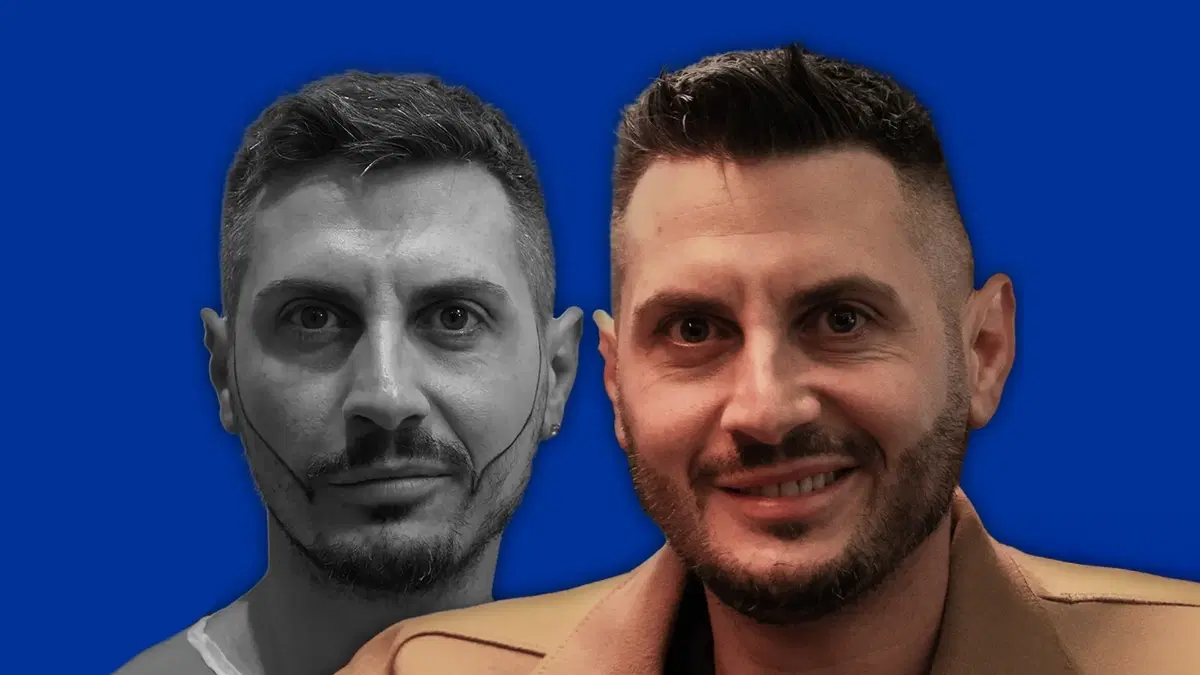
Facial Hair Transplantation Is Different From a Scalp Procedure
Moving follicles from one part of the body to another may sound straightforward, but facial hair patterns are highly specific.
Scalp hairs tend to grow in broader directional patterns. Eyebrow hairs, by comparison, sit extremely close to the skin and change direction across a very small area. Hair at the inner eyebrow tends to have a different orientation from hair through the middle and outer tail. Creating a natural brow therefore requires careful control of angle, direction, density, and follicle size. Single-hair follicular grafts are commonly preferred for eyebrow restoration because thick multi-hair grafts may create an unnatural appearance.
Beard transplantation has its own challenges. The direction of facial hair changes between the sideburns, cheeks, moustache, chin, jaw, and upper neck. A transplanted beard that grows too vertically or in an inconsistent direction can look artificial even when the grafts survive well.
This is why facial hair transplantation combines surgical technique with aesthetic design.
Donor Hair Selection Shapes the Final Appearance
For many facial hair transplants, suitable follicles are harvested individually from the scalp using an FUE-based method. The back and sides of the scalp are commonly considered because these areas often provide stable donor follicles. FUE allows follicular units to be removed individually rather than through a linear strip.
Not every donor hair behaves exactly like natural eyebrow or beard hair. Scalp hair may have a different thickness, growth speed, curl, or colour. This difference is especially important in eyebrow transplantation.
Selecting fine single hairs can help produce a softer eyebrow edge. The curvature of donor hair also matters because the wrong curvature can make transplanted eyebrow hairs project away from the skin instead of lying naturally across the brow. Long-hair harvesting techniques may sometimes help the medical team visualize curl and direction during eyebrow planning.
Beard restoration may allow somewhat greater variation in follicular-unit size because naturally dense beard regions can contain stronger hairs. Even so, single-hair grafts often remain important around borders where a softer transition is required.
Who May Be Suitable for Beard or Eyebrow Transplantation?
A facial hair transplant may be considered for cosmetic thinning as well as selected cases of permanent hair loss, but the reason for missing hair should be understood before surgery. Hair loss caused by an active medical condition may require treatment or stabilization before transplantation is considered.
Factors commonly assessed during consultation include:
Stable areas of missing or sparse hair, rather than rapidly changing unexplained hair loss.
Adequate donor supply with follicles that are suitable in thickness, colour, curl, and overall quality.
Realistic expectations about density, symmetry, and the number of grafts that can safely be used.
Healthy recipient skin, or a scarred area that has been appropriately assessed for transplantation.
A clear facial design goal, particularly when changing beard lines or eyebrow shape rather than restoring previous hair.
No uncontrolled scalp or skin condition that could interfere with healing or graft survival.
An understanding that transplanted scalp hair may require grooming, particularly when used in the eyebrows.
A willingness to follow postoperative instructions during the early healing period.
Eyebrow and beard loss can occur for different reasons, including trauma, burns, scarring, cosmetic over-plucking, previous surgery, and some forms of alopecia. Because certain causes of hair loss can remain active, diagnosis is an important part of surgical planning.
Beard Design Should Match the Face Rather Than a Template
One of the most common mistakes in cosmetic beard transplantation is planning the same beard shape for everyone.
A natural beard line should work with facial width, chin projection, jaw shape, sideburn position, age, and existing facial hair. Some patients want to fill isolated gaps, while others want greater cheek density or reconstruction of the moustache and goatee. These situations require very different graft distributions.
Density also needs to be planned realistically. Concentrating too many grafts in one area may leave insufficient donor supply for another region. Attempting to create an extremely dense full beard in a patient with limited donor availability can produce compromises in both the donor and recipient areas.
The transitions deserve particular care. A beard should not suddenly begin as a perfectly straight, heavily packed line across the cheeks. Strategic irregularity and gradual changes in density can create a softer appearance.
Current facial-hair restoration techniques emphasize attention to recipient-site angle, direction, and natural distribution rather than simply maximizing the number of transplanted follicles.
Eyebrow Architecture Requires Millimetre-Level Planning
Eyebrow transplantation is performed over a much smaller area, but that does not make it a simpler procedure.
The eyebrows strongly influence facial expression and symmetry. A few millimetres of difference in height, arch position, or tail length can noticeably change the face.
Before implantation, eyebrow shape should be planned with the patient rather than copied from a standard template. Natural asymmetry also needs to be considered. Perfect mathematical symmetry does not necessarily produce the most natural appearance.
The implanted hairs must lie at very shallow angles. Direction changes gradually from the inner brow toward the body and tail. Single follicles are generally useful because they more closely resemble naturally occurring eyebrow hairs. Research on eyebrow restoration repeatedly identifies graft selection, angulation, direction, and design as major factors influencing aesthetic results.
This precision is one reason eyebrow transplant results should not be judged only by graft count. More grafts are not automatically better if their direction or distribution is wrong.
The Procedure Begins With Individual Planning
On the day of surgery, the beard or eyebrow design is typically reviewed before transplantation begins. Photographs may be taken, the donor region is prepared, and local anesthesia is generally used.
When FUE harvesting is chosen, follicular units are extracted one by one from the donor area. The team then examines and organizes grafts according to the recipient plan. Facial transplantation often benefits from separating single-hair follicles from larger grafts because different regions require different visual effects.
Recipient sites are then created according to the required direction, angle, and density, or implantation may be performed with a suitable implanter technique depending on the surgical approach.
Because facial hair direction can change repeatedly across a few centimetres, the implantation stage requires careful attention throughout the procedure.
Beard and Eyebrow Transplants Do Not Produce Instant Final Results
The newly transplanted hairs are visible immediately after surgery, but this appearance should not be mistaken for the final result.
During the first days, small crusts, mild redness, and swelling can occur around the transplanted follicles. Some of the visible transplanted hair shafts may later shed. The follicle remains beneath the skin and new growth can gradually emerge over the following months.
Eyebrow transplant studies and clinical reports describe growth developing progressively rather than appearing all at once.
Early growth may look uneven because individual follicles enter new growth at different times. The texture and direction can also become easier to evaluate as the hairs mature.
This gradual timeline is important for international patients who may see promotional photographs taken immediately after implantation. Freshly implanted grafts show placement, not the eventual density or survival of mature hair.
Transplanted Eyebrow Hair May Need Regular Trimming
One feature that surprises some eyebrow transplant patients is that donor hair can retain characteristics of the area it came from.
When scalp follicles are transplanted into the eyebrow, they may continue growing longer than natural eyebrow hairs. As a result, regular trimming and grooming can become part of long-term maintenance. Reports of eyebrow transplantation describe patients needing periodic trimming because transplanted scalp hairs continue to lengthen.
Over time, some patients become accustomed to shaping the new brows just as they would trim or style other facial hair.
This should be discussed before surgery because an eyebrow transplant is not necessarily a completely maintenance-free cosmetic procedure.
Healing Around the Face Can Be Noticeable for Several Days
Facial skin is highly visible, so even mild postoperative changes can feel significant.
Temporary redness, small crusts, swelling, tenderness, or itching can occur following hair transplantation. Eyebrow procedures may produce swelling around the forehead or eyelids. Beard recipients can notice crusting across the cheeks, chin, or moustache region.
Hair-transplant complications are generally uncommon when properly performed, and many postoperative effects are mild and temporary, but more significant complications are possible.
Patients should avoid picking crusts or aggressively rubbing transplanted areas. Washing instructions, exercise restrictions, shaving, sleeping position, and skincare recommendations may vary, so the postoperative protocol provided for the individual procedure should take priority over generic online advice.
Cosmetic Complications Matter as Much as Medical Ones
In facial hair restoration, a technically surviving graft is not automatically a successful graft.
The eyebrows are particularly sensitive to asymmetry, incorrect direction, excessive density, or hairs growing at unnatural angles. Reviews of eyebrow transplantation identify aesthetic issues such as asymmetry among the important potential complications.
Beard transplantation can similarly produce visible irregularities if grafts are placed too deeply, at poor angles, or with an unsuitable density pattern. Skin bumpiness or irregularity in transplanted beard regions has also been described as a possible complication.
Other potential concerns associated with hair transplantation include infection, folliculitis, temporary shedding, swelling, itching, discomfort, scarring, poor graft growth, and donor-area thinning.
Good planning aims to minimize both medical and aesthetic problems.
Scarred Areas Need Additional Assessment
Beard and eyebrow transplantation can sometimes be used to camouflage scars caused by burns, trauma, previous surgery, or other injuries. Hair transplantation has been reported in scarred areas of the eyebrows, beard, and moustache.
However, scar tissue is not identical to normal skin. Blood supply, thickness, firmness, and tissue quality can vary. A medical team may therefore recommend different graft densities, staged transplantation, or additional assessment before proceeding.
A large scar should not automatically be treated as though it were simply a naturally sparse eyebrow or beard.
The origin of the scar also matters. If it resulted from an ongoing inflammatory condition rather than an old stable injury, the underlying disease may need to be inactive before transplantation is considered.
What Should You Check Before Choosing a Clinic in Turkey?
International patients often compare airport transfers, hotels, interpreters, procedure packages, and prices. These can make travel easier, but medical planning should remain the priority. Turkey maintains current authorization information for healthcare providers involved in international health tourism, so provider status can be checked as part of the research process.
Before booking a beard or eyebrow transplant in Turkey, it is sensible to clarify:
Who is medically responsible for your procedure and who will perform the important surgical stages.
Whether the facility currently has the appropriate authorization for treating international health-tourism patients.
How your hair-loss diagnosis will be assessed before transplantation.
Which donor region will be used and why its hair characteristics suit your beard or eyebrows.
How many grafts are realistically planned, rather than choosing a graft number primarily for marketing.
How eyebrow or beard direction will be designed and whether the proposed shape is reviewed with you before surgery.
What follow-up is available after you return home, particularly if redness, infection, unexpected shedding, or another complication develops.
Exactly what the quoted price includes, such as medication, postoperative checks, accommodation, transport, or later reviews.
The current official authorization page for international healthcare providers was updated on July 28, 2026, making it worth checking contemporary information rather than relying on an old screenshot or advertising claim.
Cost Should Be Compared With the Actual Treatment Plan
The cost of a beard transplant in Turkey or eyebrow transplant in Turkey can vary according to graft requirements, surgeon involvement, facility standards, donor complexity, treatment area, accommodation, and other package services.
Eyebrow transplantation usually involves a relatively small recipient area, but the precision required can be considerable. Beard transplantation may require substantially more grafts when the aim is to create broad cheek and jaw coverage.
For this reason, cost comparisons should not rely only on a “price per graft” figure.
An unusually large graft estimate is not always a benefit either. The donor supply is finite, and removing more follicles than necessary can compromise future options or create visible donor thinning.
A useful quotation should therefore explain what is being treated, where the grafts will come from, and why the proposed number makes sense for the individual's face.
Natural Facial Hair Requires Long-Term Thinking
A beard or eyebrow transplant can alter an important feature of the face for many years. The design should therefore work not only in current photographs but also with the patient's likely future appearance.
An eyebrow shape based too closely on a short-lived beauty trend may eventually feel unnatural. Similarly, a very high and sharply defined beard cheek line may not suit every face or age well.
Hair characteristics should also be considered over time. Grey hair, changes in hairstyle, future scalp hair loss, or the need for another transplant can affect donor planning.
For patients undergoing both scalp and facial transplantation, using too many donor follicles on one area without considering future needs can create limitations later.
A Natural Result Depends on Direction More Than Marketing
The technique is based on transplanting living follicular units, often harvested individually using an FUE approach. Yet the most important part of facial transplantation is not simply how the graft is extracted. The aesthetic result depends heavily on choosing appropriate follicles and placing them at the correct angle, direction, and density.
This is especially true for eyebrows, where a small number of incorrectly directed follicles can be visible. Beard restoration requires equally thoughtful transitions between different facial zones.
For people travelling to Turkey, the large number of available treatment options makes careful research essential. Provider authorization, medical responsibility, donor planning, follow-up arrangements, and realistic before-and-after examples are more useful criteria than hotel quality or an unusually low package price.
A successful facial hair transplant should ultimately look unremarkable in the best possible way. Someone looking at the finished beard or eyebrow should see facial hair that suits the face rather than immediately noticing that transplantation has been performed.
That result comes from diagnosis, design, careful donor selection, meticulous implantation, and patience during the growth process—not simply from choosing the procedure with the largest advertised graft count.
Note: This article is intended for general information and does not replace an individual medical assessment. Beard and eyebrow hair loss can have different causes, and transplant suitability should be determined after evaluating the recipient area, donor supply, medical history, and expectations.