
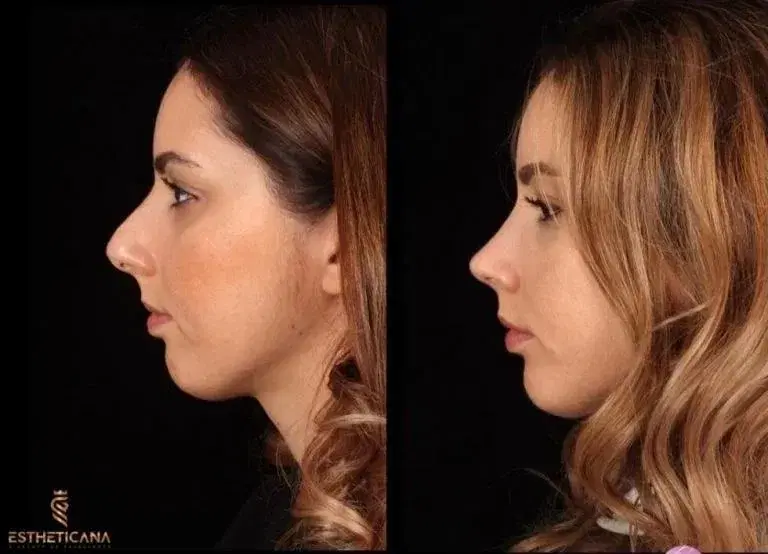
Rhinoplasty Changes Proportion, Not Facial Identity
A well-planned rhinoplasty aims to create a nose that works naturally with the rest of the face.
Someone with a strong chin, broad cheekbones and thick nasal skin may need a completely different surgical plan from someone with a narrow face and thin skin. Even when both patients dislike a similar feature, such as a prominent bridge, removing exactly the same amount of tissue would not necessarily produce equally balanced results.
This is why photographs of another person's nose should be used as a communication tool rather than a surgical template.
The surgeon needs to consider the relationship between the forehead, nose, lips and chin as well as the nose itself. Changing one feature can alter the way neighbouring facial structures appear.
Good rhinoplasty planning therefore asks how much change will improve facial balance, not how much tissue can physically be removed.
Cosmetic and Functional Goals Can Exist Together
Rhinoplasty is often discussed as cosmetic surgery, but nasal appearance and nasal function are closely connected.
A patient may want a straighter nose while also experiencing difficulty breathing through one or both sides. Structural problems involving the septum or nasal valve region can contribute to airflow obstruction and may need to be evaluated separately from the visible shape of the nose.
In appropriate cases, cosmetic reshaping and functional correction can be planned during the same operation.
This does not mean every person with nasal congestion needs rhinoplasty. Allergies, inflammation and other conditions can also interfere with breathing. A proper examination should therefore identify the actual reason for obstruction before surgery is recommended.
Changing the outer appearance without considering internal support can occasionally compromise breathing, which is one reason functional assessment matters even when the patient's original motivation is cosmetic.
Who May Be a Suitable Candidate for Rhinoplasty?
Rhinoplasty can be considered when nasal development is complete and the patient has realistic goals about what surgery can achieve. General health, smoking status, previous nasal surgery and breathing symptoms also form part of the assessment.
Several points are usually considered during candidacy assessment:
Facial growth should be sufficiently complete, particularly when surgery is being considered at a younger age.
The patient should be medically suitable for elective surgery and anaesthesia.
Expectations should be realistic, with improvement rather than perfect symmetry as the goal.
Breathing complaints should be assessed before surgery rather than treated as a purely cosmetic issue.
Skin thickness and cartilage strength should support the proposed change.
Previous nasal trauma or surgery should be disclosed, because these can alter anatomy and surgical planning.
Smoking and nicotine use should be discussed honestly, as they can affect healing.
The decision should come from the patient, rather than pressure to resemble another person or follow a temporary trend.
The consultation should also identify whether the desired change can reasonably be achieved with surgery. A photograph simulation may help communicate goals, but it should not be interpreted as a guaranteed prediction of the final result.
Thick and Thin Skin Behave Differently
Skin thickness is one of the less obvious factors that can strongly influence rhinoplasty.
Thin skin reveals the underlying cartilage and bone more clearly. This can make subtle structural changes visible, but it can also expose very small irregularities.
Thicker skin tends to hide fine structural detail. When the nasal tip has thick skin and soft tissue, creating an extremely small or sharply defined tip may not be realistic even after significant cartilage reshaping.
The surgeon therefore works with both the internal framework and the tissue covering it.
This is why a technique that produces a highly defined result in one patient may create a softer result in another. Neither outcome necessarily represents poor surgery; different tissue characteristics simply respond differently.
Open and Closed Rhinoplasty Describe Surgical Access
Patients frequently encounter the terms open rhinoplasty and closed rhinoplasty while researching treatment.
In a closed approach, surgical incisions are generally positioned inside the nostrils. In an open approach, internal incisions are combined with a small external incision across the tissue between the nostrils, allowing greater exposure of the nasal framework.
Neither approach is universally superior.
The preferred method depends on the deformity being treated, whether extensive tip work or reconstruction is required, previous surgery and the surgeon's chosen technique. A systematic review comparing primary procedures did not demonstrate a clear difference in reoperation rates that would justify declaring one approach inherently better in all patients.
The more useful question is why a particular approach has been selected for the individual nose.
Tip Surgery Requires Structural Balance
The nasal tip is not simply a small piece of cartilage that can be cut down until the desired shape appears.
Its appearance depends on several cartilage structures, skin thickness, support and the relationship between the tip and nasal bridge. Excessive removal of supporting cartilage can create long-term weakness or unwanted shape changes.
Modern rhinoplasty often emphasizes preserving or rebuilding structural support rather than relying entirely on aggressive reduction.
Some patients need tip refinement, while others require rotation, projection changes or additional cartilage support.
A naturally refined tip should also fit the rest of the nose. Making the tip dramatically narrow while leaving a broad nasal bridge, for example, can create imbalance.
Rhinoplasty Does Not Always Mean Making the Nose Smaller
Reduction rhinoplasty is common, but some noses actually require additional structural support.
Cartilage grafts may be used to strengthen or reshape particular areas. Depending on the operation, suitable cartilage may be obtained from the nasal septum or another donor site when additional material is needed.
This can be particularly relevant in revision surgery, significant trauma or noses where structural support is limited.
The goal is not maximum reduction. Removing excessive bone or cartilage can create functional and cosmetic problems that are much harder to correct later.
A conservative operation can therefore involve adding structure in one part of the nose while reducing another.
Septorhinoplasty Addresses More Than Appearance
The term septorhinoplasty is generally used when external nasal reshaping is combined with work involving the nasal septum.
A deviated septum can contribute to breathing difficulty, although nasal obstruction can have more than one cause. Structural evaluation may also consider the nasal valves and internal nasal tissues.
Functional surgery should not be treated simply as an extra item added to a cosmetic package.
The actual source of airway obstruction should be identified so the procedure addresses the relevant structure. Likewise, straightening the external nose does not automatically guarantee perfect nasal breathing.
Patients who already have breathing difficulties should make them clear during the initial consultation rather than mentioning them only after the cosmetic plan has been established.
What Happens During Rhinoplasty Surgery?
The exact procedure varies considerably because rhinoplasty is tailored to anatomy.
After anaesthesia, the surgeon gains access to the nasal framework through the planned incisions. Bone and cartilage can then be reshaped, repositioned, reduced or supported according to the surgical goal. If septal correction is required, internal structures may also be addressed.
At the end of surgery, incisions are closed and external support may be applied. A nasal splint is commonly used during early healing, while internal splints or packing may be used in selected cases depending on the operation.
The amount of surgery can range from limited tip refinement to extensive reconstruction. For that reason, operation length and recovery should not be compared solely according to the word “rhinoplasty.”
The First Week Is Only the Beginning of Recovery
The early postoperative period commonly involves swelling, nasal stuffiness and bruising, particularly when the nasal bones have been treated.
An external splint may remain in place during the initial healing phase. Patients usually receive individual instructions concerning sleeping position, washing, physical activity and nasal care.
Removing the splint does not mean the nose has finished healing.
The appearance seen during the first few weeks can change considerably as swelling decreases. The tip often retains swelling longer than other areas, and subtle asymmetry during early healing does not automatically indicate the final result.
Most visible swelling improves progressively, but refinement of the nasal contour can continue for many months.
Final Results Require Patience
Rhinoplasty is unusual among cosmetic operations because relatively small amounts of swelling can noticeably alter the appearance of the nose.
A few millimetres matter when assessing tip definition, bridge width or symmetry.
Initial swelling often decreases substantially within weeks, yet the final contour can take up to a year to become fully refined. In some individuals, particularly those with thick skin or extensive tip work, subtle changes may continue over an extended period.
Patients should therefore be careful when comparing their nose at two months with someone's one-year postoperative photograph.
Early results show the direction of healing, not necessarily the finished nose.
Perfect Symmetry Is Not a Realistic Surgical Promise
Human faces are naturally asymmetric. The eyes, cheeks, jaw and nasal bones rarely sit in perfect mirror-image positions.
Rhinoplasty can improve visible nasal asymmetry, but it cannot guarantee mathematical symmetry.
Pre-existing differences may remain to some degree, while healing itself can create temporary unevenness. Scar tissue and individual tissue response can also influence the final shape.
The objective is therefore improved balance rather than geometric perfection.
This becomes particularly important when evaluating heavily edited social-media photographs, where lighting, angles and digital changes can exaggerate how symmetrical a surgical result appears.
Revision Surgery Is Sometimes Necessary
Even with careful planning, some patients eventually consider a second operation.
Revision may be discussed because of an aesthetic concern, persistent breathing difficulty, scar-related changes or structural issues that become clearer after healing. Published studies report varying revision rates because patient groups, surgical complexity and definitions of revision differ. Rhinoplasty is recognized as a technically demanding procedure, and the possibility of further surgery should be included in preoperative expectations.
Revision rhinoplasty can be more complex than a first operation because normal tissue planes have been altered and available cartilage may be reduced.
This is another reason the first operation should be planned conservatively.
A patient should also allow adequate healing before judging whether an apparent irregularity genuinely requires another operation, unless there is an urgent functional or medical problem.
The Risks Extend Beyond Temporary Swelling
Rhinoplasty is generally an elective procedure, but it is still surgery.
Possible complications include bleeding, infection, anaesthetic problems, altered skin sensation, poor wound healing, scarring, persistent swelling, breathing difficulty and an unsatisfactory cosmetic result. Septal perforation is an uncommon but recognized complication, and revision surgery may sometimes be necessary.
Changes affecting the nasal airway deserve particular attention because appearance and function are closely connected.
Unexpected heavy bleeding, worsening pain, concerning skin changes, fever or significant breathing difficulty after surgery should be medically assessed rather than assumed to be normal recovery.
Patients travelling abroad should know in advance who will evaluate a complication and how urgent treatment will be arranged after they return home.
What Should You Check Before Choosing Rhinoplasty in Turkey?
Choosing surgery abroad requires attention to both the operation and the continuity of medical care surrounding it. Turkey maintains current authorization records for healthcare providers and facilitators serving international health-tourism patients; the relevant authorization page was updated on July 28, 2026.
Before making a final booking, it is sensible to clarify:
Who will personally perform your rhinoplasty and who remains medically responsible after the operation.
Whether the healthcare provider currently has the appropriate authorization for international health-tourism patients.
Which surgical approach is recommended for your nose and why that approach fits your anatomy.
Whether your nasal breathing has been assessed, especially if you already experience obstruction.
What changes are realistically achievable considering your skin thickness, cartilage strength and facial proportions.
How long you should remain in Turkey after surgery for early postoperative checks and splint management.
How complications are handled after you return home, including who reviews new symptoms and how further treatment is coordinated.
What the quotation includes, such as anaesthesia, facility charges, medication, postoperative examinations, accommodation and transfers.
The strongest consultation should explain the medical reasoning behind the plan rather than simply offering a choice between differently priced rhinoplasty packages.
Rhinoplasty Cost in Turkey Depends on Surgical Complexity
There is no single rhinoplasty cost in Turkey that accurately represents every procedure.
A straightforward primary operation may require a different amount of surgical work from revision rhinoplasty, major septal reconstruction or a nose affected by previous trauma.
Cost can also vary according to anaesthesia, facility fees, surgeon involvement, length of postoperative monitoring and services included for international patients.
When comparing quotations, patients should check whether the price refers to cosmetic rhinoplasty alone or includes functional procedures that have been recommended after examination.
A low package price has limited meaning if the medical plan is unclear.
Similarly, paying more for a procedure with a fashionable name does not guarantee a better outcome.
A Natural Rhinoplasty Should Still Look Like Your Nose
The strongest rhinoplasty results in Turkey are usually those that make the nose look more balanced without making the operation itself the first thing people notice.
Rhinoplasty can refine the bridge, tip, width and overall proportions of the nose while functional surgery can address selected structural causes of impaired breathing. Yet the amount of change that is appropriate depends on facial anatomy and nasal tissue rather than a standard ideal.
Open and closed approaches both have legitimate roles. A particular technique should be selected because it provides suitable access for the problem being treated, not because one label is currently more popular online.
Recovery also requires realistic expectations. Swelling changes the nose for months, and the final contour may take up to a year to fully refine. Revision surgery remains a possibility even when the first operation is carefully performed.
For international patients, choosing rhinoplasty in Turkey should therefore involve more than comparing photographs, hotel packages or advertised prices. Current provider authorization, surgical responsibility, breathing assessment, postoperative reviews and a plan for complications after travelling home all deserve consideration.
A good rhinoplasty does not simply produce a smaller or more fashionable nose. It creates a shape that fits the face, preserves or improves function where possible and remains believable as the swelling disappears.
Note: This article is intended for general information and does not replace an individual medical consultation. Rhinoplasty suitability, surgical technique, functional nasal treatment, anaesthesia and postoperative care should be determined after a personal examination and review of medical history.