
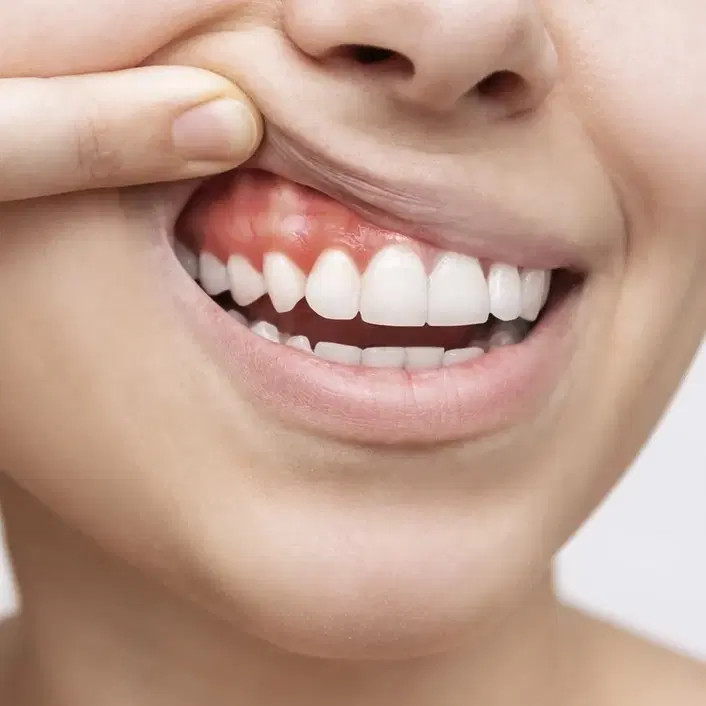
What Does Periodontology Treat?
Periodontology deals with the structures surrounding and supporting the teeth. These include the gums, periodontal ligament and jawbone immediately around the tooth roots.
The earliest form of gum inflammation is generally gingivitis. The gums may become red, swollen or prone to bleeding, but the deeper supporting bone has not necessarily been permanently damaged at this stage. If plaque-associated inflammation progresses into periodontitis, destruction can involve the attachment around the tooth and supporting bone. Untreated periodontitis can eventually contribute to tooth mobility and tooth loss.
Periodontal care also includes diseases affecting dental implants. Implants cannot develop tooth decay, but the gums and bone surrounding them can still become inflamed. This makes periodontal maintenance relevant even for patients who no longer have natural teeth in every part of the mouth.
Which Signs May Suggest Gum Disease?
Gum disease can develop gradually, and some people underestimate it because significant toothache is not always present. Bleeding during brushing is one of the most recognizable warning signs, but it is not the only one. Gum recession, changes in tooth position and mobility can suggest that supporting tissues require assessment.
Common warning signs include:
Bleeding gums, particularly when brushing or cleaning between the teeth.
Red, swollen or tender gums that repeatedly become inflamed.
Gum recession, making the teeth appear longer than they previously did.
Persistent bad breath or an unpleasant taste that does not improve with ordinary cleaning.
Spaces appearing between teeth as periodontal support changes.
Loose or moving teeth, particularly when there has been no recent injury.
Pus or recurrent swelling around the gumline, which requires professional assessment.
Changes around dental implants, such as bleeding, swelling or increasing difficulty cleaning the area.
A person does not need to have every symptom before periodontal disease is present. Some cases are discovered during routine dental examination before the patient realizes that supporting bone has been affected.
Diagnosis Looks Below the Visible Gumline
A periodontal examination involves much more than looking at whether the gums appear pink or red.
The dentist or periodontist assesses areas around each tooth to understand the relationship between the gum, tooth and supporting structures. Periodontal probing can identify deeper pockets around teeth, while bleeding during examination provides information about inflammation.
Dental imaging may also be used to evaluate supporting bone levels and identify areas where bone has been lost.
The distribution matters. Some patients have localized periodontal destruction affecting only a few teeth, while others show more generalized disease around much of the mouth. The severity, complexity and rate of progression can influence how treatment is planned.
This is one reason a photograph sent through a messaging application cannot fully replace an in-person periodontal examination.
Professional Cleaning and Periodontal Treatment Are Not Always the Same
People often use the phrase “teeth cleaning” for several different dental procedures.
Routine professional cleaning usually focuses on plaque and deposits around accessible tooth surfaces. Periodontal treatment can require cleaning considerably deeper below the gumline when deposits and bacterial biofilm are present on root surfaces inside periodontal pockets.
Scaling and root-surface instrumentation are commonly used as nonsurgical treatment for periodontitis. The aim is to remove harmful deposits and create conditions in which inflammation can reduce and the patient can maintain the area more effectively.
The mouth is then reassessed after healing. Some periodontal pockets may become shallower enough to manage through good home care and professional maintenance. Other sites may remain deep and require additional treatment.
Periodontal treatment is therefore often carried out in stages rather than as one isolated appointment.
Daily Plaque Control Determines What Happens After Treatment
A dentist can thoroughly clean the root surfaces, but plaque begins forming again afterward.
Long-term periodontal stability therefore depends heavily on what happens at home. Toothbrushing and cleaning between the teeth are central parts of periodontal treatment rather than optional extras.
Interdental brushes may be particularly useful for spaces that ordinary toothbrush bristles cannot reach effectively. The correct size depends on the space and should ideally be demonstrated individually.
This also changes the way periodontal success should be measured. Treatment is not finished simply because the gums stop bleeding for a few days. The real goal is creating an oral environment that the patient can keep clean enough to reduce the risk of disease progressing again.
Smoking Can Make Periodontal Treatment Less Predictable
Smoking has an important relationship with periodontal disease and healing.
People who smoke can experience more periodontal destruction and may respond less favourably to periodontal and regenerative treatment than nonsmokers. Smoking also matters when implants or bone-grafting procedures are being planned because healing conditions can be less favourable.
There is another difficulty: smoking can sometimes reduce visible gum bleeding, which may make inflammation appear less obvious even when disease is present.
For this reason, smoking history should be discussed honestly during periodontal assessment.
Stopping smoking can improve the conditions for treatment and long-term gum health. The decision and support plan should be individualized rather than treating smoking simply as a reason to deny dental care.
When Can Periodontal Surgery Become Necessary?
Nonsurgical periodontal treatment is usually an important first step. In many areas, reducing plaque and thoroughly cleaning the root surfaces can achieve enough improvement to avoid further intervention.
Some periodontal pockets, however, remain too deep to clean predictably even after initial therapy.
Periodontal surgery may then be considered to gain access to affected root surfaces, reshape tissues or address certain bone defects. In suitable cases, regenerative procedures may attempt to rebuild part of the supporting tissues lost through periodontal disease. Current treatment frameworks use a staged approach in which more complex surgical treatment is considered when adequate control has not been achieved through the earlier steps.
Surgery should therefore not automatically be the first treatment offered simply because periodontitis has been diagnosed.
Gum Recession Does Not Always Mean the Same Thing
Gum recession occurs when the gum margin moves away from its previous position, exposing more of the tooth or root.
It may occur in association with periodontal disease, thin gum tissues, traumatic brushing, tooth position or a combination of factors. Treatment depends on why the recession developed and whether it is continuing.
Some recession sites mainly require improved cleaning technique and monitoring. Others may be considered for soft-tissue grafting when root coverage, tissue thickness or long-term stability is a concern.
A cosmetic gum graft and treatment of active generalized periodontitis are therefore not the same thing, even though both fall within periodontal care.
The diagnosis should identify whether the main issue is inflammation, tissue anatomy or both.
Periodontal Treatment Can Be Important Before Dental Implants
Dental implant planning begins before the implant is placed.
A history of periodontitis increases the importance of achieving stable periodontal health before implant treatment and maintaining careful plaque control afterward. People who have experienced periodontal disease can also have a higher risk of developing inflammatory problems around implants.
This is why removing unstable teeth and immediately replacing them with implants does not eliminate a patient's susceptibility to inflammatory disease.
The surrounding tissues still require monitoring.
When implants are planned as part of treatment in Turkey, periodontal assessment can therefore be particularly valuable for patients with previous bone loss, gum recession or a history of tooth loss caused by gum disease.
Peri-Implant Mucositis and Peri-Implantitis Need Different Attention
Inflammation can develop around an implant in different stages.
Peri-implant mucositis affects the soft tissues surrounding an implant and is associated with inflammation without the progressive supporting bone loss that characterizes peri-implantitis. Early control of plaque and professional cleaning can often improve mucositis.
Peri-implantitis is more serious because inflammation is accompanied by loss of supporting bone around the implant. Treatment can become considerably more complex, and surgical approaches may be needed in selected cases.
An implant that feels firm can still have early disease around it. Mobility is generally a late sign rather than a useful way of deciding whether implant tissues are healthy.
Regular reviews therefore matter even when there is no pain.
What Periodontal Treatments May Be Used?
Periodontal treatment should be matched to the diagnosis rather than sold as a single standardized package. Early inflammation may require relatively straightforward professional care, whereas advanced tissue destruction can need multiple stages of therapy.
Depending on the individual case, treatment may include:
Oral-hygiene instruction and risk-factor control to reduce the plaque accumulation driving inflammation.
Professional removal of plaque and calculus above the gumline.
Deep cleaning below the gums, including instrumentation of affected root surfaces.
Reassessment after initial therapy to measure whether inflammation and periodontal-pocket depth have improved.
Periodontal surgery when persistent deep sites cannot be managed predictably through nonsurgical treatment alone.
Regenerative procedures in selected bone defects where rebuilding lost supporting tissues may be possible.
Soft-tissue grafting or other mucogingival procedures when gum recession or tissue deficiency requires surgical management.
Peri-implant treatment and maintenance when inflammation develops around dental implants.
Not everyone with periodontitis needs surgery. The response to initial treatment helps determine whether additional procedures are justified.
Saving Periodontally Affected Teeth Can Sometimes Be Possible
Severe bone loss can make a tooth look hopeless on an X-ray, but extraction is not automatically the only option in every case.
The prognosis depends on the pattern of bone loss, tooth mobility, root anatomy, ability to control infection, restorative condition and how well the patient can maintain the site.
Selected advanced defects may respond to periodontal regeneration, and recent long-term evidence has continued to examine whether some severely compromised teeth can be maintained successfully when regenerative treatment is appropriate.
This does not mean every loose tooth can or should be saved.
The important point is that extraction should follow an individual prognosis rather than an assumption that replacing a difficult tooth with an implant is automatically simpler or more predictable.
Periodontal Maintenance Continues After Active Treatment
Periodontitis is generally managed rather than treated once and then forgotten.
After active therapy, patients usually enter a maintenance phase in which the gums, plaque levels and periodontal pockets are reviewed at intervals based on individual risk. Effective home cleaning is reinforced and areas that remain difficult to maintain receive professional attention.
The frequency should not be identical for everyone.
A patient with a history of advanced generalized disease, smoking and several implants may require closer monitoring than someone who had a limited periodontal problem that is now stable.
This becomes especially important for dental tourists. Returning home after treatment does not remove the need for periodontal maintenance.
A local dental professional should be able to continue monitoring the tissues once the patient is no longer in Turkey.
Periodontology Cost in Turkey Depends on Disease Severity
There is no single meaningful periodontology cost in Turkey because periodontal treatment can range from a relatively simple nonsurgical procedure to complex regenerative or implant-related surgery.
The number of affected teeth, depth of periodontal pockets, amount of supporting bone loss, need for surgical access and whether grafting materials are required can all influence the treatment plan.
A quotation should therefore explain the individual procedures being proposed rather than using a single phrase such as “gum treatment.”
International patients should also clarify whether the quoted amount includes reassessment after initial therapy. Without reassessment, it is difficult to know whether nonsurgical treatment has achieved sufficient improvement or whether further treatment is genuinely necessary.
Price comparisons make more sense after the diagnosis and treatment stages are clear.
What International Patients Should Clarify Before Treatment
Patients considering periodontology in Turkey should pay particular attention to continuity of care because periodontal therapy may require several stages and long-term maintenance. Current rules require healthcare providers operating within international health tourism to hold the relevant authorization, and current provider lists can be checked before treatment.
The treatment plan should explain the diagnosis, the teeth or implants affected and whether disease is localized or generalized. Patients should know which treatment is expected during the first visit and when periodontal reassessment should occur.
It is equally useful to request copies of periodontal measurements, radiographs and treatment records. These documents can help another dental professional continue maintenance after the patient returns home.
A very short dental trip may be enough for one stage of treatment, but it should not force several biologically separate stages into an unrealistic timetable.
Healthy Gums Create a Better Foundation for Cosmetic Dentistry
Periodontal health has a direct effect on aesthetic dental results.
If the gums are swollen, bleeding or changing position, placing final veneers or crowns before controlling inflammation can make the eventual gumline difficult to predict.
After periodontal treatment, tissue appearance can change as inflammation resolves. This may affect where restoration margins should be positioned and how teeth appear in the smile.
Patients considering extensive crowns, veneers or implant restorations in Turkey may therefore benefit from completing necessary periodontal stabilization before the final cosmetic work.
Healthy gums are not simply an aesthetic frame around new restorations. They are part of the biological foundation supporting them.
Periodontology Is About Keeping Teeth Stable Over Time
Periodontology in Turkey can involve everything from controlling early gum inflammation to managing advanced bone loss, gum recession and inflammatory disease around dental implants.
The central aim is not merely to stop gums from bleeding. Periodontal treatment seeks to control the disease process, preserve supporting tissues where possible and create an oral environment that can be maintained over the long term. Structured treatment generally begins with plaque control and nonsurgical therapy, with more advanced procedures reserved for sites that require additional intervention.
For international patients, this long-term perspective is particularly important. A periodontal procedure completed during a dental trip is only one part of care. Home cleaning, smoking control where relevant, professional maintenance and continued monitoring remain essential after returning home.
Periodontal health also deserves attention before implants and extensive cosmetic dental work. Treating inflammation first creates a more stable foundation for restorations and can help determine which natural teeth are genuinely maintainable.
The most useful periodontal treatment in Turkey is therefore not necessarily the most extensive procedure. It is the treatment that accurately identifies the disease, controls its causes, preserves healthy tissue wherever possible and includes a realistic plan for maintaining the result years after the initial dental visit.
Note: This article is intended for general information and does not replace an individual periodontal examination. Diagnosis, treatment choice, surgical need, implant-related care and maintenance intervals should be determined after clinical assessment and, when appropriate, dental imaging.