
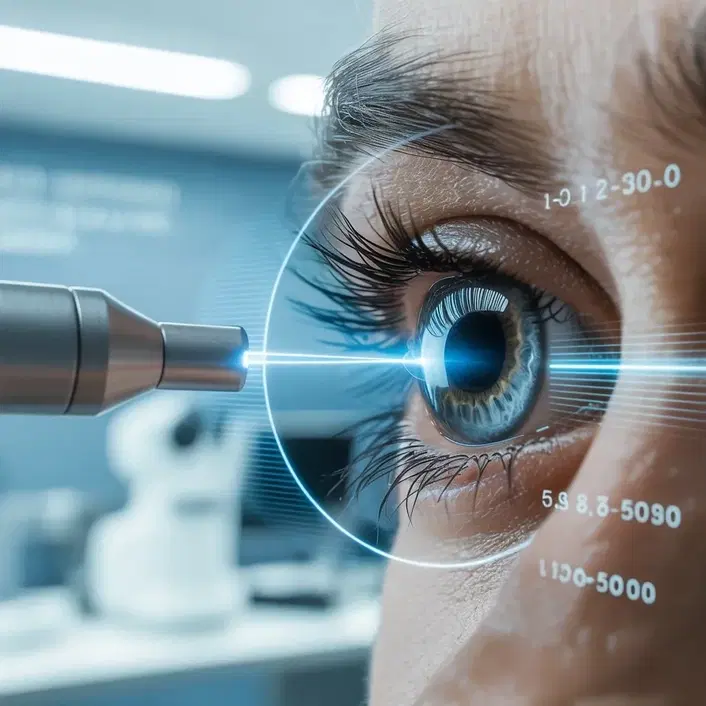
SMILE Reshapes the Cornea Without Creating a LASIK Flap
The most recognizable difference between SMILE and LASIK is the way the surgeon reaches the corneal tissue that needs to be reshaped.
LASIK involves creating a corneal flap, lifting it and then using laser treatment beneath it. SMILE takes another route. A femtosecond laser forms a small lenticule inside the corneal stroma along with a narrow access incision. The surgeon separates and removes the lenticule through that incision. No broad corneal flap is created.
Removing the lenticule changes the curvature of the cornea and therefore changes its focusing power.
This flap-free approach is one reason SMILE is sometimes considered by people who are active in sports or who prefer to avoid flap-related considerations. It does not, however, make the operation non-invasive. Corneal tissue is permanently altered, and the same careful preoperative screening expected for other refractive procedures remains necessary.
Myopia Is the Main Refractive Problem Treated With SMILE
SMILE has been developed primarily for the correction of myopia, with treatment of myopic astigmatism also available within appropriate parameters. The exact prescription range that can be treated depends on the laser platform, local approval, corneal measurements and the surgeon's assessment rather than one universal number that applies to every patient.
A person with a prescription technically falling within a device range can still be unsuitable for surgery if their cornea is too thin, irregular or showing suspicious topographic changes.
The opposite is also true. Someone should not assume they are unsuitable simply because their prescription seems high. Refractive power is only one part of the evaluation.
The decision is made by combining prescription measurements with corneal mapping, thickness measurements, ocular-surface evaluation and a complete eye examination.
Who May Be Suitable for SMILE Laser Surgery?
A good SMILE candidate usually has a stable refractive error and corneal measurements that allow the required correction to be performed safely. Screening is especially important because certain corneal abnormalities can increase the risk of postoperative instability. Severe dry eye, active inflammation and several uncontrolled medical or eye conditions may also make the procedure inappropriate.
Factors commonly assessed include:
A stable glasses or contact-lens prescription, rather than myopia that is still progressing noticeably.
Suitable corneal thickness and shape, confirmed through detailed corneal measurements.
No evidence of keratoconus or another corneal ectatic disorder that makes corneal refractive surgery unsafe.
A refractive error that can reasonably be treated with the available SMILE platform.
An ocular surface healthy enough for surgery, without severe uncontrolled dry eye.
No active eye infection or significant inflammation at the time of treatment.
Realistic expectations about the result, including the possibility that some glasses may still be useful in certain situations.
General and eye health compatible with elective refractive surgery, based on an individual medical assessment.
Passing an online eligibility questionnaire or sending a glasses prescription to a clinic does not confirm suitability. Corneal imaging needs to be performed before the final surgical decision.
Corneal Mapping Is One of the Most Important Parts of Planning
A person's cornea may look completely clear during everyday life while still having shape characteristics that make laser refractive surgery unsuitable.
This is why corneal topography or tomography is important before treatment. These examinations map the curvature and structural characteristics of the cornea and can help identify abnormal patterns, including signs associated with keratoconus or other ectatic disorders. Abnormal corneal topography and unstable corneal conditions are recognized reasons not to proceed with SMILE.
Corneal thickness is also measured. The planned correction removes a specific amount of stromal tissue, so sufficient structural tissue needs to remain after surgery.
Choosing a clinic should therefore involve more than asking what laser machine is available. The quality of preoperative screening is at least as important as the laser itself.
SMILE and LASIK Can Both Produce Strong Visual Outcomes
SMILE is sometimes advertised as the newer procedure and therefore automatically superior to LASIK. Current evidence does not support such a simple conclusion.
Comparative studies generally show that both SMILE and modern femtosecond LASIK can provide effective and safe correction of myopia and myopic astigmatism in appropriately selected patients. Some analyses have found small differences in predictability or astigmatism correction, but the overall visual results are broadly comparable.
This means procedure selection should depend on individual anatomy and visual goals rather than a belief that one method is always best.
LASIK may have advantages in certain customized treatments or enhancement strategies. SMILE offers the benefit of avoiding a corneal flap. PRK remains another useful option for selected eyes.
A good refractive consultation should be willing to explain why one method fits the individual eye better than the alternatives.
Dry Eye Can Still Occur After SMILE
One widely discussed potential advantage of SMILE is its effect on the ocular surface.
Because the procedure uses a smaller corneal incision and does not create a broad flap, fewer anterior corneal nerves may be disrupted compared with LASIK. Several comparative analyses have found better early tear-film measures or fewer dry-eye effects after SMILE than after femtosecond LASIK.
That does not mean SMILE cannot cause dry eye.
Dry-eye symptoms can still appear after corneal refractive surgery, and people who already have ocular-surface problems deserve careful evaluation before the operation. A 2024 review confirmed that dry eye remains an important issue across refractive procedures.
Someone who already experiences burning, gritty sensation, fluctuating vision or significant contact-lens intolerance should mention these symptoms during the preoperative examination.
The Procedure Itself Is Usually Short
On the day of surgery, numbing eye drops are generally used. The eye is positioned under the laser and connected to the treatment interface so that the femtosecond laser can create the planned lenticule and small access opening inside the cornea. The surgeon then separates the tissue planes and removes the lenticule through the incision.
The laser portion is brief, although the complete appointment naturally takes longer because of preparation and postoperative checks.
Patients need to remain still and follow fixation instructions during the procedure. Temporary pressure or changes in what is seen during laser treatment can occur.
SMILE is technically demanding despite the small incision. Specific intraoperative problems can include loss of suction or difficulty separating and extracting the lenticule.
The surgeon's experience with the technique therefore matters.
Vision Often Improves Quickly but May Not Be Sharp Immediately
Many patients notice useful vision soon after SMILE, but the first hours and days can involve blur, haziness or visual fluctuation.
Early visual recovery can sometimes be slightly slower than after LASIK even when the eventual visual outcome is similar.
The cornea continues adjusting after surgery. Small refractive changes can occur as healing progresses, which is why an immediate postoperative vision test should not be treated as the final result.
Patients should also expect follow-up examinations. These visits allow the eye-care team to check healing, visual acuity and the condition of the cornea.
The exact schedule depends on the surgeon and individual recovery.
Halos and Night-Vision Changes Are Possible
Refractive surgery changes the optical system of the eye, so the quality of vision matters in addition to the number of lines read on an eye chart.
Some patients can experience glare, halos, starbursts, fluctuating clarity or reduced comfort in low-light conditions during recovery. Optical-aberration studies show that both SMILE and LASIK can influence higher-order aberrations, although the pattern of change is not identical between the procedures.
These symptoms can improve as healing progresses, but no refractive procedure can promise perfect night vision for every patient.
People whose occupation depends heavily on nighttime visual performance should discuss this specifically before surgery.
Not Needing Glasses Forever Cannot Be Guaranteed
SMILE permanently changes corneal shape, but the eye itself continues to age.
A small amount of refractive regression can occur over time, particularly after larger corrections. Long-term studies extending to seven and ten years have generally found stable and effective results while also documenting some degree of refractive change in certain patients.
Later in adulthood, presbyopia can also create difficulty focusing on near objects even if distance myopia was successfully corrected years earlier.
SMILE therefore reduces dependence on glasses for an appropriate refractive error; it does not make the eye permanently immune to every future need for optical correction.
That distinction is important for setting realistic expectations.
Enhancement After SMILE Needs Separate Planning
A small residual prescription can remain after any laser eye surgery. Occasionally, refractive change can also develop later.
Enhancement after SMILE is possible, but the approach is not always as straightforward as simply repeating the original procedure. Depending on the eye and previous treatment, an enhancement may involve a surface-based laser procedure or another refractive strategy. Reviews of SMILE note enhancement options as one of the areas that differs from conventional LASIK.
Patients should therefore ask about the clinic's policy for residual refractive error before treatment rather than assuming that a second SMILE procedure will automatically be performed.
Serious Complications Are Uncommon but Possible
SMILE has a strong overall safety record in appropriately selected patients, including favourable long-term results reported over a decade of follow-up.
That does not make it risk-free.
Potential complications include inflammation within the corneal interface, infection, irregular refractive outcomes, residual prescription, visual-quality symptoms and problems related to lenticule dissection or incomplete removal. Rare cases of postoperative corneal ectasia have also been reported, reinforcing the importance of screening for abnormal or structurally vulnerable corneas before surgery.
Unexpected worsening of pain, increasing redness, discharge or a sudden reduction in vision after surgery requires prompt ophthalmic assessment rather than waiting for a scheduled routine check.
Returning to Normal Activities Should Follow the Eye Examination
Because SMILE does not create a LASIK-style flap, many everyday activities can be resumed relatively quickly. That does not mean the eye should be treated normally immediately after surgery.
Patients should avoid rubbing their eyes and should use prescribed eye drops exactly as directed. Swimming, strenuous exercise, makeup around the eyes and other activities may be restricted temporarily according to the surgeon's postoperative protocol.
These recommendations can vary, so generic schedules found online should not replace individual instructions.
For international patients, the return flight should also be planned around postoperative review. The patient should know when the first check will occur and whether an additional examination is recommended before leaving Turkey.
What Should You Check Before SMILE Laser in Turkey?
International refractive surgery requires more than confirming that a clinic offers a particular laser platform. Current regulations require healthcare providers operating within international health tourism to hold the appropriate authorization, and authorized-provider lists are publicly maintained.
Before booking SMILE Laser in Turkey, it is useful to clarify:
Who will perform the complete preoperative eye examination and who makes the final decision about surgical suitability.
Whether detailed corneal mapping and thickness measurements are included before treatment is approved.
Why SMILE is being recommended over LASIK, PRK or another option for your specific eyes.
Who will personally perform the surgery and what experience that surgeon has with lenticule-extraction procedures.
Whether the healthcare provider currently holds the relevant authorization for international health-tourism treatment.
What happens if a residual prescription remains, including the clinic's enhancement policy.
How long you should remain in Turkey for postoperative checks before travelling home.
Who will assess urgent symptoms after you return to your country, and which records will be provided for local follow-up.
A modern laser platform is useful, but careful screening and postoperative access remain more important than the equipment name alone.
SMILE Laser Cost in Turkey Depends on the Medical Plan
There is no single universal SMILE Laser cost in Turkey.
Price can vary according to whether one or both eyes are treated, the examinations included, the surgical facility, the technology used and the postoperative follow-up package.
When comparing quotations, patients should confirm whether corneal mapping, medical examination, medications and follow-up appointments are included rather than looking only at the advertised surgery price.
It is also worth being cautious when a clinic confirms eligibility and guarantees a result before performing detailed corneal measurements.
The appropriate treatment cannot be determined reliably from a glasses prescription alone.
SMILE Works Best When the Right Eye Is Selected for the Right Procedure
SMILE Laser in Turkey can provide effective correction of myopia and myopic astigmatism for appropriately selected patients. The procedure reshapes the cornea by creating and removing a small internal lenticule through a narrow incision, avoiding the large corneal flap associated with LASIK.
Comparative research shows that SMILE and modern LASIK both provide strong visual outcomes when used in suitable eyes. SMILE may have advantages regarding early ocular-surface recovery and avoids flap-related issues, while other procedures may offer advantages in different clinical situations.
The most important part of treatment is therefore not proving that SMILE is “better” than every other laser operation. It is determining whether the patient's prescription, corneal structure and eye health make SMILE the appropriate choice.
For international patients considering laser eye surgery in Turkey, that decision should include detailed preoperative screening, current provider authorization, a clear postoperative schedule and access to ophthalmic care after returning home.
A successful outcome should mean more than reading an eye chart without glasses the next morning. It should combine accurate refractive correction with a healthy, structurally suitable cornea and a realistic understanding that future eye changes can still occur.
Note: This article is intended for general information and does not replace an individual ophthalmic examination. Suitability for SMILE, refractive range, corneal safety, alternative procedures and postoperative care should be determined after a complete eye examination and corneal assessment.