
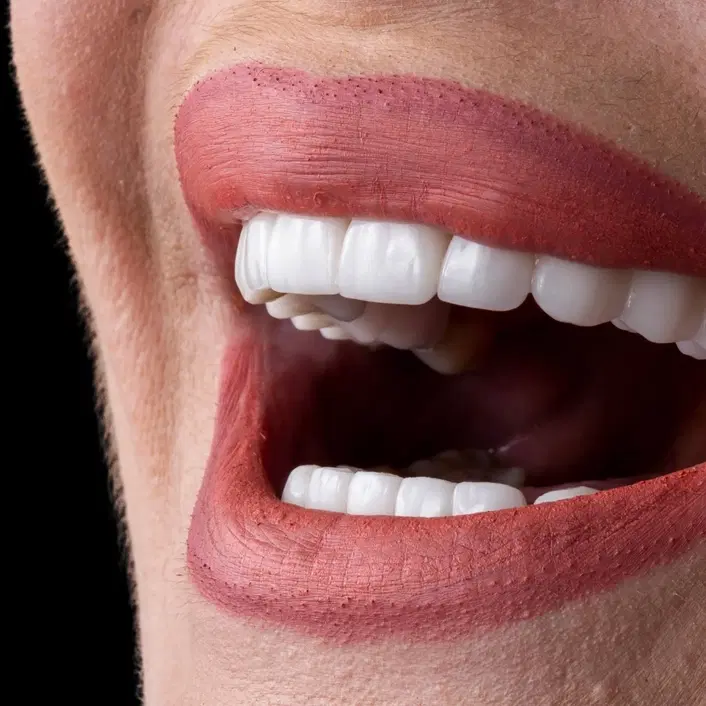
A Hollywood Smile Is a Treatment Plan, Not a Standard Package
There is no universal set of ten, sixteen or twenty teeth that must be treated to create a Hollywood Smile.
One patient may have healthy, well-shaped teeth and only need whitening and minor bonding. Another may have several chipped or heavily restored teeth that are better suited to ceramic restorations. Someone else may require orthodontic correction before cosmetic work because the main problem is tooth position rather than colour.
Veneers are thin custom-made restorations designed primarily to cover the front surface of a tooth, while crowns surround much more of the tooth structure. That difference matters because full crowns usually require substantially more preparation than veneers.
Treating every cosmetic concern with the same restoration can therefore result in unnecessary removal of healthy tooth tissue.
Who May Be Suitable for a Hollywood Smile?
A smile makeover may be appropriate for adults who want to improve visible dental concerns and have realistic expectations about what cosmetic dentistry can achieve. Before treatment, active decay, gum disease and other oral-health problems should be identified because covering unhealthy teeth does not solve the underlying disease and may make future treatment more complicated.
A Hollywood Smile may be considered when the assessment identifies concerns such as:
Persistent tooth discoloration that cannot be corrected sufficiently with whitening alone.
Chipped, worn or irregularly shaped teeth that affect smile symmetry.
Small spaces between teeth that may be suitable for conservative cosmetic correction.
Existing restorations that no longer match the surrounding teeth in shape or colour.
Uneven tooth proportions that make some teeth appear unusually short, narrow or dominant.
Minor alignment concerns where restorative treatment is genuinely appropriate rather than replacing needed orthodontic treatment.
Missing teeth that require a separate restorative plan before the smile can be completed.
Healthy gums and a manageable bite, or a willingness to complete necessary treatment before cosmetic restorations are fitted.
The best candidate is not simply someone who wants whiter teeth. Suitability depends on whether the proposed improvement can be achieved without sacrificing more healthy tooth structure than necessary.
Veneers and Crowns Should Not Be Confused
The difference between veneers and crowns is especially important when comparing Hollywood Smile packages in Turkey.
A porcelain veneer covers mainly the visible front surface of the tooth. Placement commonly requires removal of a small amount of enamel from the front and sides, although the amount varies according to tooth position and the intended design. Veneer treatment is generally considered irreversible once enamel has been removed.
A crown covers the tooth much more extensively and is often used when a tooth is structurally weakened, heavily restored, fractured or otherwise requires full coverage.
This means a crown may be an excellent restoration for a damaged tooth but an unnecessarily aggressive choice for a healthy tooth that needs only a subtle cosmetic change.
The treatment plan should explain why each tooth needs the restoration being recommended rather than treating an entire smile according to one package formula.
Preserving Enamel Can Affect Veneer Longevity
Conservative preparation is not only about keeping more of the natural tooth. It can also influence how predictably ceramic veneers remain bonded.
Recent clinical evidence has found particularly strong survival when ceramic veneers are bonded predominantly to enamel. Outcomes become less favourable as greater amounts of dentin are exposed, reinforcing the value of preserving enamel when the anatomy allows it.
Another recent review similarly reported high long-term survival for dental veneers overall and identified preservation of enamel as an important factor in successful outcomes.
This is one reason extremely aggressive tooth reduction should not be treated as a normal requirement for every smile makeover.
A beautiful result on the day the restorations are fitted is only one part of success. How much healthy tooth remains underneath also matters.
Tooth Colour Should Match the Face, Not a Shade Chart Trend
A Hollywood Smile is often associated with very bright white teeth, but the lightest available shade is not automatically the most natural choice.
Skin tone, lip colour, age, facial proportions and the amount of tooth visible during smiling all influence how a shade appears. A colour that looks balanced on one person can appear unusually opaque or artificial on another.
Natural-looking ceramic restorations also depend on more than shade. Translucency, surface texture, tooth length and the transition near the gums all influence the appearance.
Patients who prefer an intentionally bright smile can certainly discuss that goal. The important point is that the choice should be deliberate rather than based on the assumption that a Hollywood Smile has to be one specific colour.
Whitening Natural Teeth Before Ceramic Work Can Make Sense
If only some visible teeth will receive veneers or crowns, the colour of the untreated teeth needs to be considered before the final ceramic shade is selected.
Whitening changes the colour of natural teeth but does not whiten existing veneers, crowns or fillings. Once ceramic restorations have been manufactured, later bleaching will not make them lighter in the same way as natural enamel.
For this reason, patients who want both whitening and ceramic restorations may benefit from discussing the sequence before final shade selection.
This small planning detail can prevent a situation where the natural teeth are whitened later and become noticeably lighter than the new restorations.
Gum Health Shapes the Smile as Much as Ceramic Does
When people imagine a smile makeover, they tend to focus on the teeth. The gums form the frame around those teeth and can change the appearance just as strongly.
Redness, swelling, bleeding or uneven gum levels can make even well-designed restorations look less natural. Active gum disease should therefore be treated before veneers are bonded or crowns are completed. Cosmetic restorations placed over unhealthy teeth and gums can worsen existing problems rather than hide them.
In selected cases, gum contouring may form part of a smile-design plan when tooth proportions or gum levels genuinely require adjustment.
The aim should not be to create identical gum heights at any cost. Natural symmetry and healthy tissue remain more important than making every tooth follow an artificial template.
Bite Design Is Easy to Ignore Until Something Feels Wrong
A smile has to function when the mouth is closed, not only look good in photographs.
Veneers and crowns interact with the opposing teeth during chewing and jaw movement. If a restoration is too high or the bite has not been planned correctly, the patient may experience discomfort or excessive stress on the ceramic.
People who clench or grind their teeth require additional consideration. Severe grinding or a deep bite can make veneers less suitable in some situations and may increase the risk of chipping, loosening or wear.
This makes the bite examination an important part of cosmetic dentistry. Designing attractive front teeth without understanding how they contact the lower teeth can create avoidable problems.
Temporary Teeth Can Be Useful Before the Final Smile
When several crowns or veneers are being prepared, temporary restorations may be used while the definitive ceramics are manufactured.
These temporary teeth are not simply placeholders. They can give the patient an opportunity to experience the approximate length, shape and overall appearance of the planned smile.
Speech, lip support and tooth proportions may feel different after a major cosmetic change. Temporary restorations provide a useful stage for identifying obvious concerns before the definitive work is completed.
However, a short international treatment schedule should still allow enough time for necessary adjustments. Finishing quickly has little value if the patient leaves with a bite or shape that already feels wrong.
Hollywood Smile Results Are Not Maintenance-Free
Ceramic veneers and crowns do not develop decay themselves, but the natural teeth supporting them can still experience dental problems.
Veneers can chip, crack, loosen or eventually need replacement. Decay may also develop around or beneath restorations if plaque is not controlled. Daily brushing and cleaning between the teeth remain necessary after cosmetic treatment.
Patients should also avoid using restored front teeth as tools for opening packages or repeatedly biting very hard objects.
A protective night guard may be discussed when grinding or clenching creates additional risk.
A Hollywood Smile should therefore be treated like high-quality dental work that requires maintenance, not like a permanent cosmetic coating that eliminates the need for future dental care.
How Long Can Veneers Last?
There is no fixed expiration date for veneers.
Recent research has reported high long-term survival for several ceramic veneer types, with some pooled results exceeding 90% beyond ten years. Fracture, debonding and colour-related concerns remain among the reasons restorations eventually require clinical attention.
These statistics describe groups of patients, not a guaranteed lifespan for one person's smile.
A veneer placed mostly on healthy enamel in a patient with good oral hygiene and a manageable bite has a different risk profile from a veneer placed on a heavily prepared tooth in someone who grinds strongly every night.
Claims that veneers or crowns will definitely last for life should therefore be treated cautiously.
A Perfectly Straight Smile Does Not Always Require Crowns
Crowns and veneers can change the visible shape of mildly misaligned teeth, but they do not physically move the roots into better positions.
When crowding, rotation or bite problems are significant, orthodontic treatment may offer a more conservative approach because it moves the natural teeth rather than disguising their position through extensive preparation.
Sometimes orthodontics can be followed by whitening or minimal bonding to complete the cosmetic result.
This may take longer than preparing multiple crowns, but treatment speed should not be the only consideration when healthy natural teeth are involved.
A good smile consultation should present realistic alternatives rather than assuming the shortest cosmetic route is automatically the best one.
What Should You Check Before Choosing a Hollywood Smile in Turkey?
International dental treatment requires clear information before natural teeth are altered. Turkey maintains current authorization records for healthcare providers treating international health-tourism patients, with the latest provider records currently dated July 28, 2026.
Before booking a Hollywood Smile in Turkey, it is useful to clarify:
Which teeth actually need treatment and why each one has been included in the plan.
Whether veneers, crowns, bonding or whitening are being proposed, rather than accepting “Hollywood Smile” as the entire treatment description.
How much natural tooth structure will be removed from each tooth receiving a restoration.
Which ceramic material will be used and why it suits the position and condition of those teeth.
Whether gum health, decay and the bite will be assessed before cosmetic preparation begins.
Whether temporary restorations and adjustment appointments are included before the final smile is fitted.
What happens if a veneer chips, a crown feels high or another problem develops after returning home.
Whether the healthcare provider currently holds the appropriate authorization for treating international health-tourism patients.
A hotel transfer or fast laboratory turnaround can make the trip more convenient, but neither replaces careful dental diagnosis.
Hollywood Smile Cost in Turkey Depends on What Is Actually Being Done
There is no meaningful single Hollywood Smile cost in Turkey because the phrase can describe very different treatments.
One patient may receive eight porcelain veneers. Another may have whitening, bonding and only two ceramic restorations. A more complex patient might require gum treatment, replacement of old crowns or treatment of missing teeth before aesthetic work can begin.
The number of teeth, ceramic type, laboratory process, need for temporary restorations and additional dental treatment all influence the total cost.
This is why price comparisons should be made from written treatment plans rather than marketing headlines.
A package involving twenty crowns cannot be compared directly with a conservative veneer plan simply because both are advertised as a Hollywood Smile.
A Natural Smile Has Small Imperfections
Digital smile design can make symmetry easier to plan, but absolute uniformity is not always aesthetically desirable.
Natural front teeth have subtle variations in shape, translucency, surface texture and position. Making every tooth exactly the same length and completely opaque can create a result that looks more like a dental restoration than a natural smile.
The lips also move differently from person to person. Some people show a large amount of tooth when smiling, while others expose relatively little.
Good cosmetic planning works within those individual features.
The objective should be a cleaner, more balanced and confident smile without removing every trace of natural character.
The Best Hollywood Smile Preserves What Does Not Need Fixing
Hollywood Smile in Turkey can combine modern cosmetic and restorative dentistry to address colour, shape, symmetry and visible dental damage. What it should not become is an automatic reason to crown every healthy tooth.
Veneers can provide long-lasting aesthetic results, particularly when enamel can be preserved, while crowns have an important role when teeth genuinely require more extensive coverage.
Whitening, bonding and orthodontic treatment may also achieve some cosmetic goals with less alteration of natural tooth structure. Whitening should be coordinated carefully because ceramic veneers and crowns do not bleach once they have been made.
For international patients, treatment planning should also continue beyond the flight home. Patients should understand which teeth have been treated, which materials were used and who will manage future adjustments or complications. Current healthcare-provider authorization can also be checked before booking treatment in Turkey.
A successful Hollywood Smile is therefore not simply the brightest or most perfectly uniform row of teeth. It is a smile that suits the face, works comfortably in the bite, can be cleaned properly and preserves healthy natural tissue wherever possible.
That combination matters far more in the long term than how quickly a dramatic before-and-after photograph can be produced.
Note: This article is intended for general information and does not replace an individual dental examination. Suitability for veneers, crowns, whitening, orthodontic treatment or other smile-design procedures should be determined after clinical assessment of the teeth, gums and bite.