
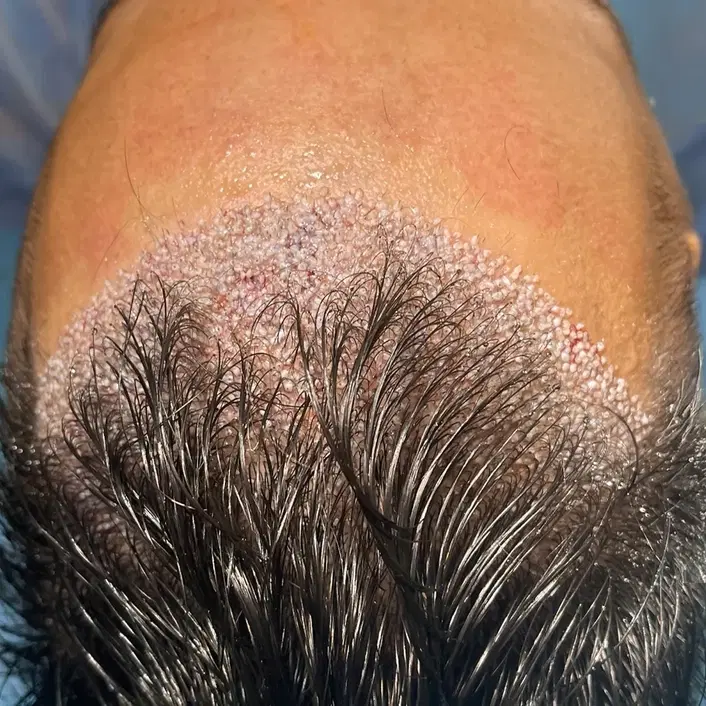
What Does an Unshaven Hair Transplant Actually Mean?
In conventional FUE, the donor region is usually shaved short so individual follicular units can be clearly identified and removed with small punches. Each follicular unit is harvested separately before being transferred to areas affected by hair loss.
Unshaven FUE modifies this process by preserving more of the existing hair.
One technique involves trimming only the follicular units selected for harvesting while leaving surrounding donor hair long. These shortened hairs can then be hidden by neighbouring strands. Another technique allows long hair shafts to remain attached to the extracted grafts. This is often referred to as long-hair FUE.
Long-hair transplantation can offer an immediate visual preview because the transplanted shafts remain visible directly after implantation. However, that early appearance is not the final result because transplanted hair shafts can later shed before new growth develops.
The appropriate technique depends on hair length, donor density, graft requirements and the experience of the medical team.
Why Do Some Patients Prefer the No-Shave Approach?
The biggest attraction is discretion.
A fully shaved donor area makes it relatively obvious that something has been done to the scalp, particularly during the first several days after surgery. Keeping surrounding hair long can make extraction sites easier to conceal and may allow some patients to return to their usual routine with less visible change.
This can be particularly useful for people with professional roles where they do not want to explain a sudden shaved haircut. It may also appeal to women and men who have spent years growing their hair and do not want to lose that length simply to undergo a transplant.
Long existing hair can also help the surgical team observe natural hair direction and curvature during planning. In selected long-hair FUE methods, maintaining the hair shaft can provide additional visual information during extraction and implantation.
The cosmetic convenience, however, comes with technical trade-offs.
Who May Be Suitable for an Unshaven Hair Transplant?
An unshaven procedure is not automatically the best option for every person who dislikes shaving. The amount of hair loss, number of grafts required, donor density and hairstyle all influence whether the technique is practical. Smaller restoration areas can sometimes be easier to manage without extensive shaving than very large sessions.
A consultation generally considers factors such as:
A sufficiently strong donor area with enough stable follicles for the proposed treatment.
Existing hair long enough to conceal donor harvesting, when concealment is one of the goals.
A realistic graft requirement, since very large sessions can become more complex without shaving.
A clear diagnosis of hair loss rather than unexplained or rapidly changing shedding.
Realistic expectations about density, particularly when the recipient area is extensive.
Healthy donor and recipient skin without uncontrolled inflammation or infection.
A willingness to accept a potentially longer procedure, since working around existing hair can require additional time.
Understanding that no-shave does not mean no surgery, no healing period or no visible postoperative signs.
Individual follicular harvesting remains a surgical technique even when the surrounding hair is preserved. Small extraction sites are still created in the donor area.
Partial-Shave and Fully Unshaven Procedures Are Not the Same
A patient may receive several different answers when asking clinics for a “no-shave transplant.”
In a partial-shave approach, a narrow section of donor hair can be shortened while the hair above it remains long. When the longer strands fall back into position, they may conceal the trimmed area.
This can be a practical compromise because the medical team gains easier access to follicles without requiring the patient to shave the entire scalp.
A fully unshaven technique goes further. Individual target follicles may be selected without broadly shaving the donor zone. Some are trimmed individually before extraction, while advanced long-hair methods attempt to extract follicular units with the hair shafts preserved.
The second approach is usually more technically demanding. It should not be assumed that “completely unshaven” is automatically superior to partial shaving. The more appropriate technique is the one that provides safe harvesting while matching the patient's cosmetic priorities.
Keeping Hair Long Makes Extraction More Complex
Shaving offers the surgeon a clear view of the direction, spacing and emergence angle of donor follicles. When long hairs remain around the extraction area, visibility becomes more limited.
The punch still has to follow the follicle accurately beneath the skin. If the angle is misjudged, the follicular structure can be damaged during extraction. This is known as transection.
Unshaven FUE has therefore been described as technically demanding, with the potential for increased transection when the technique is not performed carefully.
Long surrounding hair can also become involved in the working field, which may slow follicle selection and extraction.
This does not mean unshaven transplantation is inherently unsafe. It means the technique demands appropriate case selection and experience rather than simply being a cosmetic upgrade added to standard FUE.
Donor Preservation Still Matters More Than Concealment
The advantage of hiding extraction points should never encourage overly aggressive harvesting.
Every follicular unit removed from the donor region represents part of a limited supply. Although the surrounding hair may conceal extraction sites immediately after an unshaven procedure, excessive removal can eventually create permanent density loss.
The donor area should therefore be evaluated according to density, hair calibre, distribution and future hair-loss expectations.
Someone in their twenties who is beginning to lose frontal hair may require more transplantation later in life. Using an unnecessarily large percentage of donor follicles in the first operation can make future restoration difficult.
The most successful no-shave procedure is not necessarily the one where nobody can see the donor area on day three. It is one where the donor still looks balanced years later.
Recipient Hair May Also Be Left Long
Unshaven transplantation can refer to the recipient area as well as the donor region.
If a patient has thinning rather than complete baldness, transplantation may sometimes be performed between existing hairs without shaving them. This can make the immediate postoperative appearance easier to disguise.
Working between native hairs, however, requires careful recipient-site placement. Existing follicles need to be respected when creating openings and implanting grafts.
This is particularly important in areas where the native hair is still reasonably dense. Increasing density does not simply mean putting the highest possible number of grafts into every available space.
The medical team needs to consider blood supply, existing follicle location, direction and realistic spacing.
Hairline Design Should Not Be Compromised for Secrecy
One potential mistake is focusing so heavily on making the transplant invisible that long-term hairline design becomes secondary.
The hairline will remain long after the early postoperative period has passed.
Its height should suit the face, age and expected future hair-loss pattern. A natural frontal border normally includes small irregularities rather than resembling a perfectly drawn line.
Single-hair grafts are particularly useful around the leading edge, while follicular units with more hairs can contribute to visual density farther behind.
Direction is equally important. Hair that grows too vertically can make even a densely transplanted hairline appear artificial.
Whether the transplant is shaved, partially shaved or completely unshaven does not change these basic design principles.
What Happens During the Procedure?
The day normally begins by reviewing the treatment plan and marking the hairline or thinning areas. The donor region is examined again and local anesthesia is generally used.
During an FUE-based unshaven procedure, follicular units are selected and individually separated using small punches. Standard FUE punches are generally small, often around 0.7 to 1.2 mm, although the instrument selected depends on the individual procedure.
In pretrimmed unshaven techniques, selected donor hairs are individually shortened before extraction while surrounding hairs stay long. In long-hair FUE, the procedure attempts to preserve the length of harvested shafts.
Grafts are then prepared and transferred to the recipient region according to the planned hairline, direction and density.
Because long hair can make harvesting and implantation more complicated, the procedure may require more time than an equivalent shaved case.
The First Days Are Easier to Hide, Not Invisible
One of the biggest misconceptions about unshaven hair transplant recovery is that nobody will be able to tell a procedure has taken place immediately afterwards.
Keeping the hair long can certainly conceal much of the donor region. However, the recipient area can still show small crusts, redness or swelling. The donor scalp may also be tender and contain visible extraction points if the hair is moved aside.
Early FUE-related complaints can include mild pain, swelling and temporary changes in sensation.
Existing long hair may allow a person to style around these signs more easily, but it does not eliminate wound healing.
Patients should also resist the temptation to style aggressively during the first days. Newly implanted follicles need to be treated according to the postoperative instructions provided by the medical team.
Transplanted Long Hair Can Still Shed
Long-hair FUE can create an impressive immediate appearance because transplanted shafts show roughly where new hair will eventually grow.
That appearance should be viewed as a preview, not a finished result.
The visible shafts can shed during the normal post-transplant cycle. New hair later develops from surviving follicles below the scalp.
This can feel particularly dramatic after an unshaven long-hair transplant because the difference between the immediate postoperative appearance and the shedding stage is more obvious.
Final density therefore needs to be judged over months rather than weeks.
A clinic that focuses heavily on photographs taken immediately after long-hair implantation should also be able to show mature results under consistent lighting and styling conditions.
What Are the Possible Disadvantages of Unshaven FUE?
Preserving the hairstyle is appealing, but the method has limitations. Understanding these before treatment can help prevent the assumption that unshaven FUE is simply standard FUE without a haircut.
Potential drawbacks include:
Longer procedure time, particularly when follicles are individually trimmed or extracted among long surrounding hairs.
Greater technical difficulty because follicle direction can be harder to follow during harvesting.
Potentially higher transection risk if the technique is not performed accurately.
Limits on very large sessions, depending on donor characteristics and the chosen no-shave technique.
Higher treatment cost in some clinics because of the additional time and technical work involved.
Postoperative crusting and redness still occur, even if surrounding hair makes them easier to conceal.
Long hair can complicate early washing and scalp care, so postoperative instructions need to be followed carefully.
Not every patient is a suitable candidate, particularly when extensive restoration requires broad donor access.
The technique should therefore be chosen because it fits the individual case, not simply because it sounds more advanced.
FUE Risks Do Not Disappear When the Hair Is Left Long
An unshaven transplant still involves FUE harvesting and implantation, which means standard surgical risks remain relevant.
Possible complications of FUE include pain, swelling, infection, folliculitis, cyst formation, visible donor depletion, scarring, pigment changes, temporary sensory symptoms and unsatisfactory hair growth.
Cosmetic complications can also occur. An unnatural hairline, poor growth direction, uneven density or excessive donor harvesting may be more difficult to correct than temporary redness.
Keeping existing hair long can temporarily hide donor problems, but it cannot correct poor harvesting.
This is why the quality of planning matters more than whether a procedure is described as “undetectable.”
Unshaven Hair Transplant Cost in Turkey Varies
There is no single standard price for an unshaven hair transplant in Turkey.
Costs may depend on the number of grafts, whether partial-shave or full unshaven FUE is used, whether long-hair grafts are preserved, the size of the surgical team, physician involvement, clinic standards, accommodation and transportation.
A technically demanding no-shave procedure may cost more than a conventional shaved FUE session because harvesting can require additional time.
Patients should be cautious when comparing prices without comparing treatment details. One clinic may use the phrase “unshaven transplant” for a small hidden donor shave, while another is actually offering long-hair FUE.
Clarifying exactly what will and will not be shaved makes the quotation easier to understand.
Choosing a Clinic Requires More Than Reviewing Social Media
Turkey offers many options for international hair transplant patients, which makes verification especially important.
Healthcare providers treating international patients operate within a regulated health-tourism framework, and current authorization records for eligible healthcare providers are publicly maintained. The current provider information available in August 2026 includes lists updated on July 28, 2026.
Authorization is only one part of the decision. Patients should also understand who diagnoses the hair loss, who designs the hairline, who performs donor harvesting, who creates recipient sites and who is available if complications develop after the patient returns home.
A hotel upgrade or airport transfer can improve convenience, but neither tells you whether the donor area has been planned responsibly.
A Discreet Procedure Still Needs a Long-Term Strategy
Unshaven hair transplant in Turkey can be an attractive option for people who want to preserve their existing hairstyle and make the early signs of surgery easier to conceal.
It is especially useful in selected cases where the donor area can be accessed without extensive shaving and the required graft number is compatible with the technique.
However, unshaven transplantation should not be confused with a non-surgical procedure. Follicular units are still excised individually, small donor wounds still need to heal, and transplanted grafts still pass through the normal growth cycle.
Fully unshaven and long-hair FUE can also be more technically demanding than conventional shaved harvesting. Preserving the hair shaft or operating between long surrounding hairs requires careful control of follicle angle and extraction technique.
The best candidate is therefore not simply someone who refuses to shave. Suitability depends on donor density, the size of the recipient area, hair-loss pattern and the number of grafts required.
For international patients considering treatment in Turkey, the most useful questions concern the medical plan: what type of no-shave technique will actually be performed, how much donor hair will be used, who will carry out the key surgical steps, and what follow-up will be available after travelling home.
The main advantage of unshaven FUE is discretion during the early postoperative period. The real measure of success, however, is the same as with any carefully performed hair transplant: a natural design, healthy donor area, appropriate graft survival and a result that continues to make sense as the patient's hair loss evolves.
Note: This article is intended for general information and does not replace an individual medical consultation. Suitability for unshaven FUE, graft numbers, donor harvesting and postoperative care should be determined after examining the patient's hair-loss pattern, donor area and medical history.