
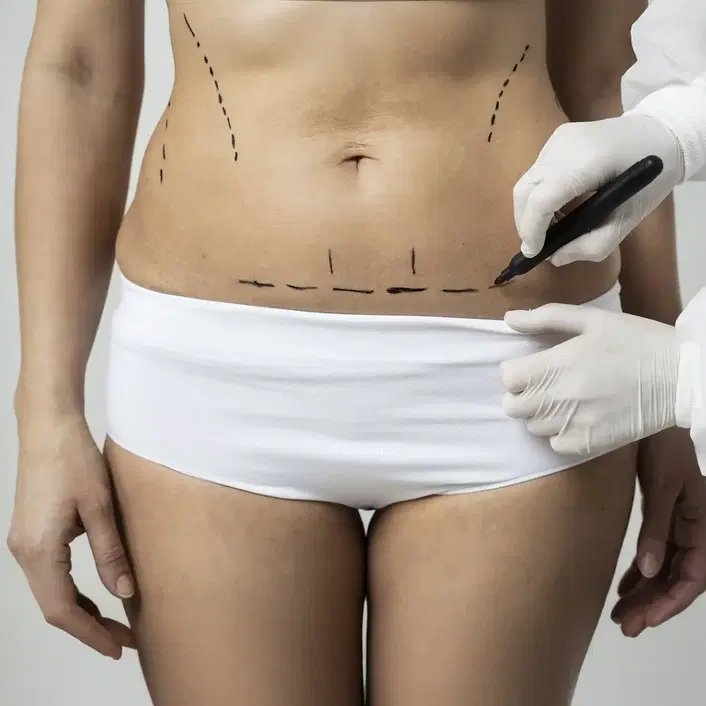
Liposuction Is About Shape Rather Than the Number on the Scale
Liposuction removes selected collections of subcutaneous fat through narrow tubes called cannulas. The surgeon creates small incisions, passes the cannula beneath the skin and removes fat using controlled suction.
What this operation does well is change proportion. Someone may be at a relatively stable body weight yet have persistent fat around the lower abdomen, flanks or outer thighs that creates an uneven silhouette. Liposuction can reduce those areas and create smoother transitions between neighbouring regions.
What it does not do is treat obesity.
Large-scale weight reduction and surgical body contouring are fundamentally different goals. Liposuction is generally more predictable when used for localized fat deposits in patients who are relatively close to a stable, healthy weight. It is also not considered an effective primary treatment for cellulite.
This distinction matters because removing more fat does not automatically create a better body shape.
Who May Be a Suitable Candidate for Liposuction?
A good candidate usually has specific areas of unwanted fat rather than expecting liposuction to create overall weight loss. Skin quality also matters because the skin must adapt to the smaller volume underneath it after fat removal. People with firmer, more elastic skin often have a better chance of developing a smoother contour.
Common factors considered during consultation include:
A relatively stable body weight with localized areas of fat that remain disproportionate to the rest of the body.
Good general health without an uncontrolled condition that could significantly increase surgical or anaesthetic risk.
Reasonably firm and elastic skin, particularly in areas where a substantial amount of volume will be removed.
Realistic expectations about contour improvement rather than dramatic weight loss.
A willingness to maintain the result through stable weight and sustainable lifestyle habits.
No active smoking or vaping, or the ability to follow the surgeon's nicotine-related instructions before and after surgery.
An understanding that loose skin may remain, particularly after major weight loss, pregnancy or significant loss of skin elasticity.
A clear understanding of recovery and possible complications, including the possibility that revision surgery may occasionally be required.
Age alone does not determine whether someone can have liposuction. Tissue quality, health and expectations are more useful considerations.
The Abdomen Is Not Always a Simple Fat Problem
The abdomen is one of the most requested liposuction areas, but an abdominal contour problem can come from several different anatomical causes.
There may be excess subcutaneous fat, loose skin, stretched abdominal tissues or a combination of all three. Liposuction can remove fat, but it cannot remove a large apron of loose skin or directly tighten separated abdominal muscles.
This becomes especially important after pregnancy or significant weight loss. If the main concern is loose skin hanging over the lower abdomen, taking away additional fat underneath may not produce the smooth, tight result the patient expects.
Skin that has become thin or significantly stretched may not contract around the new contour as effectively. In such cases, an operation designed to remove excess skin may need to be discussed instead of—or alongside—liposuction.
A good consultation should therefore identify whether the problem is primarily fat, skin, abdominal wall laxity or a mixture.
Several Areas Can Be Treated During the Same Operation
Liposuction is often used to improve the relationship between neighbouring body areas rather than treating one isolated pocket.
For example, abdominal contouring may involve the waist and flanks so that the transition around the torso looks balanced. Treating only the front abdomen while leaving significant flank fullness can sometimes produce a less harmonious result.
Other commonly treated locations include the thighs, upper arms, back, hips and area beneath the chin.
How many areas can safely be treated during one operation is an individual medical decision. Removing fat from additional regions increases operative extent, fluid shifts and recovery demands.
For this reason, “full-body liposuction” should not be understood as a standardized procedure with an unlimited number of areas.
Tumescent Fluid Is Commonly Part of Modern Liposuction
Before fat is removed, fluid containing medications may be introduced into the treatment area. This is commonly referred to as a tumescent approach.
The fluid helps prepare the tissue for fat removal and can contain local anaesthetic and medication intended to reduce bleeding. The exact composition and amount are determined according to the procedure.
The surgeon then passes the cannula through the prepared tissue using controlled movements.
This stage may sound straightforward, but contouring requires judgement. Removing too much fat close to the skin can increase the risk of surface irregularity, while leaving poorly blended borders can create visible steps between treated and untreated areas.
Liposuction is therefore partly a volume-removal procedure and partly a three-dimensional contouring operation.
VASER, Power-Assisted and Other Technique Names Can Be Confusing
Patients researching liposuction in Turkey often encounter terms such as traditional liposuction, power-assisted liposuction, ultrasound-assisted liposuction, VASER, laser lipolysis and high-definition liposuction.
These labels describe differences in how fat is prepared or how the cannula is moved. For example, some systems use mechanical movement, while ultrasound-assisted techniques use energy before or during fat removal.
The presence of additional technology does not automatically guarantee a better outcome.
Every energy-based device introduces its own technical considerations, and the final body contour still depends on case selection, tissue handling and surgical judgement. Patients should ask why a particular technology is recommended for their anatomy rather than assuming the most expensive machine represents the safest or most advanced option.
The surgical plan matters more than the marketing name attached to the equipment.
High-Definition Liposuction Has a Different Goal
Standard liposuction usually aims to reduce unwanted fat and create smoother proportions. High-definition liposuction, sometimes marketed as HD or 360-degree sculpting, may attempt to emphasize underlying muscular contours more deliberately.
This can involve selective removal around structures such as the abdominal muscles to create the appearance of greater definition.
The technique is not simply “more liposuction.” It requires suitable anatomy and careful patient selection.
Someone with significant loose skin or substantial excess body fat may not obtain the sharp muscular appearance shown in promotional photographs simply because an HD technique is used.
Lighting, posture, muscle development and postoperative swelling can also dramatically change the way early results appear in photographs.
Liposuction Does Not Guarantee Tight Skin
One of the most important expectations to discuss before surgery is what will happen to the skin after the underlying fat volume decreases.
Young, elastic skin may contract well after moderate fat removal. Skin that has been significantly stretched by pregnancy, weight fluctuations, ageing or previous obesity may adapt less effectively.
If the skin does not retract well, the area can appear loose or wrinkled even though fat volume has decreased. Liposuction can therefore occasionally make pre-existing laxity more obvious.
Some clinics combine liposuction with technologies intended to promote soft-tissue contraction. These devices should be evaluated separately because they have their own indications and risks; they should not be presented as a guaranteed substitute for surgical skin removal.
Where significant loose skin exists, removing the skin surgically may provide a more predictable contour than relying on fat removal alone.
Compression Garments Are Part of Early Recovery
After surgery, swelling and bruising are expected. Compression garments are commonly used during recovery, although the type and duration should be determined by the surgical team.
Patients may feel tight, swollen or sore for several days. Fluid drainage from small incision sites can also occur during the early period depending on the technique.
Recovery is not identical for everyone. The number of treated areas, amount of fat removed and type of work a person does all affect when normal activities can resume.
General recovery guidance suggests that the first week usually involves the greatest limitation in activity. Many patients begin feeling considerably better during weeks two and three, while swelling can continue improving over subsequent weeks.
The final contour should therefore not be judged shortly after the operation.
Swelling Can Hide the Result for Weeks
It is natural to look in the mirror immediately after surgery and expect to see the final body shape.
In reality, swelling can make treated areas look larger, uneven or asymmetrical during early recovery. One side may also resolve faster than the other.
Bruising commonly improves before all of the swelling disappears. By roughly four to five weeks, bruising is often substantially resolved and swelling has usually begun decreasing more noticeably, but continuing refinement beyond this stage is normal.
Temporary firmness or small irregularities may also be felt beneath the skin as tissues heal.
This is why before-and-after comparisons are more meaningful after adequate healing than during the first few postoperative weeks.
What Are the Risks of Liposuction?
Liposuction is widely performed, but it should never be presented as risk-free.
Possible complications include bleeding or bruising, infection, fluid accumulation, persistent changes in sensation, contour irregularity, loose or rippled skin, poor wound healing and the need for revision surgery. More serious risks include damage to deeper structures, blood clots and heart or lung complications.
The extent of surgery matters. Larger-volume treatment or combining several operations can increase physiological stress and may change the risk profile.
A patient should therefore understand not only the intended cosmetic result but also what monitoring will be available immediately after surgery.
Weight Gain Can Change the Result Later
Fat cells removed through liposuction do not simply reappear in exactly the same numbers in the treated region, but this does not make the body immune to future weight gain.
Remaining fat cells can enlarge when a person gains weight. The body may also store additional fat in untreated areas.
Large weight fluctuations can therefore change the proportions created by surgery.
A stable weight is useful both before and after liposuction. The procedure is most appropriately thought of as a contouring tool after weight has become reasonably stable, not as a repeated solution for fluctuations on the scale.
Healthy eating and physical activity still matter after surgery even when the early cosmetic result is excellent.
Liposuction and a Tummy Tuck Solve Different Problems
These two operations are frequently confused because both can improve the abdomen.
Liposuction primarily reduces fat. A tummy tuck primarily deals with excess abdominal skin and can also address the abdominal wall when required.
Some patients need only liposuction. Others may benefit more from skin-removal surgery. In selected patients, both can form part of the same body-contouring plan.
The correct choice cannot be made purely by looking at weight or waist measurement.
Pinching the abdominal skin, examining the degree of laxity and assessing the abdominal wall provide more useful information than simply asking how many litres of fat can be removed.
Flying Home Too Quickly Deserves Careful Thought
Medical travel adds an issue that local patients do not face in exactly the same way: flying soon after surgery.
Both surgery and prolonged air travel can increase concern about blood clots. General medical-travel guidance recommends avoiding air travel for approximately five to seven days after procedures such as liposuction, although the operating surgeon may advise a longer period depending on the extent of surgery and individual risk factors.
That means a two- or three-day package should not automatically determine the safest travel schedule.
Patients may need postoperative reviews, wound assessment and enough mobility to travel safely before returning home.
The timing of the flight should be part of the medical plan, not simply a decision based on hotel availability.
What Should You Check Before Liposuction in Turkey?
International patients should look beyond airport transfers and accommodation when comparing providers. Turkey maintains current records of healthcare providers authorized to operate within international health tourism; the relevant authorization information was updated on July 28, 2026.
Before paying a deposit, it is sensible to clarify:
Who will perform the surgery and who remains medically responsible throughout recovery.
Whether the healthcare provider currently holds the appropriate authorization for treating international health-tourism patients.
Which areas will actually be treated and how much contour change is realistically expected.
Why the recommended liposuction technique has been selected for your body rather than simply being sold as an upgrade.
Whether loose skin could limit the result and whether another procedure would address your concern more effectively.
How blood-clot risk will be assessed, particularly when international flights are involved.
How long you should remain in Turkey after surgery before being considered medically fit to travel.
What postoperative support is available after you return home, including how complications will be assessed and who coordinates treatment if urgent care is needed.
Verification should be based on current information because provider authorization and service arrangements can change.
Liposuction Cost in Turkey Depends on More Than the Number of Areas
There is no meaningful universal price for liposuction in Turkey.
A small submental procedure cannot be directly compared with circumferential torso liposuction involving the abdomen, waist, flanks and back. Surgical time, anaesthesia, facility costs, technique, number of areas, overnight observation and postoperative care can all affect pricing.
Some international packages also include accommodation, transportation and compression garments.
When comparing quotes, patients should check whether hospital fees, medications, blood tests, anaesthesia and postoperative reviews are actually included.
The lowest number can become much less attractive if unexpected medical expenses are excluded from the package.
The Best Liposuction Result Is Not the Largest Fat Removal
Liposuction in Turkey can create a significant improvement in body contour for appropriately selected patients with localized fat deposits. Its purpose is to reshape specific areas, not to provide a shortcut for treating obesity or replace long-term weight management.
Good results depend on restraint as much as removal.
The surgeon needs to leave smooth transitions, protect the skin and deeper structures and avoid creating an unnaturally hollow contour. The patient's skin must then adapt to the reduced volume beneath it.
If substantial loose skin is already present, liposuction alone may not produce the desired tightening effect. If the patient's main goal is major weight loss, another medical strategy is more appropriate.
International patients considering treatment in Turkey should also treat travel as part of surgical planning. Early postoperative reviews, blood-clot prevention and the timing of the flight home matter just as much as choosing the area to be treated. Current international health-tourism authorization can also be verified before surgery.
The most useful consultation therefore does not begin with “How much fat can you remove?” It begins with a more practical question: Which anatomical features are creating the shape I want to change, and what procedure can improve them safely?
That approach produces more realistic expectations and makes it easier to decide whether liposuction is genuinely the right operation.
Note: This article is intended for general information and does not replace an individual surgical consultation. Liposuction suitability, technique, treatment areas, anaesthesia, travel timing and postoperative care should be determined after a personal examination and review of medical history.