
Let’s get one thing straight right out of the gate: being a hair transplant surgeon isn't just about moving hair from the back of someone's head to the front. You are in the business of restoring confidence. Every single day, you meet people who avoid mirrors, wear hats in the dead of summer, and feel like they are losing a piece of their youth. When you do your job right, you hand that back to them.
But getting to that operating chair? That’s a marathon.
The hair restoration industry is booming. It's a multi-billion dollar field, and let's be honest, the financial incentives for surgeons are fantastic. Because it is largely an elective, out-of-pocket cosmetic procedure, you don’t have to wrestle with insurance companies the way you would in general medicine.
However, you can't just take a weekend course and start harvesting grafts. The best in the business are highly trained, board-certified medical doctors who have spent years honing an incredibly niche craft. If you are looking at this career path, here is exactly what it takes to get there, step by step.
Phase 1: The Brutal Foundation (Undergrad & Medical School)
Before you ever look at a scalp under magnification, you have to become a doctor. There are no shortcuts here.
1. The Pre-Med Grind (4 Years)
You’ll need a bachelor's degree with a heavy focus on the hard sciences—biology, chemistry, physics, and anatomy. You have to maintain a near-perfect GPA and crush the MCAT (Medical College Admission Test).
2. Medical School (4 Years)
Once you're in med school, you aren't going to hear much about hair. You are going to learn how to keep human beings alive. The first two years are buried in textbooks and lab work, learning pharmacology, pathology, and systemic diseases. The last two years are clinical rotations where you'll cycle through everything from pediatrics to emergency medicine.
By the time you graduate with your MD or DO, you are officially a doctor, but you still aren't legally or ethically ready to perform surgery on your own.
Phase 2: Choosing the Right Residency
This is where the road splits. While legally, any licensed physician in many jurisdictions can technically perform hair transplants, the ethical, respected, and successful route requires a relevant residency. You need a background that gives you elite surgical skills and a deep understanding of tissue handling.
Most top-tier hair transplant surgeons come from one of two backgrounds:
Dermatology (3-4 Years): Dermatologists are the ultimate masters of the skin and its appendages (which includes hair). A dermatology residency gives you unparalleled insight into the pathophysiology of hair loss. You learn how to diagnose complex alopecias that cannot be treated with surgery, which is just as important as knowing how to operate.
Plastic Surgery (6 Years): Plastic surgeons are the masters of aesthetics and tissue manipulation. If you go this route, you’ll learn the deep mechanics of wound healing, scar minimization, and facial proportions.
Both of these residencies are fiercely competitive. You need to be at the absolute top of your medical school class to match into either one.
Phase 3: The Hyper-Specialization
Residency teaches you to be a great dermatologist or plastic surgeon. It does not teach you how to do a 3,000-graft Follicular Unit Excision (FUE) case. For that, you need to specialize.
Fellowships and Preceptorships
Because hair restoration is such a specialized niche, it’s not a standard part of most residency curriculums. You have to seek it out. Most aspiring surgeons will apply for a fellowship approved by the ISHRS (International Society of Hair Restoration Surgery).
During this 1-to-2 year fellowship, you are finally in the weeds. You will learn the two gold-standard techniques of the trade:
FUT (Follicular Unit Transplantation): Often called the "strip method." You learn how to surgically excise a strip of tissue from the back of the scalp, suture it to leave a virtually invisible scar, and dissect the tissue under microscopes to extract individual follicular units.
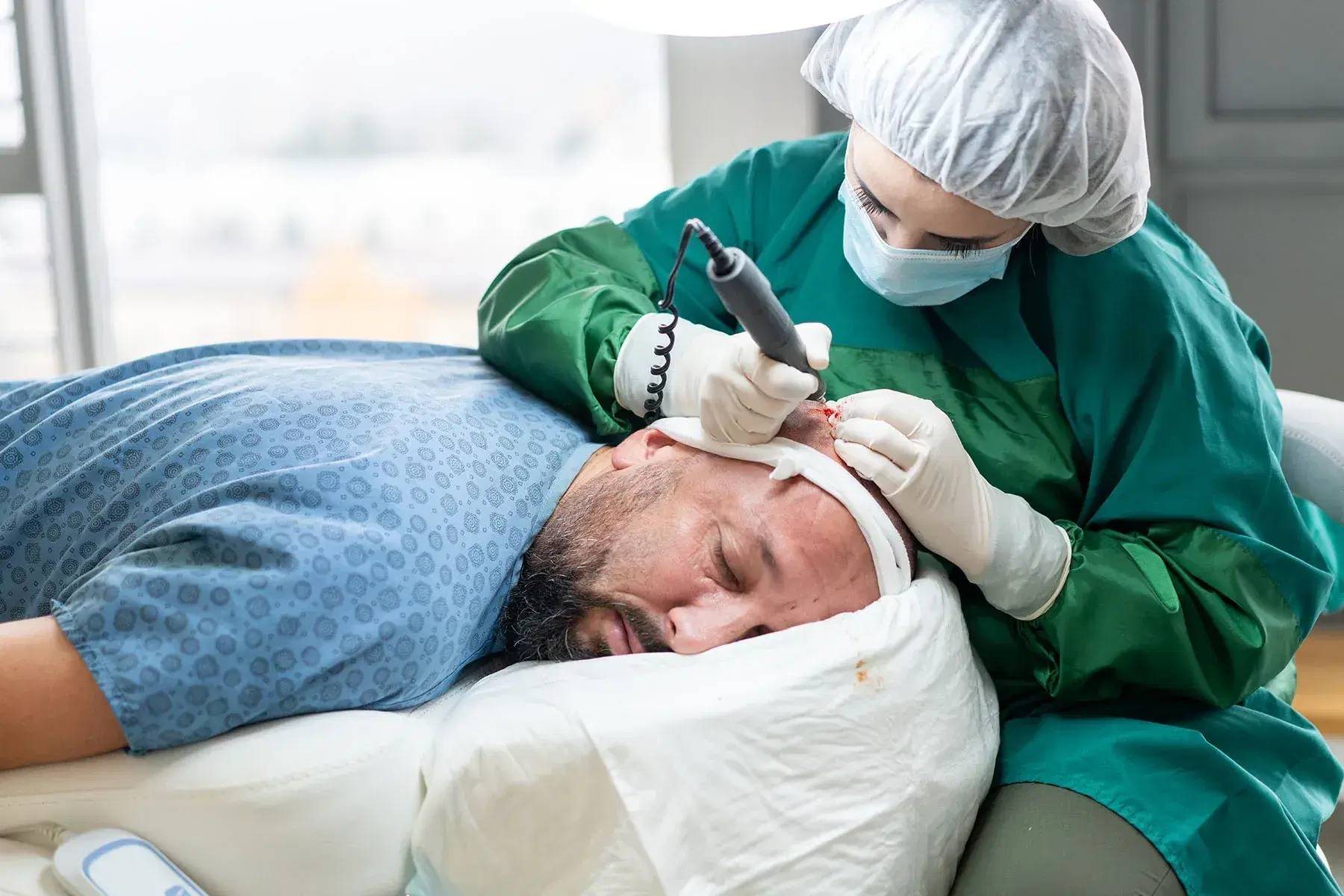
FUE (Follicular Unit Excision): The more modern, popular method. You will learn how to use micro-punches (usually 0.8mm to 1.0mm in diameter) to score and extract individual hair groupings one by one without leaving a linear scar.
You’ll also learn local anesthesia techniques specifically for the scalp, emergency protocols, and patient selection.
Phase 4: Board Certification
Once you have the training, you need the credentials. Patients are getting smarter. They are doing their research on Reddit, forums, and YouTube. They know what to look for.
You'll want to become a Diplomate of the American Board of Hair Restoration Surgery (ABHRS) or your local equivalent. This requires passing rigorous written and oral exams and presenting a log of cases you've successfully completed. This piece of paper tells the world—and your prospective patients—that you aren't just a doctor doing hair on the side, but a vetted, dedicated expert.
The Skills They Don't Teach in Medical School
If you want to be okay at this job, you just need to know the medical mechanics. If you want to be great, you need a totally different skill set.
The Eye of an Artist
Hairline design is pure artistry. You cannot draw a straight, perfectly dense line across a 30-year-old man's forehead and call it a day. It will look like a doll's head. You have to understand macro and micro-irregularities. You have to build temporal peaks, consider the patient’s facial symmetry, and design a hairline that will still look natural when that patient is 60 years old.
Physical Stamina
Nobody warns you about the back pain. Hair transplant surgeries are notoriously long. A mega-session can take anywhere from 6 to 10 hours. You will be hunched over a patient's head, wearing heavy surgical loupes (magnifying glasses), making thousands of microscopic incisions. You need incredible ergonomics, a strong core, and immense patience.
Leadership and Team Building
You cannot do a hair transplant alone. It is a team sport. You will rely heavily on a team of skilled surgical technicians who help sort, hydrate, and place the grafts. A surgeon is only as good as their technicians. Learning how to hire, train, and retain a high-performing medical staff is a massive part of your day-to-day life.
The Business of Hair
Finally, you have to decide how you want to work. You generally have two options once you're fully trained.
You can join a massive, established clinic. The upside here is that you just show up and operate. The clinic handles the marketing, the overhead, the staff payroll, and the patient acquisition. You get a steady paycheck or a percentage of the cases you do.
Or, you can open your own private practice. This is where the real money is, but it's also where the real stress lives. You become an entrepreneur. You’ll have to learn SEO, social media marketing, and patient conversion strategies. You’ll have to buy your own equipment (and top-tier FUE extraction devices aren't cheap).
Is It Worth It?
It takes roughly 12 to 14 years of higher education and training after high school to become an elite hair transplant surgeon. You will take on debt, you will lose sleep, and you will spend hundreds of hours practicing micro-movements until your hands cramp.
But the payoff? It’s hard to beat.
You get to operate in a low-stress environment (compared to the ER or general surgery trauma). Your patients are healthy people who actually want to be there. And when they come back for their 12-month follow-up, and you see them walk through the door with a full head of hair, a new wardrobe, and a completely transformed level of confidence?